India’s journey towards becoming a global economic powerhouse will depend on one critical factor—its ability to produce enough electricity for the decades ahead. As industries expand, cities grow, electric vehicles become common, and artificial intelligence powers the digital economy, the country’s demand for electricity is expected to rise dramatically.
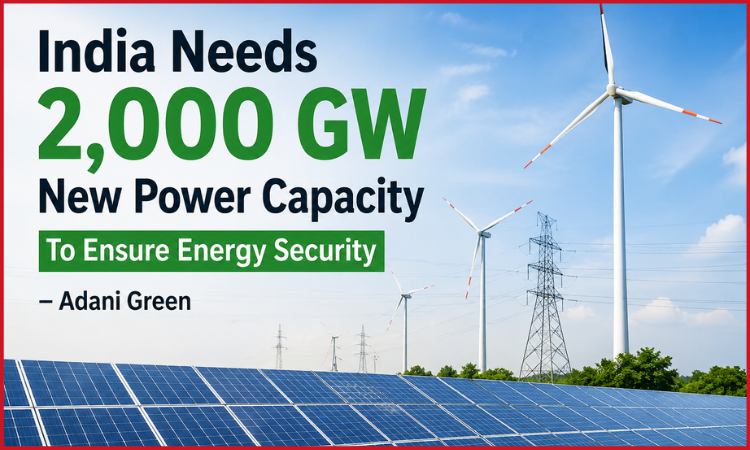
Against this backdrop, Adani Green Energy has called for an ambitious expansion of India’s power infrastructure. Speaking at an industry event, Executive Director Sagar Adani said the country will require nearly 2,000 gigawatts (GW) of additional power generation capacity over the next 20 years to ensure long-term energy security and support sustained economic growth.
The figure highlights the enormous scale of investment India will need as it transitions into one of the world’s largest energy markets.
Electricity Demand Is Entering a New Era
India is witnessing a rapid transformation in the way electricity is consumed. Manufacturing is expanding under the government’s industrial push, digital infrastructure is growing at an unprecedented pace, and electric mobility is gradually becoming mainstream.
From data centres and metro rail networks to smart cities and modern industries, almost every sector now depends on a stable and uninterrupted power supply.
According to Sagar Adani, this growing demand cannot be met by simply adding more power plants. India must simultaneously strengthen its transmission network, modernise the electricity grid, and invest heavily in large-scale energy storage solutions to ensure reliable power around the clock.
Renewable Energy Will Drive the Next Growth Phase
Renewable energy is expected to remain at the centre of India’s energy transition. Massive investments in solar parks, wind farms, hybrid projects, and battery storage systems are already reshaping the country’s power landscape.
However, experts believe renewable energy alone is not enough. Battery storage, pumped hydro projects, and smarter grid management will play an equally important role in balancing power supply during periods when solar and wind generation fluctuate.
The combination of clean energy generation and advanced storage technology is expected to become the foundation of India’s future electricity system.
Building Energy Security Beyond Fossil Fuels
India has made significant progress in reducing its dependence on conventional energy sources, but rising electricity demand presents a new challenge.
Expanding domestic power generation is increasingly being viewed as a strategic necessity rather than just an infrastructure goal. A stronger renewable energy ecosystem can improve energy security, reduce dependence on imported fuels, and help India move closer to its long-term climate commitments.
Industry leaders also believe that a larger clean energy ecosystem will encourage manufacturing, create skilled employment, attract global investment, and strengthen India’s position in the global energy transition.
A Massive Opportunity for India’s Power Sector
Developing an additional 2,000 GW of power capacity will require one of the biggest infrastructure expansion programmes in India’s history.
The opportunity extends beyond electricity generation. It will drive investments across solar manufacturing, wind energy, battery technology, transmission infrastructure, engineering services, and grid modernisation.
For businesses operating in the clean energy sector, the coming decades could represent one of the largest growth opportunities the industry has ever witnessed.
Looking Ahead
India’s economic ambitions and its energy ambitions are now closely connected. As electricity consumption continues to rise across households, industries, transportation, and digital infrastructure, expanding power generation will become essential for maintaining growth.
The call for an additional 2,000 GW of capacity reflects the scale of planning required to prepare the country for the future. While achieving such a target will demand significant investment and policy support, it also presents India with an opportunity to build one of the world’s most resilient and sustainable energy systems.