“If it doesn’t work this time, we’re done.” That was the understanding when Immanuel Louis, co-founder and COO of deeptech startup Astrophel Aerospace, and his team pooled Rs 6 lakh from their own pockets and fired their first semi-cryogenic engine — no external funding, no institutional backing, no second chances. The engine fired on the first attempt. “After that,
it just went with the flow,” Louis says.
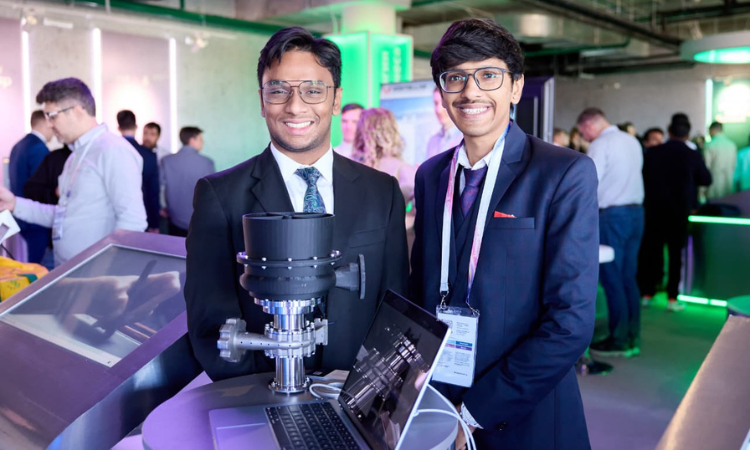
That first-attempt success in 2023 set the tone for what Astrophel Aerospace has become: a Pune-based deep-tech startup building low-cost, reusable launch vehicles for small satellites, founded in 2022 by Immanuel Louis and CEO Suyash Bafna. The co-founders have recently been named to the Forbes 30 Under 30 Asia list.
How it all began
“Suyash was in second year of college, from an EC branch. Usually you’re more interested in some other department from what you’re studying, right? He was more interested in aerospace. He wanted to do his rocket — he was into propulsion, rocket engineering.”
Louis, an aerospace engineer and former member of the early team at Agnikul Cosmos, connected with Bafna around 2019 through a mutual contact. In their first conversation, Bafna walked Louis through a rocket injector he had designed and 3D-printed himself, during the Covid lockdown, with no formal aerospace training. “He had gone and designed, 3D-printed the injectors, everything,” Louis recalls.
“It was very impressive. Being from an EC background and having so much knowledge that he had kind of learned all by himself — that gave me the motivation that if you start something, it needs to be with a person like this. He has the whole aura to pick up a totally different branch, learn about it from scratch.”
What began as a project became Astrophel Aerospace in 2022. For validation of their early rocket design, the team sent blueprints to ISRO chairman Dr. S. Somanath. “He was super impressed that such a small team could start this right from scratch,” Louis says. “That kind of gave us the motivation to move forward.”
Building in-house, cutting costs
“Usually what many people do is import — and when you import from other countries, mostly valves, everything. It’s not only the cost of the product but also the import duty that you pay, and everything adds up. By doing everything in-house in India, we save approximately 30 to 40% — including the import duties.”
That figure, Louis says, is probably an understatement. “I think 40% is a bit conservative. It’s actually a bit more when you take into account the import duties, because it’s a 20% import duty people generally pay. So making it in India saves a lot of money.”
The approach draws directly from India’s automotive manufacturing playbook. Astrophel uses 3D printing technologies alongside CNC-machined components and modular assembly principles to compress both production time and cost. Every critical subsystem — throttleable valves, turbopumps, cryogenic controls, regenerative nozzle designs, real-time avionics — is developed entirely in-house.
“Since we already have all these technologies in-house that we have built from scratch, it makes it easier moving ahead. And all of it together adds up with cost savings,” he explains.
Why Pune? Well, that’s no rocket science, even if what they do is. Sitting in Maharashtra’s automotive belt, the city gives Astrophel access to a dense ecosystem of precision component makers. But building that supply chain, Louis says, was the company’s steepest climb. “When it gets into manufacturing, sourcing raw material, equipment for a small order, if you go to a vendor who’s usually doing bulk orders for clients, the cost for them to make a small part doesn’t really make sense to them. As a startup, it doesn’t make sense for us either to invest heavily in heavy machines. So that was the big challenge — building that ecosystem, building the supply chain.”
Funding and what comes next
“We raised around $800,000 — around Rs 6.84 crore — and we completed our fundraise. We are targeting our next fundraise now, which will be a Series A, and we’re targeting around $5 million. It is scheduled after our hopper test — post August 15 will be the next one.”
The pre-seed capital, raised from undisclosed angel investors and venture firms, went toward building the reusable hopper prototype and expanding in-house R&D. An MoU with IN-SPACe — the government body overseeing India’s private space sector — has since given Astrophel access to ISRO facilities for design validation, testing, and qualification of propulsion subsystems.
The August 15 test
“In rockets, what we feel is very important is reusability — because that brings down a lot of the cost of getting satellites into orbit. A hopper is basically Astrophel’s version of reusable. It’s a small proof of concept — around 200 kgs, 10-kilometre altitude. This rocket will ignite, take off, hover, and then land. So it’s not exactly something that orbits, but it takes off and lands. We want to prove that we have the subsystems developed. We want to start small with a hopper — and it’s very easily scalable after.”
The test is targeted for August 15, 2026, which India will mark as its 80th Independence Day. It is not Astrophel’s first nod to the date: on August 15, 2023, the company fired its semi-cryogenic engine, becoming one of only a handful of private players in India to have done so. This time, the ambition is larger.
The bigger picture
“Building a deep-tech startup in India was always going to be hard. But right now, with the current government-initiated programmes — we have IN-SPACe, we have participation from the government, there’s also a lot of private investment in aerospace and R&D going on. So it’s a good time.”
The global context sharpens the argument. SpaceX’s Starship has set a new benchmark for reusable launch, but Louis is clear that the parallel only goes so far.
“SpaceX is a very big version of what we are making — a very big scale. In order to reach that scale, technology has to be developed at a small scale, and it has to be done in-house in India.” Astrophel’s Astra C1, its flagship three-stage launch vehicle, is built for small satellites — payloads of up to around 150 kg — where dedicated, low-cost access to orbit remains a meaningful gap in the market.
About the national security dimension, he says, “It’s very important for the government to support these initiatives, at least to build our own space tech, our own defence sector, quickly.”
In the meantime, Astrophel is commercialising its subsystems — cryogenic valves, turbopumps, guidance components — to generate early revenue and validate hardware in real operating conditions before it ever reaches orbit. “Our customers use the parts. It’s like getting validated before it actually goes into a rocket. So by the time it gets to orbit, everything is already proven.”
August 15 is the next proof point. “Fingers crossed,” Louis hopes.