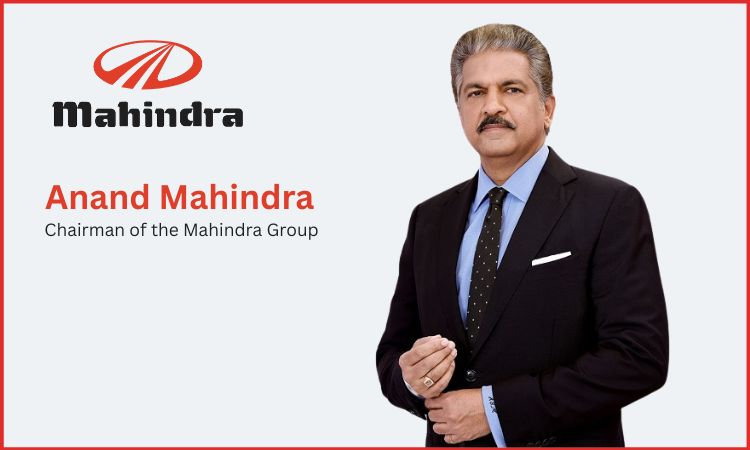
From tractors and utility vehicles to AI strategy, electric vehicles, and 10 million Twitter followers — Anand Mahindra has spent three decades quietly making Mahindra Group relevant in an era it was never designed for.
Most Indian business leaders of Anand Mahindra’s generation kept a careful distance from public discourse. Press releases, quarterly results, the odd industry speech — and not much else. Anand Mahindra went a different way. He joined Twitter when it was still considered an unusual platform for a conglomerate chairman, built a following that crossed 10 million, and turned a personal feed into something genuinely worth reading — cricket observations, reactions to Indian talent, commentary on technology, and occasionally, direct responses to customer complaints about Mahindra products.
But the feed is really just the surface of it. Mahindra Group has, over thirty years, moved from being primarily associated with tractors and utility vehicles to operating across information technology, electric vehicles, aerospace, renewable energy, and financial services — present in over 100 countries, market capitalisation exceeding $20 billion (Mahindra Group official website). How Anand Mahindra is redefining Indian business in the digital era is not a question about one company. It is a question about what Indian industrial leadership looks like when the assumptions that built you no longer apply.
Anand Mahindra Education: Harvard, Film-Making, and a Contrarian Start
Anand Gopal Mahindra was born on 1 May 1955 in Mumbai. His grandfather, J.C. Mahindra, had co-founded what became Mahindra & Mahindra. Most people assumed he’d study something practical. He enrolled at Harvard College and majored in film-making and photography instead, graduating Magna Cum Laude in 1977. For the heir to an industrial group, that was a genuinely odd choice. He followed it with an MBA from Harvard Business School in 1981 (Society Achievers — Anand Mahindra profile).
It is nothing, that combination. A film studies education trains you to look at things differently — structure, narrative, what the audience is actually receiving versus what you intended to say. He joined Mahindra Ugine Steel Company in 1981, became President of MUSCO by 1989, Deputy Managing Director of Mahindra & Mahindra in 1991, and Managing Director in 1997. The ascent was steady. The real transformation, though — the one that turned Mahindra into a diversified global group — came after 2000, when India’s economic liberalisation had fully taken hold and competition arrived from everywhere at once.
The Mahindra Rise for Good Philosophy: Tested Over Two Decades
When Anand Mahindra introduced the Rise for Good philosophy — Accept No Limits, Alternative Thinking, Drive Positive Change — the instinct would have been to treat it as corporate wallpaper. A tagline for annual reports, something to put on the investor deck and leave there. The moves that followed, though, were harder to dismiss. Mahindra entered IT services, aerospace components, financial services, and hospitality sectors, where it carried no legacy advantage and had to compete against people who had been doing it longer. By FY 2025, the group’s businesses spanned sectors projected to account for over 70% of India’s GDP growth through 2030 — automotive, financial services, technology, renewable energy, and agribusiness (Mahindra Group Annual Report 2024-25). That is not a lucky spread.
Mahindra Group Digital Transformation: Tech Mahindra’s AI Pivot
The clearest measure of Mahindra Group’s digital transformation is Tech Mahindra — a business that began as a British Telecom joint venture and now operates across 90+ countries with over 152,000 professionals serving more than 1,100 clients (Tech Mahindra FY25 results). In FY25, deal wins reached $2.7 billion — a 42% year-on-year jump. Eight consecutive quarters of margin expansion, driven by AI-led services. The numbers suggest a business that has moved past restructuring.
The strategic anchor is what Tech Mahindra calls “AI Delivered Right” — responsible AI implementation, with measurable outcomes as the only metric. In August 2025, the company was recognised as an Emerging Leader in Gartner’s Emerging Market Quadrant for Generative AI Consulting and Implementation Services (Gartner, August 2025). Its agentic AI platform TechM Orion had launched three months earlier, in May 2025.
At Tech Mahindra’s AGM in July 2025, Anand Mahindra addressed shareholders plainly. As reported by NDTV Profit: “In this new world of uncertainty, trust is your company’s currency, and a deep understanding of AI is its edge.” It was a shorter version of the same argument he had been making all year — that in an uncertain environment, the companies that survive are not necessarily the biggest, but the ones their clients trust most.
(Source: NDTV Profit, Tech Mahindra AGM, July 2025)
Mahindra Electric Vehicles and Sustainability: Early Bets, Long Payoffs
Mahindra was in electric vehicles before most Indian companies had decided the category was serious. The Reva Electric Car Company acquisition happened in 2010, when EVs were still largely a curiosity item in India. By 2025, Mahindra’s electric three-wheeler business held market leadership in a competitive segment, and the SUV division recorded record market share, partly on the back of electric and hybrid demand (Business Standard, December 2025).
Renewable energy and digital infrastructure feature as “sunrise industries” in Mahindra’s FY 2024-25 Annual Report — sectors the group has been positioning itself in alongside the government’s Aatmanirbhar Bharat defence push.
Anand Mahindra on AI and the Gold Collar Vision
The gold collar argument is probably the most interesting thing Anand Mahindra has said publicly in the last two years. And it has nothing to do with Mahindra’s quarterly results.
Speaking at the Telangana Rising Global Summit in December 2025, he went against the grain of most AI commentary in India. Where most commentary has focused on displacement — jobs lost, skills obsolete, workers left behind — Mahindra’s reading of the same data pointed in the opposite direction.
“We are living through a digital tsunami. Artificial Intelligence dominates global conversations, and it’s often accompanied by fear. But I want to take a contrarian view — the more digital the world becomes, the more valuable the human touch will be.”— Anand Mahindra, Telangana Rising Global Summit, December 9, 2025
(Source: ANI, Telangana Rising Global Summit, December 2025)
In his New Year 2026 address to Mahindra Group employees, he pushed the point further. “When technology amplifies skilled hands, those hands can become as rewarding, if not more rewarding, than traditional white-collar work. AI can turn blue collar into gold” (The Hans India, January 2026). The phrase — blue collar is the new gold collar — moved beyond corporate communication and into wider circulation. It caught something real.
He has backed this position institutionally — taking on the chairmanship of the Board of Governors of Young India Skills University in Telangana, which is designed to combine technical education with vocational training at scale. “Nations are built not only on the cloud but firmly on the ground,” he told the Telangana Rising summit (ANI, December 2025). It is worth noting who is saying this. Mahindra chairs a group whose IT arm employs over 152,000 professionals and competes globally in AI services. The argument is not anti-technology. It is about where human value sits once the technology is everywhere.
Key Milestones
- 1981 — Joined Mahindra Ugine Steel; MBA from Harvard Business School
- 1997 — Appointed Managing Director, Mahindra & Mahindra
- 2002 — Launched Scorpio SUV; Mahindra’s first global automotive credibility
- 2009 — Oversaw Satyam Computer Services acquisition
- 2010 — Acquired Reva Electric Car Company
- 2012 — Became Executive Chairman of Mahindra Group
- 2020 — Awarded Padma Bhushan for contributions to trade and industry
- 2025 — Appointed Chairman, Young India Skills University, Telangana
- 2025 — Tech Mahindra: $2.7B deal wins, 8 consecutive quarters of margin expansion
Conclusion
There is a consistent pattern in how Anand Mahindra has operated — choosing the less obvious path, then making the case for it publicly. Film-making at Harvard rather than engineering. Twitter before other executives thought it was dignified. A contrarian position on AI when the easier move was to stay quiet or say something reassuring.
What runs through all of it — the Rise philosophy, the portfolio diversification, the Twitter presence, the gold collar argument — is a consistent orientation toward what is coming rather than what has already worked. Mahindra Group today shares almost nothing with the Mahindra Group of 2001, or 2011, or even 2021 — and that is not an accident. Each decade forced a different set of decisions, and the decisions were not always correct. The Satyam acquisition was complicated in ways nobody fully anticipated. The EV bet took years before the market caught up to it. But the direction of the arc was consistent: toward sectors that rewarded competence rather than incumbency. The digital transformation of Mahindra Group under his leadership was not a single pivot point. It was a long accumulation of smaller calls that, taken together, repositioned an 80-year-old industrial house for a world its founders could not have imagined. That is, honestly, a harder thing to do than it looks.
FAQs: Anand Mahindra and Mahindra Group
Q1. Who is Anand Mahindra?
Anand Mahindra chairs the Mahindra Group — one of India’s most diversified industrial conglomerates, built over a century. Born in Mumbai on 1 May 1955, he is the third generation of the Mahindra family to run the business, and arguably the one who changed it most fundamentally. Under his watch, the group pushed well beyond tractors and utility vehicles into technology, electric vehicles, aerospace, and financial services — operating today across more than 100 countries.
Q2. Where did Anand Mahindra study?
Not what anyone expected. He went to Harvard College and chose film-making and photography as his major, graduating Magna Cum Laude in 1977. Then an MBA from Harvard Business School in 1981. The combination mattered more than it sounds.
Q3. What is Anand Mahindra’s net worth?
Recent estimates put his personal net worth at around $2.3 billion. The listed entities under the Mahindra Group, taken together, carry a combined market capitalisation that has crossed $20 billion — a figure that would have been difficult to predict when he took over as Managing Director in the 1990s.
Q4. What is the Mahindra Rise philosophy?
The Rise for Good framework runs on three ideas: Accept No Limits, Alternative Thinking, and Drive Positive Change. These are not decorative taglines — they have, in practice, shaped which sectors Mahindra has entered, and more importantly, which ones it has chosen to stay in through difficult phases.
Q5. What does Anand Mahindra think about AI?
His position, stated repeatedly and publicly, is that AI is an accelerator — not something to fear. At the Telangana Rising Global Summit in December 2025, he made the case that as the digital layer expands, what becomes scarcer is the human element — and scarcity drives value. His New Year 2026 message to employees put it in plain terms: “AI can turn blue collar into gold.” That phrase, the gold collar worker concept, has since travelled well beyond internal communications.
Q6. How many Twitter followers does Anand Mahindra have?
His following on X (formerly Twitter) crossed 10 million, which puts him in rare company among Indian corporate figures. The account is genuinely active, not a PR relay station, which is probably why the numbers are held.
Q7. Is Mahindra Group involved in electric vehicles?
Yes, since acquiring Reva Electric Car Company in 2010. By 2025, Mahindra’s electric three-wheeler business held market leadership, and its SUV division recorded record market share with strong EV and hybrid demand.
Q8. What is Tech Mahindra’s AI strategy?
Tech Mahindra’s AI positioning goes under the label “AI Delivered Right” — which, in practice, means responsible implementation with actual outcome benchmarks, not just capability claims. TechM Orion, the company’s enterprise agentic AI platform, went live in 2025. The same year, Gartner recognised Tech Mahindra as an Emerging Leader in its Generative AI Consulting and Implementation Services quadrant.
Q9. What awards has Anand Mahindra received?
The longer list includes the Padma Bhushan in 2020, Fortune’s World’s 50 Greatest Leaders in 2014, the Harvard Business School Alumni Achievement Award in 2018, the Harvard Medal that same year, and the CNBC Asia Business Leader Award, among several others.