How did a small village dairy grow into a brand recognised in every Indian home? Amul’s inspiring journey, from a small co-operative society in Anand to becoming the Taste of India, is an impressive example of how local initiatives can lead to a national revolution. Today, Amul has redefined the dairy industry by empowering millions of farmers through its co-operative model and has developed itself as India’s most trusted and influential food brand. This Amul Success Story shows how a local movement can transform into a nationwide legacy of self-reliance and innovation.
Source: Wikipedia
Profile: Amul- The Taste of India
| Founded on | 14 December 1946 |
| Founders | Tribhuvandas Patel |
| Industry | Dairy |
| CEO | Jayen Mehta |
| Headquarters | Anand, Gujarat |
| Brand Value | $4.1 billion |
| Revenue | Rs. 65,911 crore [2025] |
Establishment of Amul
Source: Amul Dairy
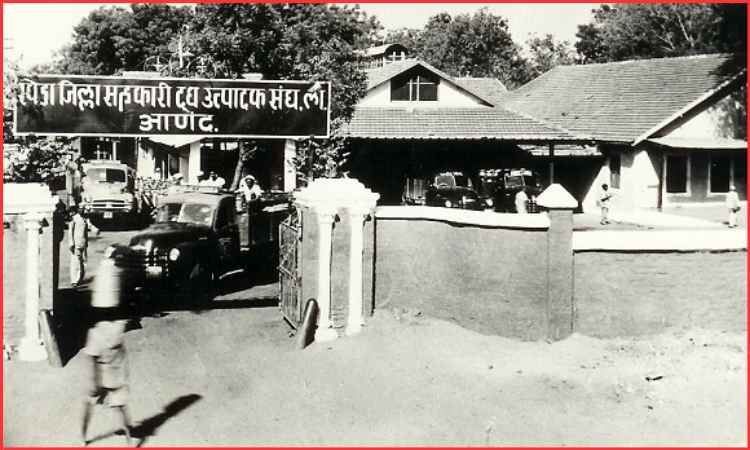
Back in 1946, dairy farmers of the Kaira [now Kheda] district of Gujarat were exploited by local traders and agents through unfair and manipulative practices. The Polson company established a monopoly on milk collection in the district, preventing farmers from selling their milk to other vendors. They bought milk from farmers at very low prices and sold it to customers and the Bombay Milk Scheme at higher prices, to make a higher profit.
Frustrated with these unfair trade practices, the farmers and Tribhuvandas Patel approached Sardar Vallabhbhai Patel for a solution. Vallabhbhai advised them to form a dairy co-operative society. By establishing a co-operative society, the farmers would have direct control over milk supply to the Bombay Milk Scheme. Vallabhbhai sent Morarji Desai to solve the concerns of farmers and assist them in establishing a co-operative society.
Under the guidance of Morarji Desai and Tribhuvandas Patel, farmers established the Kaira District Co-operative Milk Producers Union Ltd. In the initial time, milk collection was decentralised because most farmers were marginal, able to deliver only 1-2 litres of milk per day. By June 1948, the union started milk pasteurisation for the Bombay Milk Scheme.
Dr. Verghese Kurien starts working at Amul.
Source: India Today
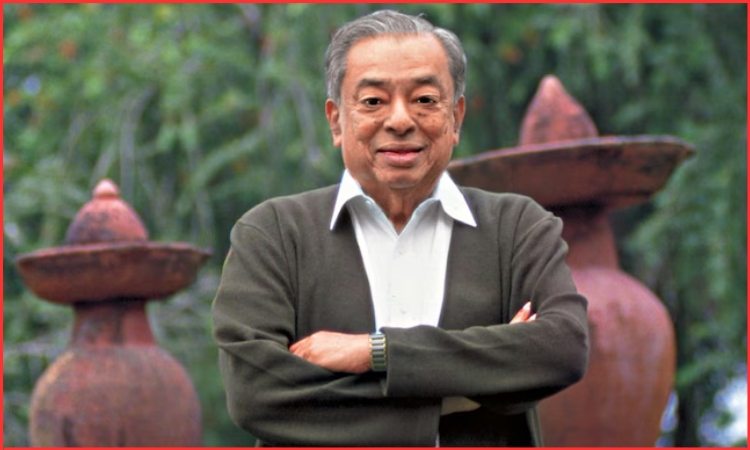
In 1949, Dr. Verghese Kurien was appointed to the position of general manager. He was responsible for the technical and marketing aspects of the co-operative. In 1955, the brand name ‘Amul’ was officially adopted, which is an acronym for ‘Anand Milk Union Limited’. In addition, the word ‘Amulya’ in Sanskrit means priceless or invaluable, representing the precious value of the milk producers and the pride of Indian production.
Then, in October 1964, Prime Minister Lal Bahadur Shastri visited Anand to inaugurate Amul’s cattle feed factory. He even discussed the co-operative with the farmers. After returning to Delhi, he started focusing on creating an organisation, the National Dairy Development Board [NDDB], to establish a co-operative similar to Kaira in other parts of India. Dr. Verghese Kurien was appointed as the chairman of NDDB by the Prime Minister.
The Popular Amul Girl
In 1966, Amul hired Sylvester daCunha to design an ad campaign for Amul Butter. Kurien suggested creating a mischievous little girl as a mascot to capture the attention of housewives in the country. Thus, the popular ‘Amul Girl’, also called ‘Amulya’, was launched. daCunha created a series of hoardings featuring the Amul Girl. The ad was so popular that it earned a Guinness World Record for the longest-running ad campaign in the world.
White Revolution in India
Dr. Verghese Kurien, also recognised as the Father of the White Revolution in India, gave the idea to launch a programme to increase milk production in India. In 1970, the ‘White Revolution’ was launched to increase milk production and connect the farmers throughout India. It also helped the farmers and consumers trade milk at a fair price and reduce poverty in India. In 1973, the Gujarat Co-operative Milk Marketing Federation Ltd., as an apex marketing body for these district co-operatives, was also set up to combine the forces and expand the market.
Not just a Village Dairy, Amul completed 25 years.
Source: OpIndia
Under Tribhuvandas Patel’s leadership, in 1973, Amul celebrated its 25th Anniversary with Morarji Desai, Maniben Patel, and Verghese Kurien. In the same year, Amul was transferred to the Gujarat Co-operative Milk Marketing Federation Ltd. [GCMMF]. Tribhuvandas served as chairman until his retirement in the 1970s. Verghese Kurien became the chairman of Amul in 1994.
Afterwards, Amul expanded through the collaborative efforts of Verghese Kurien and H.M. Dalaya. Dalaya is honoured for innovating skim milk powder from buffalo milk, which brought a technological breakthrough in India’s organised dairy industry. With Kurien’s expertise, the innovation was expanded on a commercial scale and led to the first modern dairy co-operative at Anand.
The success of the dairy co-operative was getting recognised all over Gujarat, with the trio’s name [Tribhuvandas Patel, Verghese Kurien, and H.M. Dalaya]. Thus, five unions were established in districts including Mehsana, Banaskantha, Baroda, Sabarkantha, and Surat in a similar pattern.
Amul- The Taste of India.
Source: Business of Food
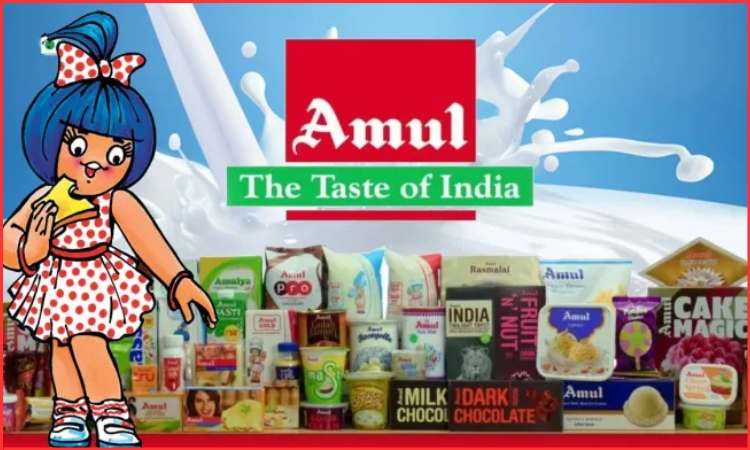
Today, GCMMF has become India’s largest food product marketing organisation with a turnover of $7.3 billion. It is owned by 3.64 million milk producer members across 18,600 village milk co-operative societies, producing approximately 35 million litres of milk per day.
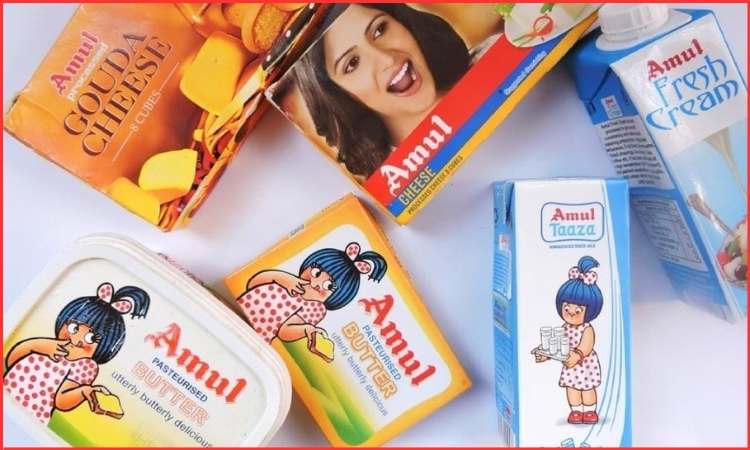
Amul has become India’s most trusted brand with its expanding product portfolio, including fresh milk, bread spreads, cheese, beverages, paneer, dahi, ghee, indian sweets, and many more. From kids to teenagers, men to women, calorie-conscious to health-conscious, Amul has ensured that it launches products for every segment.
Hence, with the advertising campaign including the Amul girl, continuous innovation, efficient supply chain, and diversified portfolio of products, Amul has shifted from village dairy to every Indian home.
Amul’s Business Model.
Amul follows a three-tier co-operative structure, which includes the dairy co-operative society at the village level. The co-operative societies are then connected to milk unions at the district level and further with the milk federation at the state level.
Hence, milk is collected at the village dairy co-operative society and then procured and processed at the district milk union. The state milk federation plays a significant role in marketing and logistics.
Amul was the first company to implement this model, and the same model was replicated all over the country under the White Revolution in the 1970s.
Challenges faced by Amul.
- Increase in Productivity: The whole Indian dairy industry addresses the challenge of increasing the productivity of animal-based milk. Therefore, Amul, by leveraging the use of technology, has overcome the challenge. New technologies like sex semen, embryo transplant, milking machines, and solar-powered bulk milk coolers have been introduced by them to increase productivity.
- Growing consumer preference: The rise of plant-based milk and products has decreased the demand for traditional dairy milk. The sales of Amul have been negatively impacted by the increasing demand for plant-based products. However, they have introduced plant-based protein products such as soya milk, lactose-free and vegan products to maintain their leading position in the market.
- Maintaining trust: Amul is India’s leading food brand across all age groups, income classes, and religions across the country. Hence, sometimes it gets difficult for them to keep their brand trust intact while continuously enhancing the quality and innovations. However, with their award-winning marketing campaigns, they ensure that each new generation of consumers continues to consume their products.
Awards & Recognitions.
- In 1999, Amul was recognised with the “Best of All” Rajiv Gandhi National Quality Award.
- Amul received the International CIO 100 Award for resourcefulness.
- In 2003, Amul won the Qimpro Gold Standard Award and the Ramkrishna Bajaj National Quality Award.
- Amul’s probiotic ice cream won the No.1 Award at the World Dairy Summit.
- In 2009, 2010 & 2013, Amul was recognised with the Srishti G-cube Award for good green governance.
- Amul won the International Dairy Federation Award.
- Dr. Verghese Kurien was honoured with the Lifetime Achievement Award.
- In 2013, GCMMF won the SAP Award for customer excellence, under the category of ‘Best Run Award in Finance’.
- Amul won the AIMA High Performance Brand Award 2013.
- In 2014, Amul won the ‘CNN-IBN Innovating for Better Tomorrow Award’ and ‘World Dairy Innovation Award’ for its continuous innovation.
- In 2015, Amul won the Forbes India Leadership Award and the Development Leadership Award.
- Amul was also recognised with the CFBP Jamnalal Bajaj Award and the ET Iconic Brand Award.
- GCMMF was awarded the Best FMCG in the food sector by IAA.
- In 2018, they won the Special Jury citation for the Risk Management Award and the World Dairy Innovation Award.
- In 2018 & 2020, Amul was recognised with the IMC Ramkrishna Bajaj National Quality Performance Excellence Trophy.
- In 2022, Amul received the ‘Shree Guruji Puruskar’ for sustainability and environmental initiatives.
- In 2025, Amul was ranked the third most valued brand in India in the YouGov India Value Rankings 2025.
Amul’s Future Plans.
By 2047, Amul aims to achieve a turnover of Rs 18 lakh crore. They are focusing on a major expansion by building new plants, expanding their product range, and expanding on a global level, including the European market. In addition, they aim to capture a larger share of the market by catering to the shift from unorganised to branded products. Moreover, they continue their focus on improving the distribution network and adopting eco-friendly packaging.
Summary
The Amul Success Story, from farmers protesting against middlemen to becoming India’s largest food brand, is a model of self-reliance and innovation. Amul has empowered millions of farmers while ensuring quality for consumers. With sustainability and global expansion on its roadmap, Amul continues to prove that growth is possible without compromising on values.
FAQs: Amul Success Story
Q-1. Who is the current owner of Amul?
Amul is a dairy co-operative, not owned by a single person. It is collectively owned by GCMMF and millions of milk producers in Gujarat.
Q-2. Which dairy brand is considered No. 1 in India?
Amul is considered the No. 1 dairy brand in India.
Q-3. Who created the Amul Girl?
The Amul Girl was created by Sylvester daCunha in 1966.
Q-4. Who is the Amul founder?
Tribhuvandas Patel is Amul founder.