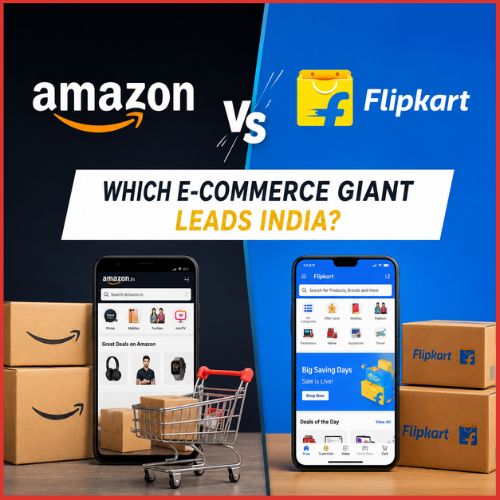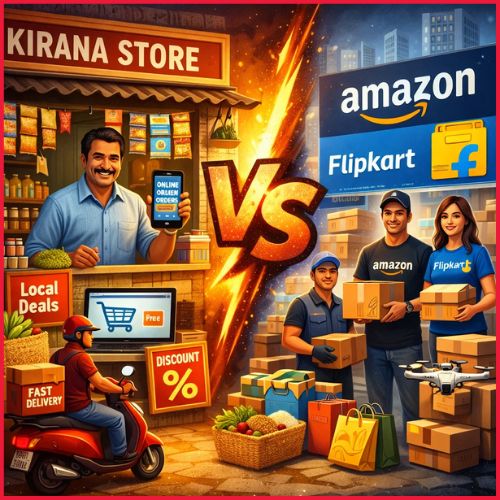
The only names that come up in every discussion around online shopping in India are Amazon and Flipkart. Amazon brings decades of global infrastructure and a checkbook few could rival. Flipkart was born in Bangalore, learned how to sell books to an audience that barely trusted online payments, and then beat a trillion-dollar competitor on their home turf.
Neither company has managed to win outright — both are pouring billions into ensuring they don’t lose. In this piece, we’re going to break down exactly where each platform leads us as we enter 2026 and explore why the balance continues to shift. We’ll also examine how things look from the perspectives of those who shop, sell and want to understand India’s most consequential retail rivalry.
The Numbers: Who Actually Leads?
The first measure is how big their overall presence is. According to most of the numbers we’ve seen from both sides (which are based on projections for 2025–2026) Flipkart’s share is about 48 percent of the e-commerce GMV in India, while Amazon is at somewhere between 24-31 percent. The distance here is substantial, but neither side wants to be the sole player in this space.
That’s because none of them need to capture India as a standalone entity to have made an investment worth it. What they need is to have some kind of a solid footing there, which they do. And together these two companies capture almost 80 percent of the market, so it isn’t even a true two-horse race anymore. In fact, it’s a duopoly where everyone else fights over scraps.
Ownership: Two Very Different Parent Companies
In terms of funding, Flipkart is now majority-owned by Walmart, having been acquired for $16 billion back in 2018. Walmart’s involvement provided them with access to Flipkart’s knowledge of Indian consumers, alongside the company’s own extensive experience in retailing and logistics. While Amazon India works on its own, pledging $48 billion worth of investment into India from 2026 to 2030 – including AI infrastructure, AWS data centres in Mumbai and Hyderabad, and logistics facilities – it’s unlikely they’ll be able to replicate all of Flipkart’s advantages.
Where Each Platform Actually Wins
Amazon’s Edge
Amazon wins on breadth. Its global catalogue, Prime’s bundled ecosystem, and a seller-fulfilment network refined over more than a decade give it real strength in premium categories — electronics, imported goods, and anything where brand trust and delivery reliability matter more than price. Amazon also moved fast on fee restructuring in 2025, zeroing out referral fees on items under ₹300 across more than 135 categories, and trimming apparel commissions in key price bands.
Flipkart’s Edge
Flipkart wins on reach. Deep, unmatched reach into tier-2 and tier-3 India, the markets that will define the next phase of the country’s e-commerce growth. It built its reputation as the homegrown option — the platform Indian shoppers trusted before Amazon had built the same layer of confidence. That trust, plus consistently aggressive pricing, has translated into a durable lead that Amazon has spent years trying to close.
The New Battlefield: Quick Commerce
Both these companies are well aware of what’s at stake here, as much as they’ve been battling for years over who will own which segment of the e-commerce landscape, it’s abundantly clear that the real fight today is happening in the minutes (pun intended). Flipkart Minutes launched in August 2024, and despite the time invested, it already operates in 1,000+ micro-fulfilment centres in 130+ cities in India. Amazon Now, however, is working its way up to operating in 300+ cities in order to prevent losing all bets on the category to Flipkart and quick-commerce natives such as Blinkit & Zepto.
But neither can really afford to stand on the sidelines because consumer preferences have rapidly changed in favor of immediate gratification when shopping online. Whoever gets the edge here essentially owns how consumers shop in the coming decade. Flipkart might have gotten there first but that doesn’t mean Amazon will rest until it makes sure it isn’t permanently behind in this race.
Pricing, Discounts, and Sale Events
Price is where most Indian shoppers actually decide. Flipkart built its entire early reputation on undercutting Amazon during festival season, and that instinct hasn’t gone away. Its Big Billion Days event remains one of the most anticipated sale periods in Indian retail, often timed to overlap directly with Amazon’s Great Indian Festival. This is why searches for Flipkart Sale and Amazon Sale become especially common during the festive shopping season, as neither company is willing to let the other own that shopping window alone.
That’s where Amazon steps on the gas again with its Prime offering. Prime members get exclusive first looks at new releases and discounts across the wider Amazon ecosystem, including Prime Video and Prime Music, along with perks such as faster delivery. This subscription-led approach shows how the e-commerce business has evolved beyond simply offering the lowest price. Amazon is trying to build a longer-term relationship with customers by making shopping part of a broader digital ecosystem, while still using discounts and convenience to keep them coming back.
In order to offer anything close to this, Flipkart would have to develop another tier of customers akin to Prime, known as Flipkart Plus. However, Plus doesn’t seem to hold anywhere near the same cultural sway over Indian consumers as Prime does in urban India. This means two different approaches towards customer acquisition – Amazon selling you a subscription-based lifestyle complete with online shopping, whereas Flipkart offers you the best prices possible irrespective of what other aspects of your experience might be sacrificed in exchange.
For sellers, this trickles down directly into commission structures. Flipkart has generally kept its take-rate lower on mass-market categories, reinforcing its position as the platform of choice for budget and mid-range products. Amazon’s 2025 fee restructuring — zero referral fees below ₹300, trimmed apparel commissions — was a direct response to that pressure, an acknowledgment that price sensitivity in India isn’t a temporary phase to be waited out.
Customer Experience: Delivery, Returns, and Trust
Delivery speed used to be Amazon’s unambiguous strength. Prime built an entire value proposition around it. That edge has narrowed considerably as Flipkart’s logistics arm, Ekart, matured into one of the most extensive last-mile networks in the country — reaching pin codes Amazon still struggles to service economically.
Returns policy is where the platforms diverge more visibly. Amazon’s return process is often described as the more consistent of the two, backed by a customer service reputation built over two decades globally. Flipkart has invested heavily in closing that gap, particularly around fashion and apparel returns, a category where try-before-you-keep behavior is common in India and where return-friendliness can make or break conversion.
Trust, in the end, is the quieter variable neither company talks about directly but both compete on constantly. Flipkart carries the advantage of being seen as homegrown, even under Walmart’s ownership — a perception that still matters to a meaningful segment of Indian shoppers wary of foreign platforms. Amazon counters with two decades of global brand consistency, betting that reliability eventually outweighs origin. Neither argument has fully won. Both keep making it anyway.
| Dimension | Amazon India | Flipkart |
| Market share | Holds roughly a quarter to a third of India’s e-commerce GMV, depending on the source and category mix. | Leads with close to half of India’s e-commerce GMV, anchored by deep penetration in tier-2 and tier-3 cities. |
| Ownership and backing | Wholly owned by Amazon.com, backed by a pledged $48 billion investment in India through 2030 across AI, cloud, and logistics. | Majority owned by Walmart, which has steadily increased its stake since the original $16 billion deal in 2018. |
| Core strength | Global catalogue depth, Prime’s bundled ecosystem, and a mature seller-fulfilment network built over more than a decade. | Home-field trust, aggressive pricing, and the deepest reach into India’s smaller cities and value-conscious shoppers. |
| Quick commerce | Amazon Now is expanding toward 300+ cities, entering later and playing catch-up against established players. | Flipkart Minutes has scaled past 1,000 micro-fulfilment centres, moving fast to defend its lead before rivals catch up. |
| Pricing and fees | Cut referral fees to zero for sub-₹300 items across 135+ categories and lowered apparel commissions in select price bands. | Generally undercuts Amazon on commission for mass-market categories, reinforcing its low-price positioning with sellers and shoppers alike. |
| Best suited for | Premium and branded products, sellers wanting global reach, and shoppers who value Prime’s bundled services. | Value-focused categories, first-time online sellers, and reaching deep into India’s non-metro markets. |
| Logistics network | AWS-backed infrastructure and a fulfilment network refined globally, though last-mile reach in smaller towns still trails Flipkart’s. | Ekart provides one of India’s most extensive last-mile networks, reaching deep into pin codes many competitors can’t service economically. |
| Flagship sale events | Great Indian Festival, timed to compete directly with Flipkart’s biggest sale window and reinforced by Prime-exclusive early access. | Big Billion Days, historically the more culturally recognized sale event among Indian value-conscious shoppers. |
Choose Amazon If
You’re shopping for premium or imported goods, you value Prime’s bundled ecosystem, or you’re a seller with strong margins looking for global reach and a mature advertising and logistics infrastructure to lean on.
Choose Flipkart If
You’re shopping value-driven categories, you live outside a metro city where Flipkart’s reach and trust run deepest, or you’re a first-time seller who needs lower commissions and a platform built around India’s mass market rather than its premium segment.
The Bottom Line
Flipkart leads today. The market-share numbers make that unambiguous. But leadership in Indian e-commerce isn’t static — it hasn’t been for a decade, and 2026 won’t be the year that changes. Amazon’s capital commitment is enormous, its infrastructure keeps compounding, and quick commerce has reopened a battlefield that was supposedly settled years ago. Betting on a permanent winner here has been a losing bet since 2013. The smarter read: expect the gap to narrow, not disappear, and expect both companies to keep spending like the outcome is still very much undecided — because it is.
Frequently Asked Questions
Who has a bigger market share in India, Amazon or Flipkart?
Flipkart holds the larger share, estimated near 48% of India’s e-commerce GMV in recent data, compared to Amazon’s estimated 24-31%, though exact figures vary by source and category.
Is Flipkart an Indian company or is it foreign-owned?
Flipkart was founded in India in 2007, but it is now majority-owned by Walmart, the American retail giant, following a series of acquisitions that began with a $16 billion deal in 2018.
Which platform is better for sellers, Amazon or Flipkart?
It depends on the product category: Amazon suits sellers with premium goods and strong margins who want global reach, while Flipkart typically offers lower commissions and stronger positioning for mass-market and value-priced products.
Does Amazon or Flipkart offer faster delivery in India?
Both now compete in quick commerce — Flipkart Minutes has scaled past 1,000 micro-fulfilment centres, while Amazon Now is expanding rapidly to close the gap, so delivery speed increasingly depends on your specific city and pin code.
Will Amazon ever overtake Flipkart in India?
It’s possible but not guaranteed: Amazon’s $48 billion investment through 2030 signals serious intent, but Flipkart’s deep trust in non-metro India and its head start in quick commerce give it a durable defensive position.