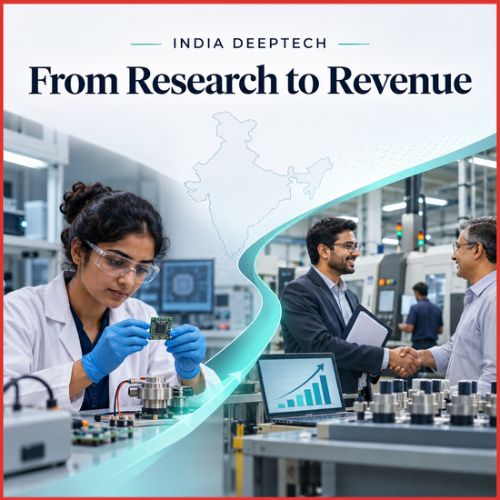
India’s growing pipeline of science-led startups is reaching a consequential stage, according to Vishnu Rajeev of Speciale Invest. More researchers are considering entrepreneurship, and more investors are willing to examine technically demanding businesses. The next challenge is getting those businesses into the market.
In an interview published on November 28, Rajeev described an ecosystem with stronger foundations but substantial work ahead on commercialisation.
His assessment draws attention to the distance between a promising invention and a company capable of supplying paying customers. Funding a prototype is one stage. Financing qualification, production and repeat orders can be a much longer exercise.
For India’s deeptech ecosystem, that transition will help determine whether scientific capability produces durable businesses.
A Prototype Is The Beginning Of A Business Test
A working demonstration answers an important question: can the technology perform the intended task under the conditions tested?
Customers usually have several more questions.
Can it operate reliably outside the laboratory? Can the supplier produce it consistently? What happens when a component fails? Is the improvement valuable enough to justify changing an existing process?
Those questions create a commercial journey that can look very different from early research.
Consider a startup developing an industrial sensor. Demonstrating accurate readings is necessary, but a factory may also require installation support, compatibility with existing equipment and dependable replacement supplies.
That example illustrates why scientific progress and commercial readiness need separate milestones. A company can advance on one measure while still having significant work remaining on the other.
Rajeev’s Investment Test Starts With Technology
Rajeev identifies four broad considerations for early-stage investing: proprietary technology, the founding team, market opportunity and a credible commercialisation direction.
The emphasis on a defensible scientific or engineering advantage is particularly relevant when the deeptech label is applied widely.
A business needs to explain what it has developed, why that capability matters and how difficult it would be for another team to reproduce.
But technical distinctiveness cannot answer every investment question. A difficult invention may still address a small problem, arrive too late or cost more than customers will pay.
The commercial case therefore needs to sit alongside the scientific explanation from an early stage. Investors are assessing both whether the technology can work and whether a substantial business can be built around it.
The Funding Gap Becomes Clearer During Scale-Up
A separate Speciale Invest report, covered earlier in November, highlights the imbalance between funding activity and the capital available for growth.
Indian deeptech companies raised $914 million across 257 rounds in 2025. The report found that India accounted for 12.8% of global deeptech funding rounds but only 1.6% of the money.
Indian Series A and B rounds averaged $11.5 million between January and August 2026, compared with $55.5 million globally.
For a founder, a smaller round is not automatically a problem. The difficulty arises when the available capital does not cover the next meaningful milestone.
A manufacturing business may need equipment before predictable revenue arrives. Raising enough to complete only part of that work can leave it seeking money again before it has the evidence new investors want.
Customer Trials Need A Route To Purchase
A pilot can help a startup demonstrate value. It can also become an expensive holding pattern if neither side agrees what happens afterwards.
Before starting a trial, the parties can define the performance required, the testing period and who will make a purchasing decision.
That gives the startup a clearer target and helps the customer distinguish experimentation from procurement.
Without those arrangements, a successful technical result may still produce no order. The startup has spent time and money, while the customer continues evaluating alternatives.
For deeptech commercialisation, a first purchase can be more informative than enthusiastic feedback. It demonstrates that an organisation has moved beyond interest and committed a budget.
Repeat purchases then test whether the product delivers enough value to remain in use.
Universities And Industry Have Different Starting Points
Rajeev calls for stronger links between researchers and businesses, alongside better support for transferring technology out of institutions.
The practical issue is that academic and commercial work often answer different questions.
A research project may establish a new method or explain a phenomenon. A business must identify a customer, deliver a usable product and support it at an acceptable cost.
Regular industry interaction can expose researchers to requirements that are easy to miss from inside a laboratory. It can also help businesses recognise capabilities they would otherwise overlook.
Clear arrangements around intellectual property, licensing and researcher participation can reduce uncertainty when a company is formed.
These decisions are easier to address early than after investors, institutions and founders have developed conflicting expectations.
Founding Teams Need More Than One Kind Of Expertise
Scientific authority gives a deeptech company credibility, but building the business introduces responsibilities that research training may not cover.
Someone must negotiate contracts, plan cash requirements, recruit staff and understand the customer’s buying process.
That does not mean the technical founder becomes less important. It means the team needs complementary capabilities and agreement over how decisions are made.
A useful commercial colleague can translate customer requirements into priorities without promising features the technology cannot deliver.
Likewise, a technical founder needs enough commercial understanding to recognise when an impressive improvement is unlikely to influence a purchase.
The relationship becomes especially important when development takes longer than expected. Limited funds force choices, and those choices need both engineering judgement and business discipline.
Progress Will Be Measured Beyond Valuations
Rajeev’s longer-term ambition includes globally competitive companies and meaningful exits, rather than success measured only through unicorn status.
That offers a more demanding view of deeptech investment in India.
A valuation records what investors agree to pay at a particular moment. A sustainable company must continue producing something customers value.
For the ecosystem, successful products, repeat orders and credible returns can create experienced founders and investors willing to back another generation.
India’s opportunity is increasingly visible. Converting it into an enduring advantage will require the less glamorous work between invention and scale: testing, procurement, manufacturing, financing and delivery. That is where the next phase will be decided.
Sources: Indian Startup Times’ Interview With Vishnu Rajeev, Speciale Invest’s Partner Profile and YourStory’s Coverage Of The Firm’s Deeptech Report. Indian Startup Times