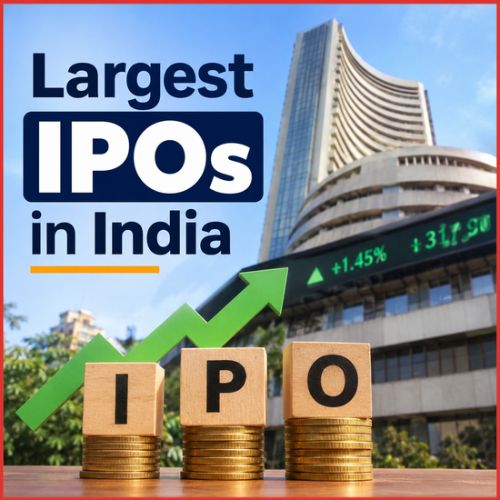
India’s largest IPOs have changed how companies, promoters and retail investors think about the stock market. A decade ago, a ₹10,000 crore public issue was a rare event. In the Indian IPO market 2026, it barely raises eyebrows.
The biggest IPOs in India come from very different corners of the economy: a state-run coal giant, an insurance behemoth, a payments app, a carmaker, a stock exchange. Each one raised serious money. But the headline number only tells you how much was collected, not whether the people who bought in actually made any.
That gap is what makes the largest IPOs by issue size worth studying. Some of these public offerings rewarded investors handsomely on day one. Others slipped below the issue price within minutes of listing. A few, like Reliance Power in 2008, show how loud demand can fade quickly once the excitement dies down.
This guide walks through the biggest public offerings in India, how each was structured, what the IPO valuation in India looked like at the time, and how the shares behaved after debut. It closes with practical pointers on judging the next mega issue that comes along.
Biggest IPOs in India at a Glance
As of October 2026, Hyundai Motor India still holds the record for the largest completed IPO in India by issue size. The National Stock Exchange (NSE) has since joined the top tier with its 2026 offering, at ₹22,563 crore. Jio Platforms’ proposed ₹30,213 crore issue could overtake Hyundai, but until it opens, lists and settles, it belongs in a separate conversation.
| Rank | Company | IPO year | Issue size | Listing-day performance |
|---|---|---|---|---|
| 1 | Hyundai Motor India | 2024 | ₹27,870 crore | Discount |
| 2 | National Stock Exchange (NSE) | 2026 | ₹22,563 crore | Premium |
| 3 | Life Insurance Corporation (LIC) | 2022 | ₹20,557 crore | Discount |
| 4 | Paytm (One 97 Communications) | 2021 | ₹18,300 crore | Discount |
| 5 | Tata Capital | 2025 | ₹15,512 crore | Premium |
| 6 | Coal India | 2010 | ₹15,199 crore | Premium |
| 7 | HDB Financial Services | 2025 | ₹12,500 crore | Premium |
| 8 | LG Electronics India | 2025 | ₹11,605 crore | Strong premium |
| 9 | Reliance Power | 2008 | ₹11,563 crore (approx.) | Premium at open, closed below issue price |
| 10 | Swiggy | 2024 | ₹11,327 crore | Premium |
Figures are rounded. Listing-day performance describes the debut only, not what happened to the shares afterwards.
The Biggest Public Offerings in India, One by One
1. Hyundai Motor India: ₹27,870 Crore
When Hyundai Motor India went public in October 2024, it became the largest IPO in India’s history, raising about ₹27,870 crore and leaving LIC’s earlier record behind.
The shares were priced at ₹1,960 at the top of the band, which put the company’s valuation at roughly ₹1.59 lakh crore. The whole issue was an offer for sale (OFS). Hyundai Motor Company, the South Korean parent, sold part of its stake, so the Indian arm saw none of the money.
The pitch was easy to understand: a well-known passenger car brand with a large domestic network and an export business. The trouble was the sheer size. A deal this big leaves little room for a pop on day one, and the stock opened below the issue price on 22 October 2024. Even a household name can face selling pressure when buyers think the price is full.
2. National Stock Exchange: ₹22,563 Crore
The NSE’s public offering in September 2026 raised around ₹22,563 crore, the second-largest among completed Indian IPOs by issue size.
This isn’t a typical consumer or manufacturing story. The exchange runs trading, market data and related services, which makes it a piece of the country’s financial plumbing. The issue was an OFS, with existing shareholders selling and no fresh equity raised. Demand was healthy, with an overall subscription of about 5.7 times, and the shares listed at a modest premium. That’s a better debut than Hyundai or LIC managed.
Still, a first-day gain says very little about whether the valuation will look reasonable a few years from now. What attracts investors here is a strong market position, recurring revenue and a direct link to the growth of Indian capital markets.
3. Life Insurance Corporation of India: ₹20,557 Crore
LIC’s May 2022 issue was one of the biggest disinvestment exercises the government has ever attempted. It raised about ₹20,557 crore and was the country’s largest IPO until Hyundai arrived.
Most investors paid ₹949 a share, with discounts for certain categories. Like Hyundai, it was entirely an OFS, so the proceeds went to the government and not to LIC itself.
On paper, LIC had everything: a huge agent network, a massive policyholder base and a leading share of the life insurance market. But buyers worried about valuation, the product mix and growing competition from private insurers. The stock listed below its issue price in May 2022, which disappointed many who had expected a bigger debut.
The lesson is about price. Government ownership and brand strength don’t cancel out valuation risk.
4. Paytm (One 97 Communications): ₹18,300 Crore
Paytm’s November 2021 IPO raised ₹18,300 crore, making it one of the largest technology listings in the country. It combined a fresh issue of ₹8,300 crore with an OFS of ₹10,000 crore, at ₹2,150 a share.
The story sold itself. India was moving rapidly to digital payments, and Paytm had a sprawling network of consumers and merchants it hoped to turn into a financial products business. What the market kept asking was when all that scale would turn into profit.
The IPO valuation drew sharp questions on exactly that point, and the stock fell hard on its first day, closing well below the issue price. Later performance has moved with sentiment, quarterly results, regulatory changes and expectations on profitability.
Revenue growth and a big user base only go so far. Margins, cash flow and a clear route to profit matter just as much.
5. Tata Capital: ₹15,512 Crore
Tata Capital raised about ₹15,512 crore in October 2025. The issue had a fresh component of roughly ₹6,846 crore and an OFS of about ₹8,666 crore, with shares priced at ₹326.
That mix matters. The fresh money goes into the company, while the OFS lets existing shareholders trim their holdings. In a lender, funding costs, asset quality and loan growth drive profits, and the Tata name adds plenty of trust on top.
The shares listed at a modest premium. Whether the stock rewards patient investors depends on loan growth, return on equity, bad loans and the cost of raising capital. For financial companies, the right yardsticks are sector-specific ones, not brand reputation or deal size.
6. Coal India: ₹15,199 Crore
Coal India’s 2010 IPO was a government stake sale that raised about ₹15,199 crore and pulled in huge investor interest. For its time, it was among the biggest IPOs in India by a distance.
The company dominates domestic coal production, and the country leans on coal for a large share of its electricity. Buyers saw a strategic, cash-generating business. Priced at ₹245, the stock closed its first day at ₹342.55 on the NSE, about 39.8% above the issue price.
The risks were always visible, though: environmental rules, the slow shift away from fossil fuels, operating costs and changes in power demand. A strong listing day doesn’t make those go away.
7. HDB Financial Services: ₹12,500 Crore
HDB Financial Services raised ₹12,500 crore in 2025, split between a fresh issue of ₹2,500 crore and an OFS of ₹10,000 crore, at ₹740 a share.
HDB is a non-banking financial company (NBFC) with a lending book across consumer and business loans, and its link to the HDFC Group helped attract buyers. The issue was subscribed roughly 13 times and the shares listed at a premium.
That demand reflected appetite for exposure to India’s expanding credit market. But lenders live and die by borrower defaults, interest rate cycles and funding costs, so asset quality needs watching closely after the listing buzz fades.
8. LG Electronics India: ₹11,605 Crore
LG Electronics India’s October 2025 IPO raised about ₹11,605 crore through an OFS, priced at ₹1,140 a share.
The company sits in consumer electronics and home appliances, so the offering was a way to bet on Indian household spending. It turned out to be one of the strongest IPO listing performances among the recent mega issues. The shares debuted around ₹1,710, roughly 50% above the issue price.
A fat listing gain doesn’t guarantee a good long-term return. From here, what counts is sales growth, margins, competition, new products and how consumers spend.
9. Reliance Power: About ₹11,563 Crore
Reliance Power’s January 2008 issue raised about ₹11,563 crore (the headline figure often quoted is ₹11,700 crore) and was one of the biggest public offerings of its day. It was built on plans to add power generation capacity in a booming energy sector.
Demand was extraordinary. The issue was subscribed around 73 times, and the shares opened above the ₹450 issue price on 11 February 2008. Then they turned. By the close, the stock was at ₹372.50, roughly 17% below the issue price, and it kept sliding after that.
That day is still cited as a cautionary tale. Infrastructure projects need huge capital, long timelines and flawless execution. Heavy subscription and a hot grey market are no substitute for studying debt, cash flows and delivery.
10. Swiggy: ₹11,327 Crore
Swiggy’s November 2024 IPO raised about ₹11,327 crore, combining a fresh issue with an OFS, so part of the money went to the business and part to selling shareholders.
The company runs food delivery and quick commerce, two businesses that ride on changing eating habits and demand for fast delivery. Shares listed at ₹420 against an issue price of ₹390, a premium of about 7.7%.
Growth is not the issue here. Profitability is. Delivery costs, customer acquisition spending, discounts and the economics of quick commerce all weigh on earnings, and investors in tech-led consumer companies should separate fast expansion from profitable expansion.
Issue Size vs Market Cap: Two Different Rankings
People often mix up the largest Indian IPOs by market cap with the largest IPOs by issue size. They aren’t the same list, and the difference is worth understanding.
Issue size is the money raised in the offering. Market capitalisation is the value of the entire company at the issue price. A company can sell a small slice of itself and still raise a big sum if its overall valuation is huge.
Hyundai is a clean example. It raised ₹27,870 crore at a market value of about ₹1.59 lakh crore, which means it sold only around 17% of the company. LIC went further in the other direction: the government sold a very small percentage, yet the size of the business pushed the issue past ₹20,000 crore. Reliance Power’s issue, by contrast, accounted for about 11.5% of its post-issue capital.
This is why IPO valuation in India deserves its own look. A record issue size can reflect a large stake sale, a very large company, or both. When you compare biggest IPOs in India, check the market cap at the issue price, the percentage of equity offered and whether the money came from a fresh issue or an OFS.
What Drives IPO Listing Performance and Valuation in India
Look across the ten issues above and a few patterns repeat.
- Valuation: A solid business can still be an expensive buy if the price already assumes years of strong growth. LIC and Paytm are the usual examples.
- Market mood: Risk appetite on listing day shapes demand, subscription numbers and the first trade. Reliance Power listed into a falling market.
- Fundamentals: Revenue growth, profit, cash flow, debt and competitive strength decide what happens over years, not days.
- Issue structure: A fresh issue brings money into the company. An OFS pays existing shareholders. Check where the proceeds go before you apply.
- Sector outlook: Regulation, technology shifts and competition can change a company’s earnings path quickly, whether it’s coal, lending or quick commerce.
So a large IPO is not automatically a good one. What you pay, and what the company can earn, matter as much as the amount raised.
Conclusion
The list of India’s largest IPOs shows how far the Indian IPO market 2026 has come, from Hyundai’s record-setting issue to the NSE’s offering this year. Bigger deals, deeper pockets and more varied sectors have become normal.
But listing outcomes have been all over the place. Coal India and LG Electronics India rewarded early buyers. Hyundai, LIC and Paytm didn’t. Reliance Power showed that a packed order book can still end badly.
So the next time a mega issue opens, look past the issue size and the subscription count. Read the valuation, the use of proceeds, the balance sheet and the risks of the industry. That’s a better guide than the headline.