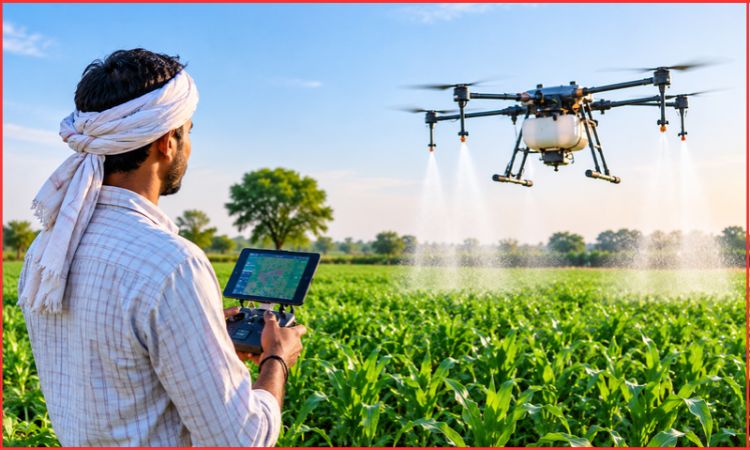
Walk through a wheat or paddy field at spraying time and the problem is easy to see. Workers are hard to find, wages keep rising, and one bad week of weather can undo a month of planning. That pressure is why the drone agriculture industry in India is getting so much attention from farmers, investors and startups.
Drone farming technology has moved well past the demo stage at agri expos. It now handles crop spraying, field mapping and crop health checks, and it has opened doors for equipment makers, agritech firms and village-level entrepreneurs. This article looks at the agriculture drone market in India, the main players, the business models that bring in money, the government support on offer and the hurdles that remain.
Quick Glance
| Parameter | Overview |
| Industry | Agricultural drones and precision farming |
| Main applications | Spraying, crop monitoring, mapping and field analysis |
| Key companies | Garuda Aerospace, IoTechWorld Avigation, Marut Drones, General Aeronautics, ideaForge |
| Customers | Farmers, FPOs, cooperatives, agribusinesses and government agencies |
| Revenue models | Drone sales, rentals, spraying services, subscriptions and analytics |
| Growth drivers | Labour shortages, mechanisation and government support |
| Challenges | High costs, training, maintenance and small landholdings |
| Opportunities | Drone-as-a-service, dealerships, repairs and pilot training |
These companies work in different parts of the ecosystem, so their products and specialisations vary.
How the Drone Agriculture Industry in India Works
Agricultural drones are unmanned aircraft built or adapted for farm work. They carry spray tanks, cameras, sensors or mapping gear and take over jobs that once meant people walking the field.
Manual inspection and spraying eat up time, especially on large farms or when a task must be finished inside a narrow window. Drones cover ground quickly and apply inputs where they are needed, which can shorten the job and limit wasted chemicals.
The ecosystem is wider than most people assume. It includes hardware makers, software developers, drone spraying services, pilot training institutes, agricultural input companies and government-backed programmes.
Adoption is still uneven. Large commercial farms find drones easier to use than small farmers with scattered plots, which is why service-based models matter so much in the agriculture drone market in India.
Leading Agricultural Drone Companies in India
Several agricultural companies in India compete through manufacturing, spraying technology and service delivery. The names below are notable examples, not a market-share ranking.
Garuda Aerospace
Based in Chennai, Garuda Aerospace is one of the more visible names, with offerings in precision agriculture, industrial use and pilot training. Its farm solutions cover crop monitoring, precision spraying and data-driven farm management. It pairs hardware sales with drone-as-a-service, so farmers can use drones through a provider instead of buying one.
IoTechWorld Avigation
IoTechWorld Avigation is known for agricultural spraying drones, which suit farms where pesticides and liquid fertilisers must go on at the right time with less manual effort. Its opportunity lies in demand for locally developed systems, through drone supply, distribution and technical support.
Marut Drones
Marut Drones links drone manufacturing with entrepreneurs who buy equipment and offer drone spraying services to nearby farmers. That matters because a small farmer can rarely justify buying a drone for occasional use. One local operator can serve many farms and spread the cost.
General Aeronautics
General Aeronautics builds agricultural technology, including drone-based tools for precision farming. Firms in this space can earn from equipment, field operations and tie-ups with crop-input suppliers, bundling spraying with crop-protection programmes.
ideaForge
ideaForge is better known for mapping, surveying and security drones. It still matters here because aerial data supports land assessment and farm planning. Just remember that a mapping drone and a spraying drone are different machines with different payloads.
Agriculture Drone Applications
Agriculture drone applications now touch most stages of crop production, from preparing a field to judging damage after a storm.
- Spraying. Drones apply approved pesticides and liquid fertilisers quickly, keep workers away from direct chemical exposure and reach patches that are hard to walk. Results still depend on weather, crop structure, settings and correct chemical use.
- Crop health monitoring. Cameras and sensors pick up differences in growth and canopy condition. Farmers can then look into nutrient gaps, water stress or pest damage before choosing a fix.
- Farm mapping. Aerial images help measure cultivated area, spot uneven terrain and find drainage problems, which supports planning and irrigation design.
- Irrigation management. Imagery can show uneven growth and possible water-stress zones. Paired with field checks and soil-moisture data, it helps farmers question how efficiently they use water.
- Crop damage assessment. After storms or floods, aerial images record field conditions. Insurers, agribusinesses and authorities may use them to support their own assessments, subject to verification.
Agricultural Drone Business Model and Revenue Streams
A workable agricultural drone business model rarely rests on one income source. Companies sell equipment, charge for field work or earn recurring fees from data.
| Revenue model | How it works | Main customers |
| Drone sales | Drones and accessories sold outright | Entrepreneurs, FPOs, agribusinesses |
| Drone-as-a-service | Charge per acre or operation | Farmers, cooperatives |
| Rental and leasing | Equipment hired for a period or task | Farmers, local operators |
| Software and analytics | Maps, insights, subscriptions | Large farms, agribusinesses |
| Training and maintenance | Pilot training, repairs, servicing | Operators, drone owners |
| Enterprise contracts | Services under larger agreements | Input companies, government agencies |
- Drone sales. Manufacturers earn from drones, batteries, chargers, spray systems and spares, while dealers add installation and servicing. Hardware alone doesn’t guarantee repeat income, so service networks and spare parts decide whether customers stay.
- Drone-as-a-service. The farmer pays per acre while the operator handles the drone, batteries, pilots and upkeep. For smallholders, drone spraying services make far more sense than ownership, and the model suits FPOs and community farming groups.
- Rental and software. Owners can rent equipment to qualified operators, which helps entrepreneurs who have demand but little capital. Others turn imagery into crop-health maps and field reports, charging subscriptions or per-survey fees. That only works when the data is reliable and the advice is useful.
- Training and maintenance. Pilot training, battery servicing and repairs bring steady income. They matter because drones work in tough outdoor conditions during time-sensitive seasons.
Government Schemes Backing Drone Farming Technology
Namo Drone Didi Scheme. Approved with an outlay of ₹1,261 crore for 2023–24 to 2025–26, it aims to put drones in the hands of 15,000 selected women’s self-help groups. Eligible SHGs can get central assistance covering 80% of the drone package cost, up to ₹8 lakh, with equipment, training and maintenance support included. A February 2026 government update reported 1,094 drones distributed to SHGs by lead fertiliser companies, 500 of them under the scheme.
Sub-Mission on Agricultural Mechanization. SMAM offers financial help for drone adoption to eligible custom hiring centres, FPOs and individual farmers. Support varies by beneficiary and scheme guidelines, so confirm eligibility and funding with the agriculture department before investing.
Drone rules and training. India’s framework sets out registration, certification, airspace and pilot-training requirements. Check the current DGCA rules and Digital Sky airspace restrictions before any flight.
A subsidy lowers the entry barrier. It does not create customers or guarantee profit.
Challenges Facing the Industry
The agriculture drone market in India has real potential, but several obstacles stand in the way.
- High upfront cost: drones, batteries, chargers, transport and upkeep add up, and small entrepreneurs often struggle to finance them.
- Fragmented landholdings: small, scattered plots mean more travel and setup time, so fewer paid jobs a day.
- Low awareness: some farmers don’t yet know when drone spraying works and where it doesn’t.
- Weather: wind, rain and short battery life can wreck a schedule.
- Skills and maintenance: peak season needs trained pilots and spare parts on hand.
- Uncertain demand: income depends on crop patterns, repeat orders and what farmers will pay compared with conventional spraying.
A July 2025 government study also flagged transportation as a practical obstacle for some SHGs running drones. A viable business needs logistics and local demand, not just equipment.
Where the Drone Agriculture Industry in India Is Heading
Expect the sector to move from selling equipment towards selling complete farming services. Manufacturers will compete on reliability, spray performance, batteries and after-sales support, while operators build local networks and chase repeat customers.
Three shifts look likely. Service marketplaces may grow, connecting farmers with trained operators so they can compare prices and book spraying. Drone farming technology may become more data-driven as imagery joins AI, satellite data and agronomic advice. And rural entrepreneurship could become the strongest growth channel, with SHGs, FPOs, agriculture graduates and local businesses running services without relying on every farmer buying a drone. Industry reporting in August 2026 pointed to rising interest in on-demand drone services and entrepreneur-led networks, though lasting growth will depend on quality, affordability and visible value for farmers.
Conclusion
The drone agriculture industry in India is turning into a mix of hardware, software, field services and rural enterprise. Garuda Aerospace, IoTechWorld Avigation, Marut Drones and General Aeronautics each cover a different piece, while mapping specialists support the wider picture.
The biggest opportunity probably isn’t selling a drone to every farmer. It is building dependable services farmers can book when they need them, backed by trained operators, fair pricing and good maintenance. For entrepreneurs, drone-as-a-service is a sensible entry point. For farmers, the real test is simple: does it save effort and money?
Frequently Asked Questions (FAQs)
1. Which are the leading agricultural drone companies in India?
Garuda Aerospace, IoTechWorld Avigation, Marut Drones and General Aeronautics are among the notable names. Their products and services differ.
2. What are the main agriculture drone applications?
Spraying, crop monitoring, field mapping, irrigation assessment and crop damage surveys.
3. How do drone companies earn revenue?
Through equipment sales, drone spraying services, rentals, software subscriptions, data analysis, training and maintenance.
4. What is the Namo Drone Didi Scheme?
It is a government initiative that provides drones to selected women’s self-help groups so they can rent out spraying services to farmers. The outlay is ₹1,261 crore for 2023–24 to 2025–26.
5. Is an agricultural drone business profitable?
It can be, with enough local demand, repeat orders, efficient scheduling and controlled maintenance costs. Returns depend on financing, running costs, seasonal demand and pricing.
6. Can small farmers benefit from drones?
Yes. They can hire drone spraying services from local operators, FPOs or cooperatives instead of buying equipment.