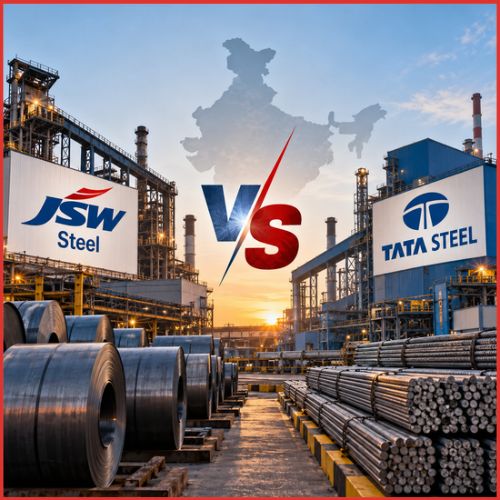
Two names dominate almost every conversation about Indian steel, and the question of who is ahead rarely gets a straight answer. Under the leadership of Sajjan Jindal, JSW Steel has emerged as a major force in the sector, while Tata Steel remains one of India’s most established steel producers. The JSW Steel vs Tata Steel debate looks simple on the surface, yet the verdict changes depending on whether you count tonnes, capacity, growth rate or overseas exposure.
Here is the short version. JSW Steel makes more steel in India, while Tata Steel has recorded faster year-on-year growth in its latest quarterly results. The longer version matters to investors, suppliers and anyone tracking where India’s steel production is heading. This article compares JSW Steel production with Tata Steel production using FY26 and April-September 2026 disclosures, checks how JSW Steel capacity and Tata Steel capacity compare, and explains which numbers deserve the most weight in a JSW vs Tata Steel comparison.
JSW vs Tata Steel Comparison: The Numbers Side by Side
The table below brings together the latest JSW Steel vs Tata Steel figures reported by both companies. Definitions differ slightly, so read the notes underneath before drawing conclusions.
| Metric | JSW Steel | Tata Steel |
|---|---|---|
| FY26 crude steel, Indian operations | 29.25 MT | 23.48 MT |
| FY26 growth | 8% (consolidated, 30.14 MT) | 8% (India) |
| Q2 FY27 crude steel, Indian operations | 7.07 MT | 6.21 MT |
| Q2 FY27 growth | 5% (India); 5% consolidated | 10% (India) |
| Q2 FY27 overseas output | 0.20 MT (US, Ohio) | 1.52 MT (Netherlands), 0.32 MT (Thailand) |
| Reported capacity | 37.9 MTPA (including 4.5 MTPA JV) | About 36 MTPA group; about 27.4 MTPA India |
| Stated expansion target | 54.8 MTPA over four years | About 40 MTPA India; 51.5 MTPA group by FY31 (reported) |
Notes: JSW Steel’s production figures are adjusted to account for the transfer of Bhushan Power and Steel’s business to the JSW-JFE Steel joint venture in March 2026. Tata Steel’s India figures include NINL on a proforma basis. Capacity and expansion targets are based on company announcements and may change.
Three things stand out. First, JSW Steel leads on volume in India by a clear margin: 29.25 MT against 23.48 MT in FY26, a difference of about 5.8 MT. Second, JSW Steel continues to produce more steel in India in the latest quarter, with 7.07 MT against Tata Steel’s 6.21 MT in Q2 FY27. However, Tata Steel recorded faster year-on-year growth at 10%, compared with JSW Steel’s 5% in Indian operations. Third, on headline capacity, the two groups look close, at 37.9 MTPA against about 36 MTPA. However, Tata Steel’s India-only capacity is smaller than its group total because a significant part of its operations is based in Europe and Thailand.
Why India Steel Production Is Worth Watching Right Now
India is the world’s second-largest crude steel producer, according to the Ministry of Steel’s annual report for 2025-26. China is far ahead, with roughly 53% of global output in the period covered by that report, but India has no close rival for second place. Roads, railways, housing and automobiles continue to support steel demand.
Within the Indian steel industry, three producers sit at the front of the pack: JSW Steel, Tata Steel and SAIL. For FY26, Tata Steel, part of the Tata Group, reported a record 23.48 million tonnes from its Indian operations, SAIL recorded 19.43 million tonnes, and JSW Steel produced 29.25 million tonnes from its Indian plants. So, the race for India steel production has a clear front-runner by volume. The interesting part is how the gap is moving.
A quick note on terms: crude steel is the steel produced directly from the steelmaking process, and MTPA means million tonnes per annum, the usual measure of production capacity. Every figure below comes from company releases and filings. Some production figures are provisional and may be revised.
JSW Steel Production and Capacity: The Volume Leader
How Much Steel Does JSW Steel Actually Make?
JSW Steel production crossed the 30 million tonne mark in FY26, with combined crude steel output of 30.14 MT, up 8% from 27.79 MT in FY25. Indian operations contributed 29.25 MT, while the Ohio unit in the US added 0.83 MT, according to the company’s April 2026 update.
Blast Furnace 3 at Vijayanagar was shut down at the end of September 2025 for a capacity expansion, which affected output. Indian operations ran at about 87% of capacity across FY26 with the furnace offline.
The April-June 2026 quarter showed a similar picture. Consolidated JSW Steel production came in at 6.59 MT, up 3% year on year, with Indian operations contributing 6.35 MT. Excluding the idled furnace from the previous year’s base, the company said growth would have been around 15%. Prior-year numbers were also adjusted after the Bhushan Power and Steel business moved into the JSW JFE Steel joint venture in March 2026. BF3 restarted hot metal production on 23 June 2026.
The company continued its recovery in the July-September 2026 quarter. Consolidated production reached 7.27 MT, up 5% year on year, while Indian operations contributed 7.07 MT. BF3 gradually ramped up following its restart, with capacity utilisation in Indian operations reaching around 90% in September 2026.
JSW Steel Capacity and the Expansion Plan
On JSW Steel capacity, the company reports 37.9 MTPA, including 4.5 MTPA held through the JSW JFE Steel joint venture, and plans to reach 54.8 MTPA over the next four years.
Indian operations reported capacity utilisation of about 88% in Q2 FY27, with utilisation reaching around 90% in September. A mill running close to its operating limit cannot increase production significantly without additional capacity, which explains the company’s expansion push.
Tata Steel Production and Capacity: The Faster Climber
Where Tata Steel Production Stands
Tata Steel production in India set a record in FY26 at 23.48 MT, an 8% rise helped by the ramp-up at Kalinganagar. The first quarter of FY27 was stronger still, with 5.82 MT of crude steel from Indian operations, up 11% from 5.23 MT a year earlier, with higher output at Jamshedpur and Kalinganagar. These Indian figures include Neelachal Ispat Nigam Limited on a proforma basis.
Deliveries in India were 5.17 MT, and the product mix leaned towards higher-value products. The company reported its best-ever first-quarter volumes for the Tiscon retail rebar brand, up 33%, and cold-rolled Steelium, up 41%.
Tata Steel continued its growth in Q2 FY27. Indian crude steel production reached 6.21 MT, compared with 5.64 MT in the same quarter of the previous year. This represented year-on-year growth of around 10%. Indian deliveries also increased to 5.97 MT.
Outside India, Tata Steel produced 1.52 MT of liquid steel in the Netherlands and 0.32 MT of saleable steel in Thailand during Q2 FY27. These figures reflect its international operations and should not be directly compared with India’s crude steel production.
Tata Steel Capacity and What Is Being Built
Tata Steel capacity stands at about 36 MTPA for the group, with roughly 27.4 MTPA in India. The roadmap points to about 40 MTPA in India, and the board has approved a 4.8 MTPA expansion at NINL costing ₹33,873 crore. One report puts the group goal at 51.5 MTPA by FY2030-31.
The UK business is moving towards an electric arc furnace with a capacity of about 3 MTPA. This changes the European production story but does not add to Indian steel production capacity.
What to Weigh Before Declaring a JSW Steel vs Tata Steel Winner
Consolidated or India-only? JSW Steel production and Tata Steel production are reported on different operational footprints. Tata Steel has a large European operation, while JSW Steel’s overseas share is relatively small. If your interest is India steel production specifically, compare the Indian operations, as in the table above.
Base effects. A 10% jump sounds better than 5%, and Tata Steel recorded faster year-on-year growth in Q2 FY27. However, JSW Steel’s earlier production figures were affected by the shutdown of one furnace. Its BF3 furnace has since restarted and is gradually ramping up. Growth rates over one quarter can reflect maintenance schedules and operational changes rather than long-term strength alone.
Capacity on paper versus steel on the ground. Announced JSW Steel capacity and Tata Steel capacity targets are plans with multi-year timelines, land, funding and commissioning risks attached. Only commissioned capacity that is running at high utilisation adds to actual output.
Product mix. JSW Steel reported record first-quarter sales to the automotive sector, up 18%, and renewables, up 24%. Tata Steel is pushing value-added and retail product lines. A tonne of crude steel can earn very different margins depending on the product and market it serves.
Volume is not profit. Production figures are one input, not investment advice. They do not show which company earns more per tonne or generates better returns.
Who Is Ahead in India Steel Production, Depending on What You Care About
If you track raw India steel production: JSW Steel is ahead. Its Indian operations produced 7.07 MT in Q2 FY27 against Tata Steel’s 6.21 MT. The gap remains significant, although both companies are increasing production.
If you want momentum: Tata Steel had the better year-on-year growth rate in Q2 FY27, at 10% compared with JSW Steel’s 5% in Indian operations. However, JSW Steel is also recovering as BF3 gradually returns to full operation.
If you are comparing expansion plans: JSW Steel’s 54.8 MTPA target represents a significant increase from its reported 37.9 MTPA capacity, while Tata Steel wants to increase its India capacity from about 27.4 MTPA towards 40 MTPA. Actual commissioning will say more than the announcements.
If you are a buyer or supplier: Product fit, pricing, quality and regional availability usually matter more than tonnage rankings.
The next checkpoint will be the Q3 FY27 production updates. These will help show whether JSW Steel can continue increasing output as BF3 ramps up and whether Tata Steel can maintain its recent growth rate.
Final Verdict
On the question of who leads the JSW Steel vs Tata Steel race today, JSW Steel wins on production volume in India and has a higher reported headline capacity. Its lead over Tata Steel in annual Indian production remains substantial.
However, Tata Steel has the edge in year-on-year production growth in the latest quarter. JSW Steel is also showing signs of recovery following the BF3 shutdown, making the next few quarters important for the comparison.
The practical takeaway is to judge the race using India-only production, account for operational changes and treat expansion targets as plans until the additional capacity is commissioned. The Q3 FY27 production updates will be the next important test.
Frequently Asked Questions
1. Which Has Higher Steel Production in India: JSW Steel or Tata Steel?
JSW Steel. In FY26, its Indian operations produced 29.25 MT of crude steel against 23.48 MT for Tata Steel. In Q2 FY27, JSW Steel produced 7.07 MT against Tata Steel’s 6.21 MT.
2. What Is JSW Steel’s Capacity Right Now?
The company reports 37.9 MTPA, including 4.5 MTPA through the JSW JFE Steel joint venture. It plans to increase this capacity to 54.8 MTPA over the next four years. Timelines may change.
3. What Is Tata Steel’s Capacity in India and Globally?
Tata Steel’s reported group capacity is about 36 MTPA, with roughly 27.4 MTPA in India. The company aims to increase its Indian capacity to around 40 MTPA.
4. Is Tata Steel Growing Faster Than JSW Steel?
In Q2 FY27, yes. Tata Steel’s Indian operations recorded around 10% year-on-year production growth, compared with 5% for JSW Steel’s Indian operations. JSW Steel’s production was affected by the earlier BF3 shutdown, but the furnace has since restarted and is gradually ramping up.
5. Why Does a JSW vs Tata Steel Comparison Need Care?
JSW Steel and Tata Steel report production across different operational footprints. JSW Steel’s consolidated figures include its US operations, while Tata Steel reports separate production figures for India, the Netherlands and Thailand. Capacity figures also include joint ventures and planned expansion. A fair comparison requires looking at similar metrics.
6. How Does India Rank Globally in Steel Production?
India is the world’s second-largest crude steel producer, behind China, according to the Ministry of Steel’s 2025-26 annual report. JSW Steel and Tata Steel together produced 13.28 MT of crude steel in their Indian operations during Q2 FY27.