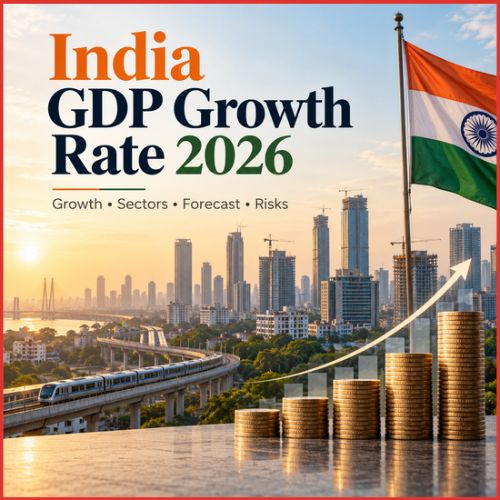
Seven point eight percent is the number everyone keeps quoting. It sits at the top of nearly every headline about the India GDP growth rate 2026 conversation, and for good reason. The Press Information Bureau (PIB) reports that real GDP grew by 7.8% in Q1 of FY 2026–27, the April to June 2026 quarter. Real GDP came in at ₹81.36 lakh crore, up from ₹75.46 lakh crore a year earlier.
That’s quick by any global standard. But does it add up to a boom? This article looks at India GDP growth in 2026 beyond the headline: what the official data says, the sectors driving India’s GDP growth, what forecasters expect, and where the Indian economy 2026 story gets less tidy.
The short version: India’s economic growth is strong, but “boom” is a bigger word than the data alone supports.
Quick Glance: India GDP Growth Rate 2026
| Indicator | Latest figure |
|---|---|
| Real GDP growth, Q1 FY2026–27 | 7.8% |
| Nominal GDP growth, Q1 FY2026–27 | 10.3% |
| Real GVA growth, Q1 FY2026–27 | 8.2% |
| Real GDP growth, FY2025–26 | 7.7% |
| World Bank projection, FY2026–27 | 7.1% |
| IMF projection, 2026 | 6.4% |
| New GDP base year | 2022–23 |
Sources: MoSPI/PIB, World Bank and IMF. Quarterly figures are official estimates; World Bank and IMF figures are projections.
GDP Growth Rate in India: What the Latest Data Shows
The Ministry of Statistics and Programme Implementation (MoSPI) puts real GDP growth for Q1 FY2026–27 at 7.8% year-on-year. Nominal GDP grew by 10.3%, while real GVA, which tracks the value added by producers, rose by 8.2%.
Real figures matter more than nominal ones here. Real GDP adjusts for price changes, so it shows actual output rather than growth in rupee value caused by rising prices. That’s why analysts rely on it when discussing the Indian economy’s growth rate.
Nor is this just a one-quarter development. PIB’s provisional annual estimates, released in June 2026, show real GDP growth of 7.7% for FY2025–26, with Q4 (January to March) alone recording 7.8% growth. Two consecutive quarters at the same pace suggest that the GDP growth rate in India has maintained a strong upward momentum.
Sectors Driving India’s GDP Growth in 2026
No single engine explains India’s economic growth. Four areas stand out.
Household Consumption
India’s large domestic market still does the heavy lifting. According to MoSPI’s estimates, private final consumption expenditure (PFCE) grew by 7.0% in FY2025–26 in the First Advance Estimates. The subsequent provisional annual estimates showed growth of more than 7.5%. That spending reaches cars, phones, restaurants, travel, housing and financial products.
The World Bank also noted that domestic demand remained strong in early 2026. Rural consumption was especially firm, and urban demand showed signs of recovery. A consumption-led economy has some cushion when overseas demand weakens, which matters for the India economic outlook in 2026.
Services
Services remain the biggest contributor among the sectors driving India’s GDP growth. MoSPI estimates that financial, real estate and professional services, together with public administration and related services, grew by 9.9% at constant prices in FY2025–26. IT, global capability centres, fintech and digital payments connect the domestic economy to global business, while Q1 FY2026–27 GVA growth of 8.2% shows that the momentum has continued.
Manufacturing
Investors watch manufacturing most closely. India has been building capacity through infrastructure spending, production-linked incentives, electronics assembly and supply-chain diversification. In Q1 FY2026–27, the Index of Industrial Production for electrical equipment rose by 27.0% year-on-year, while computer, electronic and optical products recorded growth of 12.4%, according to PIB.
Those gains are selective. They don’t mean every factory floor is busy. Still, they show where India’s economic growth is translating into real output.
Infrastructure and Investment
Gross fixed capital formation, the measure of investment in fixed assets, grew by more than 7.5% in FY2025–26, according to MoSPI’s provisional estimates. Roads, railways, ports, power and urban projects create demand now and capacity later.
The open question is private investment. Government spending can carry an investment cycle for a while, but a broad upswing usually needs companies to commit their own money too.
India GDP Forecast 2026: What the World Bank and IMF Expect
This is where the boom talk gets more nuanced. In October 2026, the World Bank projected India’s growth at 7.1% for FY2026–27, raising its earlier April estimate of 6.6%. The revised outlook reflects robust domestic demand and strong exports despite global headwinds.
The IMF’s July 2026 World Economic Outlook Update put India’s real GDP growth at 6.4% for 2026, slightly below its April projection of 6.5%.
Both figures are below the 7.8% Q1 growth figure. The gap is understandable because one strong quarter doesn’t guarantee the same pace for an entire year. Even so, the projections indicate that India is expected to remain among the world’s fastest-growing major economies.
Is the Indian Economy in 2026 Really Booming?
If a boom means fast headline expansion, India qualifies. If it means every household, sector and company feeling the surge at once, the evidence is thinner. Growth isn’t spread evenly, and external risks are real.
A fairer label for the Indian economy in 2026 is this: strong, uneven in places, and still being tested. The India GDP growth rate 2026 tells us how fast the economy is moving. It doesn’t tell us who is benefiting.
Risks to India’s Economic Outlook
Oil and Geopolitics
The IMF has flagged geopolitical fragmentation, renewed trade tensions and higher commodity prices as risks to global growth. India depends on imported crude, so a sustained jump in oil prices increases transport and production costs and adds pressure on inflation, which clouds the India economic outlook in 2026.
Weak Global Demand
IT services, engineering, pharmaceuticals, textiles and electronics all rely partly on overseas buyers. If major economies slow down, exporters and globally exposed firms feel the impact first. This could weigh on the Indian economy as a whole.
Jobs and Incomes
GDP growth doesn’t automatically bring matching job growth. India has a large, young workforce that needs productive employment, and the World Bank has stressed the importance of private-sector-led growth and job creation over the longer term.
Why Per-Capita Numbers Matter
Total GDP can climb fast while output per person rises more slowly. Wages, inflation, productivity and access to opportunities decide whether a headline gain reaches households.
For businesses, the difference matters too: premium categories may see stronger demand than mass-market ones. Read the GDP growth rate in India alongside per-capita income, consumption and employment data.
New GDP Series: Why Older Numbers Don’t Match
In February 2026, MoSPI introduced a new national accounts series with 2022–23 as the base year, replacing 2011–12. The revised method draws on newer data sources and aims to reflect structural shifts in the economy.
Under the new series, FY2025–26 growth was initially estimated at 7.6%, compared with 7.1% for FY2024–25. Later provisional estimates raised FY2025–26 growth to 7.7%.
So, if an older article quotes a different Indian economy growth rate, check which series it used before comparing the figures. Anyone tracking India GDP growth in 2026 or the wider Indian economy should do the same.
What Strong Growth Means for Businesses
- Banking and financial services: More business loans, housing finance, consumer credit and investment products.
- Infrastructure: Steady work for construction, engineering, logistics and capital goods firms.
- Consumer businesses: Rising incomes and urbanisation can lift demand for vehicles, electronics, travel and lifestyle products.
- Technology: AI, cloud, fintech, SaaS and cybersecurity continue to open up new opportunities.
- Manufacturing: Electronics, automotive, semiconductor and engineering firms could benefit from the push for domestic production.
A strong Indian economy growth rate doesn’t guarantee that every company in these sectors will do well. Company fundamentals still decide who wins.
Conclusion
The data says India GDP growth in 2026 is running strong. A 7.8% Q1 growth figure and 8.2% GVA growth back that up, and consumption, services, manufacturing and investment are all contributing to the momentum. But the World Bank’s 7.1% and the IMF’s 6.4% projections are reminders that energy prices, geopolitics and global demand can shift the picture quickly.
So, is it a boom? Not quite, at least not yet. The India GDP growth rate 2026 shows speed. The real test for the Indian economy is whether that speed translates into broader growth, more private investment and better employment opportunities. If it does, India’s economic growth could stay strong for years. If jobs and incomes lag, the headline will look better than daily life feels.
Frequently Asked Questions (FAQs)
1. What is the GDP growth rate in India in 2026?
India recorded real GDP growth of 7.8% in Q1 FY2026–27 (April to June 2026), according to PIB. Full-year projections include 7.1% from the World Bank for FY2026–27 and 6.4% from the IMF for 2026.
2. Which sectors are driving India’s GDP growth?
Services, manufacturing, construction, household consumption and investment are the main contributors to India’s economic growth.
3. Is India’s economy growing faster than the global economy?
Yes. India’s projected growth remains significantly higher than the global growth outlook, according to the IMF’s economic projections.
4. Why is the India GDP forecast 2026 lower than the Q1 figure?
One quarter doesn’t set the full-year pace. The World Bank and IMF point to higher energy prices, geopolitical uncertainty, supply-chain disruption and weaker external demand as potential risks.
5. Why do older GDP figures differ from newer ones?
MoSPI introduced a new GDP series in February 2026, with 2022–23 as the base year instead of 2011–12. Articles using the old series can show different figures for India’s economic growth rate.
6. Does high GDP growth mean all Indians are getting richer?
Not necessarily. GDP measures total economic output. Per-capita income, wages, employment, inflation and how economic gains are distributed determine what households actually experience.