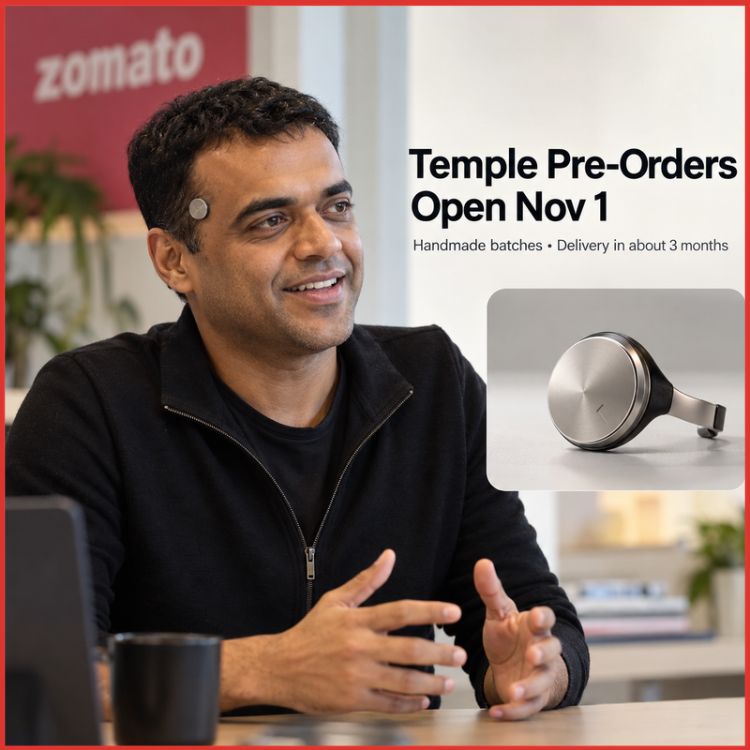
Temple is moving closer to a wider consumer launch after opening pre-orders to everyone who registered for early access over the past few months.
The wearable project backed by Zomato founder Deepinder Goyal is currently inviting those early users to check their email for ordering details. Everyone else will get access soon: public Temple device pre-orders are scheduled to open on November 1, 2026.
The rollout will still be deliberately slow.
Temple says its first consumer units will be handmade and produced in batches rather than manufactured immediately at mass-market scale. Buyers have also been told to expect a delivery timeline of roughly three months.
That could push some November orders into early 2027.
Early-Access Users Can Order Now
Temple has been collecting early-access registrations for several months.
Those users are now being moved into the actual purchase process.
Goyal said people who had registered should check their mailboxes for details about placing a pre-order. Users who missed the early-access programme are being asked to download the Temple app, prepare their carts and wait for November 1.
It is a fairly controlled launch compared with the usual consumer-electronics model.
There is no rush to put thousands of units onto e-commerce platforms on the first morning.
The company appears to be using early orders partly as a way to test manufacturing, fulfilment and customer support before opening availability more widely.
Each Early Temple Unit Will Be Handmade
The three-month waiting period is not simply a shipping delay.
Temple says its initial devices will be handmade.
That puts a natural limit on how quickly production can increase.
Goyal previously described the strategy as “grow slow”, arguing that the priority is product quality and serving each early customer properly rather than chasing immediate scale.
It is an unusual approach for a consumer wearable.
Smartwatches and fitness bands are normally produced through highly automated manufacturing systems capable of shipping large volumes quickly.
Temple is starting closer to a limited hardware experiment.
Whether that changes after the first batches will depend on demand and how reliably the company can manufacture the device.
Temple Measures Blood Flow Near the Brain
The Temple wearable is also different from a normal wrist-based fitness tracker.
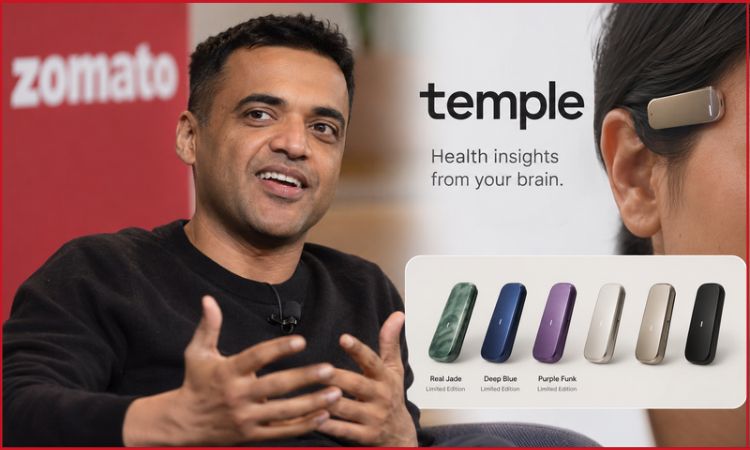
Rather than sitting on the wrist, it is worn around the temple area of the head.
The device uses optical sensing to monitor changes in cerebral blood flow and oxygenation. Temple refers to one of its measurements as BrainFlow.
The company wants to use those signals to give wearers information related to recovery, stress, physical activity and wider wellness.
This positioning puts Temple closer to experimental physiological monitoring than the familiar step-counting and heart-rate features found on mainstream fitness bands.
There is an important caveat.
Temple’s own metrics should not automatically be treated as established clinical measures, and the company has not presented the device as a replacement for medical diagnosis.
The Product First Appeared Publicly on a Podcast
Temple attracted public attention before the company had properly introduced the product.
Earlier in 2026, viewers noticed a small metallic-looking device being worn near the temple during a podcast appearance.
That prompted questions about what it was.
The project gradually became more public afterwards.
In May, Goyal said the first 100 devices were ready to go to a group of founding users that included athletes, scientists, doctors, founders and creators.
By August, the hardware had changed significantly.
Goyal said the newer version was less than half the size of the earlier device. He also described it as extremely small and powerful, although independent technical specifications supporting those claims had not yet been released.
Six Colour Options Are Planned
Temple is moving beyond a single prototype-style finish for the consumer release.
The device is expected to come in six colours.
Real Jade, Deep Blue and Purple Funk have been identified as limited-edition options.
That may sound cosmetic, but it tells us something about how Temple wants the hardware to be used.
A device worn on the side of the head is highly visible.
Unlike a sensor hidden under clothing, its appearance becomes part of the purchase decision.
Wearables such as smartwatches have already shown that health technology often needs to work as a fashion object too if users are expected to wear it throughout the day.
Temple has an even harder design problem because its placement is less familiar.
The Price Still Has Not Been Announced
One significant detail remains missing.
Temple has not yet disclosed the retail price.
The company has also not confirmed exactly how many devices will be included in the first public batch.
Those details are expected closer to the Temple November 1 pre-order opening.
Price will matter considerably.
Temple is entering a wearable market where customers can already buy products measuring heart rate, sleep, skin temperature and blood oxygen at several price points.
Its argument will need to be that temple-based sensing provides useful information that consumers cannot easily obtain from existing wristwear.
How much people are prepared to pay for that difference remains untested.
BrainFlow Is the Feature Temple Needs to Explain
The hardware itself is only part of the product.
Temple’s bigger challenge may be making the data useful.
A customer does not necessarily benefit simply from knowing that cerebral blood flow changed at a particular moment.
The software has to turn raw measurements into something understandable.
That is where BrainFlow and Temple’s wider interpretation layer come in.
The company says its sensing approach can help people understand how sleep, exercise, stress and recovery affect their bodies.
For that to work beyond early adopters, users will need simple explanations rather than pages of physiological numbers.
That is a familiar challenge across health wearables.
Collecting more data is easier than convincing users what they should do with it.
A Slow Launch Could Help Temple Avoid an Early Hardware Problem
The deliberate three-month delivery window may frustrate buyers, but it gives the company some protection too.
Hardware problems are expensive.
A software company can fix a bug with an update. A faulty physical product may need to be recalled, repaired or replaced.
Temple is also dealing with an unusual form factor and sensing location, making quality control especially important.
Producing early units in smaller batches gives the team more opportunity to identify manufacturing and usability issues before much larger volumes ship.
That appears to be the logic behind the gradual Temple health wearable launch.
November 1 Is the First Real Consumer Test
The next major date is now straightforward.
Users who previously registered can begin ordering first.
Public pre-orders open November 1.
After that, the company will finally begin seeing how much demand exists outside the smaller community that has followed Temple’s development from its prototype stage.
There are still unanswered questions around price, validation, battery performance and how useful its brain-related measurements prove in everyday life.
But the project has crossed an important point.
Temple is no longer simply the mysterious device people noticed in a podcast.
It is becoming a product people can actually order.
Source:
The Times of India – Deepinder Goyal shares Temple pre-order update