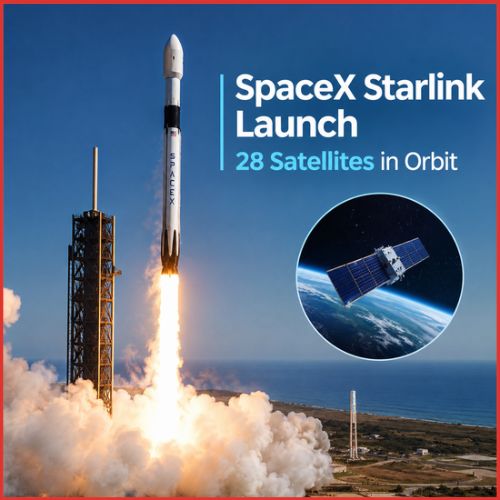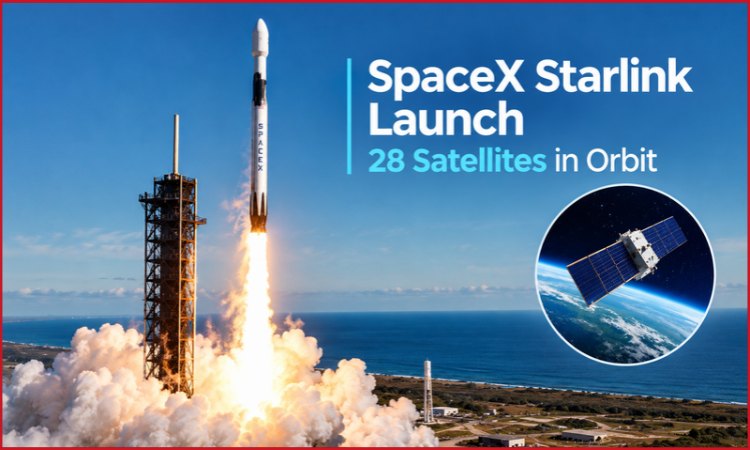
SpaceX has added another 28 satellites to its Starlink network after a Falcon 9 lifted off from California on October 22, turning what would once have been a major rocket event into another entry on an increasingly crowded launch calendar.
The SpaceX Starlink launch took place at 7:16 am Pacific Time from Space Launch Complex 4 East at Vandenberg Space Force Base.
Falcon 9 successfully carried the satellites into low-Earth orbit after earlier attempts had been delayed.
The flight itself went largely as SpaceX intended. What makes it more interesting is how routine missions like this have become.
The first-stage booster was flying for the 21st time.
Falcon 9 Lifted Off From Vandenberg
The mission, identified in SpaceX and launch-tracking records as Starlink 11-5, departed from SLC-4E on California’s central coast.
Twenty-eight Starlink V2 Mini satellites were aboard.
SpaceX’s own post-launch information confirmed that number, although some pre-launch listings had previously shown 27 satellites.
The discrepancy does not appear to indicate a launch problem.
Payload manifests can change between initial scheduling and the final flight, particularly after a mission is delayed.
The important part is that SpaceX confirmed 28 Starlink satellites were carried on the successful October 22 launch.
The Mission Had Been Delayed
The flight did not leave on its first planned attempt.
An October 20 launch attempt was scrubbed after an apparent technical issue.
The mission was subsequently pushed back before eventually lifting off on October 22.
SpaceX did not publish a detailed technical explanation for the scrub.
For routine Starlink operations, that is not especially unusual.
A pre-launch issue that can be resolved quickly generally results in another attempt rather than the kind of lengthy investigation associated with an in-flight anomaly.
The turnaround highlights how Falcon 9 operations have matured.
A two-day delay now looks more like a scheduling adjustment than a major disruption.
Booster B1075 Was Flying for the 21st Time
The most telling number from the flight may not be the satellite count at all.
The Falcon 9 first stage, booster B1075, was making its 21st flight.
Roughly eight minutes after liftoff, it returned to Earth and landed on the Of Course I Still Love You droneship in the Pacific Ocean.
A successful landing means SpaceX can inspect and potentially fly the booster again.
That reuse model is the main reason the company can maintain such a dense launch schedule.
Building an entirely new first stage for every batch of Starlink satellites would be slower and substantially more expensive.
Instead, Falcon 9 reusability has turned boosters into fleet hardware.
They launch, land, undergo inspection and then return to service.
A 21st Flight Barely Feels Unusual Now
That would have sounded extraordinary during Falcon 9’s early years.
Landing a rocket stage itself was once a major engineering milestone.
Today, a booster completing its 21st mission can fly on a relatively routine satellite deployment without the reuse number becoming the main headline.
That is a significant change.
SpaceX spent years reducing the amount of refurbishment needed between flights and improving how launch sites, droneships and booster fleets work together.
The result is an operating model that looks increasingly like transportation rather than traditional expendable rocketry.
Reliability still matters on every flight.
What has changed is the frequency with which the hardware gets another chance to prove it.
Vandenberg Has Been Exceptionally Busy
The California launch site has seen an unusually heavy workload during 2026.
Official and independent launch records show Vandenberg had already reached its 69th launch of the year by mid-October.
Starlink flights make up a substantial portion of that activity.
SpaceX has repeatedly sent Falcon 9 missions south over the Pacific from SLC-4E, adding satellites to orbital planes that are well suited to launches from California.
The pace would be difficult to achieve without reusable rockets.
Launch pads also need to support rapid propellant loading, inspections and turnaround between flights.
That ground infrastructure is just as important as the rocket when SpaceX launch cadence reaches several missions in a matter of days.
Starlink Needs Constant Launches
There is a business reason behind that pace.
Starlink does not reach a finished state where SpaceX can simply stop launching satellites.
The network needs more spacecraft as customer numbers grow and demand for capacity increases.
Existing satellites also have limited service lives.
Older spacecraft eventually need to be retired and replaced.
That creates an unusual model where continual rocket launches are part of running the communications network itself.
Each batch adds incremental capacity and helps SpaceX maintain coverage across different parts of the world.
The satellite network and the launch business therefore reinforce each other.
SpaceX can fly Starlink frequently because it owns Falcon 9, and Falcon 9 flies frequently because Starlink continually needs launches.
V2 Mini Satellites Carry More Capability
The newer Starlink V2 Mini spacecraft are designed to provide greater capacity than earlier generations.
They are still launched on Falcon 9 while SpaceX develops Starship as the vehicle intended to carry much larger future satellite batches.
That distinction matters.
Falcon 9 is currently doing the bulk of the operational work needed to maintain and expand Starlink.
Starship is meant to change the scale later.
If SpaceX can make Starship routinely reusable, it could carry far more satellite mass on each flight and potentially change the economics again.
For the moment, however, Falcon 9 Starlink missions remain the backbone of the network’s deployment programme.
Routine Is the Real Achievement
A single launch carrying 28 satellites does not fundamentally transform Starlink overnight.
That is almost the point.
The network grows because SpaceX repeats this process again and again.
Launch schedules now contain multiple Starlink flights within the same month, sometimes only days apart.
A scrub can move a mission by a day or two without derailing the wider deployment programme.
A booster can complete more than 20 flights and return to a droneship for another landing.
The dramatic part of the story has gradually moved away from the individual mission and towards the industrial system behind it.
Another 28 Satellites Join an Ongoing Build-Out
The October 22 flight finished with the satellites heading into low-Earth orbit and booster B1075 safely recovered.
SpaceX already has more Starlink launches scheduled from both California and Florida.
That makes this mission less of a standalone event than another step in an almost continuous build-out.
For Starlink customers, those launches translate into more capacity and a denser network.
For SpaceX, they demonstrate something equally valuable: Falcon 9 can keep flying at a pace that would have been difficult to imagine when reusable rockets were still experimental.
The 28-satellite Starlink launch may look routine now.
Making orbital launches routine was the difficult part.
Source
Tech Insider: SpaceX Falcon 9 Launches 28 Starlink Satellites