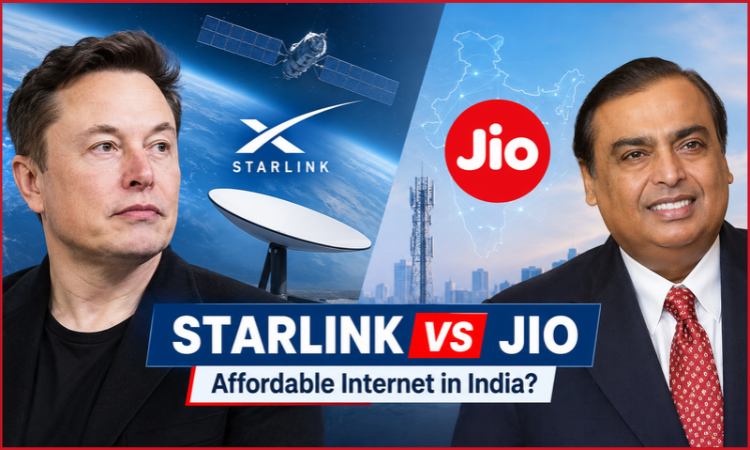
Elon Musk has made one part of Starlink’s India strategy clear even before the satellite internet service receives its final approval to launch: it cannot arrive with a price tag that feels out of place in one of the world’s cheapest mobile-data markets.
The SpaceX chief said Starlink India pricing would have to be affordable if the company wanted people to actually use the service. That puts Starlink on an interesting path towards Reliance Jio, which spent years reshaping India’s telecom market around cheap data and is now preparing what could become the country’s largest-ever stock market listing.
Neither company’s satellite service is operating commercially in India yet. Both are still waiting for final security clearance.
That means the price battle has not started. The positioning already has.
India Is a Very Different Market for Starlink
Starlink has built a global business around a fairly simple idea: take broadband to places where laying fibre or building conventional telecom infrastructure is difficult.
That works particularly well in remote areas, islands, rural communities and locations where terrestrial internet is either slow or unavailable.
India presents a different challenge.
Mobile data here costs around 8 cents per gigabyte, placing the country among the cheapest data markets globally. Consumers have also become accustomed to large data allowances at relatively modest monthly prices.
A satellite internet plan cannot be compared directly with a mobile data package, but customers will still notice the difference when looking at the monthly bill.
Elon Musk acknowledged that reality himself.
His point was straightforward: if Starlink satellite internet is simply too expensive for Indian households, the size of the market will not matter because customers will not sign up.
Jio Built Its Scale Through Low Prices
That creates an unusual competitive backdrop.
Reliance Jio entered India’s mobile market in 2016 and quickly built its position through inexpensive data and aggressive subscriber acquisition.
Today, Jio Platforms sits across mobile connectivity, broadband, cloud services, digital applications and other technology businesses.
Its telecom operations have more than 500 million subscribers, giving the wider group a customer base Starlink cannot easily replicate.
Satellite broadband, however, serves a somewhat different need.
Jio has developed its own satellite venture, meaning the two companies could eventually compete not only for ordinary broadband customers but also for homes and businesses in areas where fixed networks are harder to reach.
That is where Starlink vs Jio becomes more interesting than a conventional telecom price war.
Starlink Does Not Necessarily Need to Beat Mobile Data
Comparing Starlink’s per-gigabyte cost with a normal Jio SIM also misses part of the point.
The strongest use case for satellite internet is generally where other connections are weak or missing altogether.
A household in central Mumbai with fibre running into the building may have little reason to pay for satellite broadband.
A business, school, medical centre or family in a poorly connected rural area could look at the decision very differently.
For those users, the comparison is not always Starlink versus a cheap 5G connection.
It may be Starlink versus unreliable broadband, slow fixed wireless access or no usable high-speed connection at all.
That gives SpaceX some room on pricing.
Affordable does not necessarily mean matching a mobile plan rupee for rupee. It means finding a price where the improved availability and coverage justify the extra cost.
Both Satellite Businesses Are Still Waiting to Launch
There is another reason not to get too far ahead of the story.
Commercial pricing has not been announced.
Starlink and Jio’s satellite operation are both awaiting final security clearance in India.
Until those approvals are complete, consumers do not know exactly when services will begin, which packages will be available or what hardware costs will look like.
Satellite broadband usually requires a user terminal, often referred to as a dish, in addition to the monthly subscription.
That upfront equipment cost can be just as important as the recurring bill in a price-sensitive market.
If SpaceX wants affordable Starlink in India, it may therefore need to think about both sides of the equation rather than simply reducing the monthly tariff.
Financing, equipment subsidies or different plans for different users could all become relevant once commercial details emerge.
Jio Is Heading Towards a Huge Stock Market Listing
The timing makes Elon Musk’s comments more noticeable.
Jio Platforms is preparing for an initial public offering that is expected to value the business at around $106 billion.
If completed at that level, the listing would be one of the biggest events in Indian capital markets.
Jio enters that process from a position few telecom businesses can match.
Its customer base is enormous, and its services stretch beyond basic connectivity into home broadband, cloud, enterprise technology, entertainment and artificial intelligence.
Satellite connectivity can add another layer to that network.
Rather than depending on one method of reaching customers, Jio can combine mobile towers, fibre, fixed wireless and eventually satellites.
Starlink comes from the opposite direction. Satellite connectivity is the core product, with SpaceX using a large low-Earth-orbit constellation to reach users directly.
Pricing Will Decide How Large That Market Becomes
Technology alone will not settle the question.
Starlink has already shown that its system can provide high-speed internet using low-Earth-orbit satellites. What it needs to prove in India is that enough people can afford it.
Jio faces its own challenge.
Its domestic scale and understanding of the Indian market are enormous advantages, but satellite operations involve different economics from traditional telecom networks.
Customers will eventually compare speed, reliability, equipment costs, monthly tariffs and service quality rather than the names of the billionaires behind the companies.
That is why Elon Musk’s comments about Starlink India affordability matter.
They show SpaceX recognises that India cannot simply receive a pricing structure copied from wealthier markets.
The Competition Has Not Started Yet
For the moment, Indian consumers cannot walk into a store and choose between Starlink and Jio satellite broadband.
The services are still working through the final stages before commercial launch.
That makes any prediction about who wins premature.
What is already clear is the shape of the challenge.
Jio comes with enormous scale, a low-cost telecom history and a broad digital ecosystem. Starlink brings a global satellite network built specifically for delivering internet where terrestrial infrastructure struggles.
Price could determine how much those strengths matter.
Elon Musk has now signalled that SpaceX understands that. In India, simply having advanced satellite technology will not be enough.
It also has to fit the bill.