A career in artificial intelligence no longer begins and ends with learning how to build a machine learning model.
The AI job market has widened. A technical graduate may work on model development, data pipelines or AI infrastructure, while someone with a business background may move into AI product management, automation or implementation. A writer, designer, analyst or software developer can also build a career around AI without becoming a machine learning researcher.
That creates a practical problem for people entering the field: which AI skills are actually worth learning?
There is no single answer because artificial intelligence covers a wide range of jobs. A machine learning engineer needs strong programming and mathematical skills, an AI product manager needs to understand models, users, business requirements and product development, and someone working with generative AI may need strong prompting, evaluation and workflow design skills.
Still, some capabilities appear repeatedly across these roles.
The World Economic Forum’s Future of Jobs Report identifies AI and big data as the fastest growing skill category through 2030. It also places analytical thinking, creative thinking, technological literacy, curiosity and lifelong learning among the skills that employers expect to remain important.
For someone planning an AI career, that points to a broader lesson. Learning a particular AI tool is useful, but understanding how AI systems work and how to apply them to real problems has a much longer shelf life.
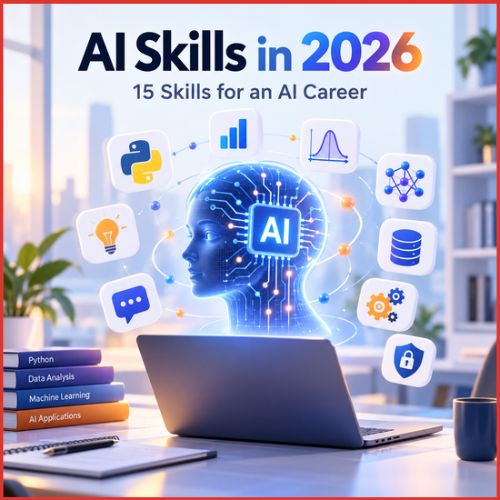
Here are 15 AI skills worth developing.
1. AI and machine learning fundamentals
Before learning advanced AI tools, understand the ideas underneath them. You should know what artificial intelligence means, how machine learning differs from traditional programming, what training data does, and why models sometimes produce incorrect results.
You do not need to begin with advanced mathematics. Start with concepts such as supervised learning, unsupervised learning, classification, regression, neural networks, training, inference, overfitting and model evaluation.
These ideas give you a framework for understanding new technologies when they appear. Someone who understands the fundamentals can usually learn a new AI system faster than someone who has memorised how to use one particular platform.
2. Python programming
Python remains one of the most useful programming languages for people working in artificial intelligence. It is widely used for data analysis, machine learning, experimentation and AI application development, and its large ecosystem also gives learners access to libraries and frameworks used across the field.
A beginner should first become comfortable with variables, functions, loops, data structures, files and error handling. After that, libraries such as NumPy, pandas and scikit learn provide a useful path into data work and machine learning.
You do not need to become a software engineer before touching AI. But if you want to build AI systems rather than simply use them, programming eventually becomes difficult to avoid.
3. Statistics and probability
AI depends heavily on data, and data is rarely as clean or certain as people would like. Statistics helps you understand whether a pattern is meaningful, whether a model is performing well and how uncertainty should be interpreted.
Useful areas include probability, distributions, averages, variance, correlation, sampling, hypothesis testing and basic statistical inference.
These subjects may seem less exciting than generative AI applications. They become much more important when a model produces an unexpected result and you need to work out whether the problem is in the data, the model or your assumptions.
For many AI roles, a working understanding of statistics is more valuable than memorising a long list of AI tools.
4. Mathematics for AI
Mathematics becomes increasingly important as you move deeper into technical AI work. Linear algebra helps explain vectors, matrices and many of the operations used in machine learning, calculus is important for understanding optimisation and how models learn, and probability provides the foundation for reasoning about uncertainty.
You do not necessarily need the same mathematical depth as an AI researcher. The requirement depends on your career path.
An AI researcher may need advanced mathematics, while an AI application developer may need enough mathematics to understand the behaviour of the models and systems being used.
The useful approach is to learn mathematics alongside practical AI work instead of treating it as a separate academic exercise.
5. Data handling and data analysis
AI systems are only as useful as the information they receive and the way that information is prepared, which makes data skills important across almost every AI career.
You should know how to collect, clean, organise and inspect data. You should also understand missing values, duplicate records, inconsistent formats and basic data quality checks.
For practical work, learn tools such as spreadsheets, SQL and Python based data analysis.
SQL deserves particular attention. Many business AI applications depend on information stored in databases, and knowing how to retrieve the right data is a valuable skill even when you are not building the model yourself.
A person who can connect an AI system to useful business data is solving a different problem from someone who can simply generate a response from a language model.
6. Generative AI literacy
Generative AI is now relevant far beyond specialist AI teams. Professionals in marketing, finance, software development, customer support, research and operations may encounter systems that generate text, images, code, audio or other forms of content.
AI literacy means understanding what these systems can do, where they tend to fail and how to use them responsibly.
LinkedIn has reported strong growth in AI literacy as a workplace skill, while also noting rising demand for large language model proficiency in more technical roles.
A useful AI professional should be able to look at a generative AI tool and ask practical questions. What information does it need? How reliable is its output? What should be checked by a person? Can sensitive information be entered safely? Where does the tool save time, and where does it create additional work?
Those questions matter more than simply knowing how to open an AI application.
7. Prompt design
Prompting is useful, but it is often misunderstood.
Good prompt design is not about collecting hundreds of clever phrases. It is about communicating the task, context, constraints and desired result clearly enough for an AI system to produce useful work.
A strong prompt may specify the audience, source material, objective, format, limitations and evaluation criteria.
For example, asking an AI system to “write a business report” leaves many important decisions unanswered. A better instruction might define the target audience, provide the underlying data, explain the business question and specify what the final report needs to contain.
As AI systems become better at interpreting ordinary instructions, the value of elaborate prompt tricks may decline. The durable skill is clearer thinking about the task itself.
8. Machine learning model development
If you want a technical AI career, you will eventually need to understand how models are developed and evaluated. That includes selecting an appropriate model, preparing training data, splitting datasets, training the model, tuning relevant parameters and evaluating performance.
You should also understand the difference between training performance and performance on unseen data. This is where concepts such as overfitting, underfitting, precision, recall and accuracy become practical rather than theoretical.
Not every AI professional needs to train models from scratch. For machine learning engineers and data scientists, however, model development remains a core technical skill.
9. AI evaluation and testing
Building an AI system is only part of the job. You also need to know whether it works.
Evaluation is especially important for generative AI because a response can sound convincing while still being incorrect.
A useful AI professional should be able to define what good performance means before judging the system. For a customer service application, that might include factual accuracy, response time, appropriate escalation and customer satisfaction. For a coding assistant, it could involve whether the generated code works, passes tests and follows the required security standards.
Evaluation turns a vague claim such as “the AI seems good” into something a business can actually measure.
10. Data engineering and AI infrastructure
As AI systems move from experiments into production, the surrounding infrastructure becomes important. Data has to move between systems, models need computing resources, applications need storage, monitoring and security, and information may have to be retrieved from databases or company documents before an AI system can respond.
This creates demand for people who understand the technical environment around AI. Useful areas include databases, APIs, cloud platforms, data pipelines, version control, containers and basic system architecture.
You do not have to master all of them at once. For a beginner, understanding how an AI application connects a model, data source and user interface is a good starting point.
11. Retrieval augmented generation
Many businesses do not want an AI system relying only on information learned during model training. They want it to work with company documents, product information, policies, databases or other controlled sources.
Retrieval augmented generation, commonly called RAG, is one approach to this problem. In a RAG system, relevant information is retrieved from an external knowledge source and provided to the model when generating a response.
Understanding this architecture is useful for people building enterprise AI applications. It also teaches an important lesson about AI development: the model is only one part of the system, and the quality of the information around the model can have a major effect on the final result.
12. AI automation and workflow design
Businesses rarely adopt AI simply because a model is impressive. They adopt it when it improves a process, which makes workflow design an increasingly useful AI skill.
Consider a customer support department. An AI system could classify incoming requests, retrieve account information, draft responses and send complicated cases to a human employee.
The difficult part is not necessarily generating the response. It is deciding where AI should enter the process, what information it should access, when a person should intervene and how the result should be checked.
People who understand both AI and business processes can therefore occupy an important position between technical teams and business departments.
13. AI security and responsible AI
More capable AI systems also create new security and governance problems. AI professionals need to understand issues such as data privacy, access controls, prompt injection, model misuse, biased outputs and insecure integrations.
Responsible AI is not simply an ethics topic reserved for policy teams. It becomes a practical engineering concern when an AI system handles customer information, internal documents or business decisions.
The World Economic Forum’s skills research also places networks and cybersecurity among the fastest growing skill areas, alongside AI and big data. For people building AI applications, basic security knowledge can therefore complement technical AI expertise.
14. Analytical and problem solving skills
This may be the most underestimated skill on the list.
AI development involves plenty of technical knowledge, but the starting point is usually a problem. A company may say it wants to “use AI.” That is not yet a useful specification.
The better questions are more specific. Where is time being lost? Which decisions are repetitive? Which tasks require employees to search through large amounts of information? Where do errors occur? What would improve if the process became faster?
Analytical thinking helps turn a vague request into a problem that can actually be solved.
The World Economic Forum ranks analytical thinking as the leading core skill identified by employers and expects it to remain important alongside AI and big data. This is one reason a person with strong reasoning skills can remain valuable even as AI tools become easier to use.
15. Communication and collaboration
AI is not developed in isolation. A machine learning engineer may need information from a product manager, a data scientist may need to explain findings to a business team, and an AI consultant may have to understand what a client actually wants before recommending a solution.
Technical ability alone does not solve those problems. You need to explain complex ideas without hiding behind technical language, you need to ask useful questions, and you also need to listen when a business user says that a technically impressive solution is not practical.
The workplace is becoming more technical, but that does not make communication less important. In fact, the opposite may be true.
The World Economic Forum lists leadership, social influence, creative thinking, resilience and collaboration related capabilities among the skills expected to remain important as technology changes.
Which AI skills should beginners learn first?
Trying to learn all 15 skills simultaneously is a good way to make very little progress. A better approach is to build a foundation and then specialise.
For someone with little technical experience, a sensible starting sequence is: AI fundamentals → Python → data analysis → statistics → generative AI → machine learning → AI application development.
Once the foundation is in place, choose skills according to the career you want.
If you want to become a machine learning engineer
Prioritise Python, mathematics, statistics, data structures, machine learning, model evaluation, data engineering and cloud infrastructure.
If you want to become a data scientist
Focus on statistics, Python, SQL, data analysis, machine learning, visualisation and business problem solving.
If you want to work in generative AI
Learn AI fundamentals, large language models, prompt design, evaluation, RAG, APIs, workflow design and responsible AI.
If you want to work in AI product management
You do not need to become a machine learning researcher. Focus instead on AI fundamentals, product thinking, data literacy, evaluation, workflow design, communication and business analysis.
If you want to work with AI without becoming a programmer
Start with AI literacy, prompt design, workflow analysis, data literacy, evaluation and communication. You can then learn enough technical concepts to work effectively with engineers and AI platforms.
Do you need a computer science degree for an AI career?
Not for every AI role.
A computer science, mathematics, statistics or engineering background can make the technical path easier, particularly for research and engineering positions. But the AI job market includes roles that combine technology with business, design, operations, marketing, research and product development.
The more technical the role, the more technical knowledge you will generally need. Someone aiming to develop machine learning systems cannot avoid programming and mathematical foundations simply because AI tools are becoming easier to use.
On the other hand, a professional using AI to redesign business workflows may gain more from domain knowledge and process analysis than from advanced calculus.
The useful question is not “Do I have the right degree?” It is “What job do I want, and what skills does that job actually require?”
Are AI tools replacing the need to learn AI skills?
They are changing what people need to learn. That is different from eliminating the need to learn.
AI coding tools can generate code, AI assistants can explain statistics, and generative systems can create prompts and improve written instructions. Those capabilities make some parts of learning faster, but they do not remove the need to understand whether the output is correct.
This distinction is becoming important as companies integrate AI into everyday work. For example, Wipro said in September 2026 that it had trained more than 100,000 employees in advanced AI skills while moving toward a broader human and AI operating model.
The practical lesson for job seekers is simple: learn to work with AI rather than competing with it at tasks that AI can already perform cheaply.
Know enough to check its work. Know enough to improve the process. And, where possible, know enough to build the system yourself.
How to build AI skills without getting overwhelmed
AI is a large field. Trying to learn everything can quickly become counterproductive.
Start with one project. For example, build a simple system that analyses a dataset and produces a useful business report. Then connect it to an external data source. Later, add an AI component and evaluate its results.
Each stage introduces another skill.
You can also choose a problem related to an industry you already understand. Someone interested in finance could build a financial document analysis project, a marketing student might analyse campaign data, and a software developer could create an AI powered code review tool.
The project gives the technical skills a reason to exist. That matters because employers generally care about what you can do with your knowledge, not simply how many online courses you have completed.
What matters more: AI tools or AI fundamentals?
Tools change quickly. The underlying concepts move much more slowly.
A particular model, framework or AI application may become less popular within a few years. The principles behind data preparation, model evaluation, programming, statistics, system design and problem solving are considerably more durable.
This is also why evergreen AI career advice should avoid telling readers to master a fixed list of products.
Learn the concept. Use the current tools to practise it. When the tools change, transfer the knowledge.
That approach requires more effort at the beginning, but it produces a stronger professional foundation.
The future of AI careers
The AI job market will continue to change as companies learn where these systems actually create value.
Some jobs will become more automated. Others will acquire new responsibilities. Entirely new roles may appear around AI implementation, evaluation, governance and workflow design.
The World Economic Forum estimates that 39% of workers’ existing skill sets could be transformed or become outdated between 2025 and 2030, while AI and big data rank among the fastest growing skill areas. It also expects human capabilities such as analytical thinking, creative thinking and adaptability to remain important.
That combination is worth paying attention to.
The strongest AI professionals are unlikely to be defined only by their ability to operate the latest model. They will understand technology, but they will also understand problems.
They will know when an AI system should be used, when it should not be used and how its output should be checked. They will keep learning as the field changes.
Final takeaway
There is no single “AI skill” that guarantees a career in artificial intelligence.
The field needs programmers, data scientists, researchers, engineers, product managers, analysts, security specialists and professionals who understand how AI can be applied inside particular industries.
That is why the best strategy is not to chase every new AI tool. Build a foundation first.
Learn programming and data if you are pursuing a technical role. Develop statistics and mathematics as your work demands them. Understand generative AI and learn how to evaluate its output. Then add workflow design, security, communication and business problem solving.
The tools will change. The ability to understand a problem, work with data, build or use an AI system and judge the result will remain useful.
For anyone planning an AI career, that is a much safer investment than simply learning whatever happens to be popular this month.
Frequently asked questions about AI skills in 2026
What are the most important AI skills to learn?
The most useful skills depend on the role, but AI fundamentals, programming, data analysis, statistics, generative AI literacy, model evaluation, problem solving and communication provide a strong foundation.
Is Python necessary for an AI career?
Python is highly useful for technical AI careers, particularly machine learning, data science and AI application development. It is less essential for roles such as AI product management, AI consulting and some business focused AI positions.
Do I need mathematics to work in artificial intelligence?
The amount of mathematics required depends on the job. AI research and machine learning engineering require considerably more mathematics than many applied AI roles. Basic statistics and quantitative reasoning are useful across the field.
Is prompt engineering still a useful AI skill?
Prompt design remains useful for working effectively with generative AI. However, it should not be treated as a substitute for broader AI knowledge. Understanding the task, providing useful context and evaluating the output are more durable skills than memorising prompt formulas.
Can I get an AI job without a computer science degree?
Yes, depending on the role. Technical positions usually require substantial programming, mathematics and machine learning knowledge. Other AI careers can combine AI knowledge with business, communication, product, design, research or industry expertise.
How long does it take to learn AI skills?
There is no fixed timeline. Someone learning AI literacy for their current job can make useful progress within weeks. Becoming capable of developing production machine learning systems can take considerably longer and requires sustained practice.
Should I learn machine learning or generative AI first?
For a technical machine learning career, start with programming, mathematics, statistics and machine learning fundamentals. For an applied generative AI career, you can begin with AI fundamentals and generative AI tools, then move into APIs, evaluation, retrieval and workflow design.
Which AI skills will remain valuable as AI tools improve?
Foundational skills are generally more durable than knowledge of a particular tool. Programming, statistics, data analysis, system design, analytical thinking, evaluation, communication and understanding business problems should remain useful even as AI platforms change.