A garment exporter in Tiruppur got a call from her biggest client this March: no Udyam number, no purchase order. Not because the client suddenly developed a fondness for paperwork. Section 43B(h) of the Income Tax Act now blocks a company’s tax deduction on dues owed to unregistered small suppliers, so buyers everywhere started asking vendors for proof of MSME status before signing anything. A document that used to sit in a drawer became a condition of doing business.
That document is the Udyam Registration Certificate, and the process behind it has quietly become one of the more consequential pieces of MSME registration India has rolled out in the last decade. Getting an MSME certificate is free, entirely online, and on paper takes fifteen minutes. In practice, founders still get tripped up on classification, GSTIN mismatches, and PAN-linked errors that stall an Udyam registration online application for weeks. This piece walks through what the Udyam Registration Certificate actually does, how the Udyam registration process works step by step, and where businesses commonly lose time trying to figure out how to register MSME status correctly.
MSMEs already carry outsized weight in the economy. The sector contributes 30.1% of India’s GDP, 35.4% of manufacturing output, and 45.73% of exports, the Ministry of MSME told reporters in July 2025. Uttar Pradesh and West Bengal alone account for 12% and 11% of all Udyam registrations nationally, according to industry data from May 2025, which is one reason so many founders across Uttar Pradesh are working through MSME registration India right now.
What Is a Udyam Registration Certificate?
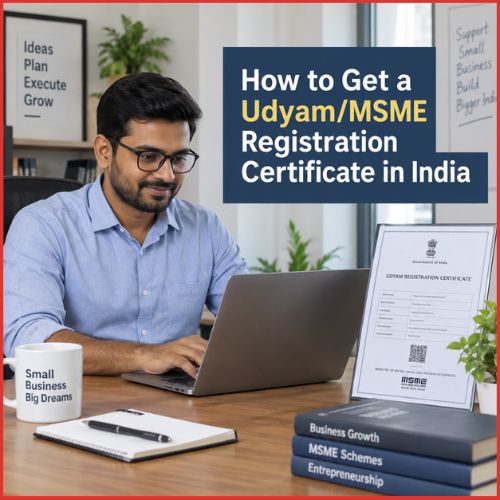
Strip away the acronyms, and it’s simple. The Udyam Registration Certificate is the government’s formal acknowledgment that your business qualifies as a Micro, Small, or Medium Enterprise under the MSMED Act, 2006. Run a boutique design studio in Lucknow with a modest turnover, or a components manufacturer outside Pune with ten crore in equipment, both get the same kind of MSME registration certificate: a unique Udyam Registration Number (URN), a downloadable e-certificate with a QR code, and a permanent digital identity that plugs into GST, income tax, and government procurement systems.
It replaced the old Udyog Aadhaar Memorandum system in July 2020. Udyog Aadhaar is dead for benefit purposes now; anyone still holding one needs to migrate to Udyam registration online to keep accessing MSME certificate benefits.
How the Udyam Registration Process Works
Step 1: Confirm You Actually Qualify
Classification runs on two numbers: investment in plant, machinery, or equipment, and annual turnover, and both have to sit within the band, not just one. Cross either ceiling, and you move up a tier automatically; you only move down once you fall below both limits. The Ministry of MSME raised every threshold sharply, effective April 1, 2025: Micro now caps out at ₹2.5 crore investment and ₹10 crore turnover, Small runs up to ₹25 crore and ₹100 crore, and Medium stretches to ₹125 crore and ₹500 crore. Export turnover doesn’t count toward the ceiling, so an export-heavy small manufacturer gets more room than the raw revenue number suggests. Anyone researching how to register MSME status should check they’re working off the current, post-2025 numbers; a lot of older guides still quote the ₹1 crore / ₹5 crore micro band.
Step 2: Register on the Portal
Head to the official Udyam registration portal, not one of the many lookalike sites that charge a “processing fee” for something the government gives away free. For a fresh registration, the proprietor, managing partner, or authorised signatory enters their Aadhaar number, verifies it by OTP, then supplies PAN and GSTIN. No documents get uploaded. The whole Udyam registration process runs on self-declaration cross-checked later against your PAN and GST filings, which is exactly why the numbers you enter need to match what’s already on those records before you start the MSME registration online journey.
Step 3: Wait Out the Verification Window
The URN itself is issued almost instantly. The certificate PDF, complete with QR code and digital signature, can take a few hours to a couple of days while the system reconciles your declared figures against Income Tax and GST data. It’s common to see “classification pending” during this window that’s not a rejection, and the URN already works for most practical purposes while the MSME certificate clears.
Step 4: Keep the Certificate Current
Udyam registration carries lifetime validity, but the numbers behind it don’t stay static. Investment and turnover figures need annual updates through the portal, since a business that outgrows its bracket gets reclassified usually a good problem, but one that changes which schemes still apply to your MSME registration certificate.
| Category | Investment Limit (Plant, Machinery or Equipment) | Turnover Limit |
| Micro Enterprise | Up to ₹2.5 crore | Up to ₹10 crore |
| Small Enterprise | Up to ₹25 crore | Up to ₹100 crore |
| Medium Enterprise | Up to ₹125 crore | Up to ₹500 crore |
Who Actually Uses This Certificate
Manufacturers and service providers form the bulk of registrations, but the eligibility net is wider than most founders assume. Freelancers and consultants operating as sole proprietors qualify for MSME registration certificate status. So do retail and wholesale traders, brought under Priority Sector Lending eligibility since July 2021. E-commerce sellers, whether product-based or service-based, register too through the same Udyam registration online system.
The certificate matters differently depending on who’s asking for it. A bank wants it before extending a Credit Guarantee Trust Fund-backed loan. A large corporate buyer wants it to stay compliant with Section 43B(h). The Government e-Marketplace wants it before letting a seller claim the purchase preference reserved for MSMEs. Same paper, three different gatekeepers.
How to Apply for Udyam Registration: A Practical Framework
Gather Aadhaar, PAN, and GSTIN details before opening the portal; that alone saves the second half of most stalled applications. Cross-check turnover and investment figures against your last filed GST return and ITR so the self-declaration doesn’t trigger a mismatch flag. Register directly on the official government portal, never through a third-party site asking for advance payment. Download the certificate once issued, and calendar a reminder to revisit the portal every financial year to update figures. If your Udyam Registration Certificate sits in “pending classification” beyond a week, that’s usually a data mismatch worth chasing down directly rather than waiting out.
How to Download the Udyam Registration Certificate
Registration doesn’t hand you a PDF right away. You go back to the portal, log in, and pull the MSME certificate yourself.
To access it, you’ll need:
- Your Udyam Registration Number
- The mobile number you registered with
- An OTP sent to that number for verification
Once you’re in, the certificate itself carries:
- Udyam Registration Number
- Enterprise name
- Organisation type
- Major activity
- Enterprise category (micro, small, or medium)
- Date of incorporation
- Date of commencement
- Official business address
- Plant/unit information
- NIC codes
- Date of Udyam Registration
That’s the exact set the government’s own verification page lists – if a certificate you’re checking is missing half of these, treat it as a red flag.
One thing trips people up: lose access to the mobile number linked at registration, and downloading the certificate gets a lot harder. Worth keeping that number active, or updating it on the portal the moment it changes.
Benefits and Opportunities
Collateral-free credit through CGTMSE, up to ₹5 crore in many cases, tops most founders’ list once they complete MSME registration in India. But the quieter benefits compound over time: a 50% rebate on trademark and patent filing fees, EMD exemption on government tenders, a 25% procurement reservation on GeM, and the 45-day payment protection under the MSMED Act that gives micro and small suppliers actual legal recourse against a slow-paying buyer. None of this happens automatically – a business has to know these levers exist and use them once the Udyam Registration Certificate is in hand.
Factors to Consider Before You Register
Match your declared investment and turnover to what your GST returns and ITR already show – mismatches are the single biggest reason Udyam registration online applications stall in “pending” status. Decide your classification honestly rather than optimistically; claiming Micro status while your turnover already reads Small invites scrutiny later, not a benefit now. And if you’re a trading business, note that classic trading activity sits outside Udyam’s manufacturing-and-services scope in most reads of the rules, though retail and wholesale trade got a specific carve-in for lending purposes.
Common Mistakes and Risks
The most expensive mistake is paying anyone for something free. Dozens of lookalike domains charge ₹500 to ₹2,000 for “assisted registration” on a portal that costs nothing directly through the government. The second mistake is entering a mobile number not linked to Aadhaar, which kills OTP verification before the MSME registration certificate application even starts. The real risk sits further out: letting the annual update lapse. A business that crosses into a new turnover bracket but never updates Udyam keeps operating on stale classification, which can mean forfeiting scheme eligibility it’s actually earned, or worse, holding benefits it’s no longer entitled to.
Conclusion
The Udyam Registration Certificate has moved from a nice-to-have to something closer to a business passport. What began as a lending and subsidy tool now decides which vendors get onboarded, which sellers can bid on GeM, and which invoices can move through TReDS for faster cash. Founders who treat MSME registration online as a fifteen-minute afterthought rather than infrastructure tend to be the ones scrambling when a client suddenly asks for a URN before releasing a purchase order. Get the classification right, keep the figures current, and the MSME registration certificate does its job quietly in the background right up until the day a buyer, bank, or tender makes it the difference between winning the deal and losing it.
Frequently Asked Questions
1. Is Udyam Registration mandatory for every small business in India?
No. It isn’t legally compulsory to operate a business without it. But it has become functionally necessary for priority-sector lending, GeM tenders, TReDS financing, and staying compliant with Section 43B(h) if you supply to large corporates.
2. How long does the Udyam registration process take?
The Udyam Registration Number is usually issued within minutes of submitting Aadhaar and PAN details. The downloadable MSME certificate can take a few hours to a couple of days while the system verifies figures against GST and Income Tax records.
3. Does Udyam Registration expire or need renewal?
No. It carries lifetime validity once issued. However, businesses must update turnover and investment figures annually on the portal, and reclassification happens automatically if those numbers cross into a new bracket.
4. Can freelancers and service providers apply for an MSME registration certificate?
Yes. Freelancers, consultants, and other sole proprietors offering services qualify, provided their investment and turnover fall within the Udyam thresholds for their category.
5. What’s the difference between Udyog Aadhaar and Udyam Registration?
Udyog Aadhaar was the pre-2020 system; it carries zero validity now for schemes or benefits. Businesses still holding a Udyog Aadhaar Memorandum need to migrate to Udyam registration online to keep accessing government support.
6. Is there any government fee to register MSME status?
No. Registration on the official portal is entirely free. Any site charging a fee for registration itself, rather than for optional advisory support, is not the official government portal.