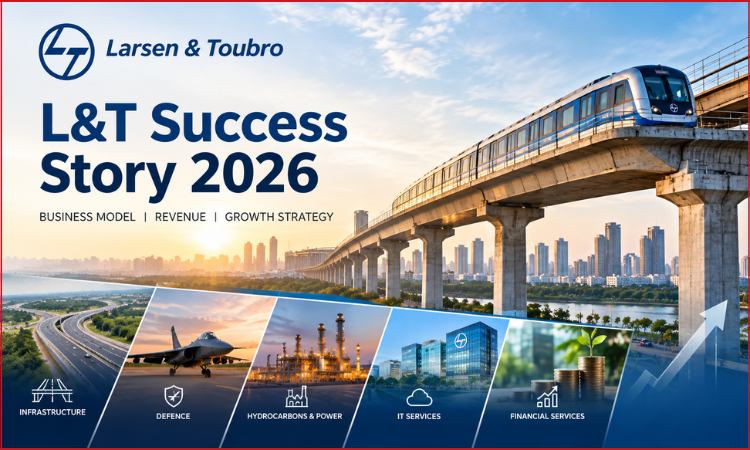
Two Danish engineers landed in Bombay in the 1930s to sell dairy machinery, and then World War II cut off their supply of imported parts overnight. Henning Holck-Larsen and Søren Kristian Toubro had two choices: shut the small trading office or start building the equipment themselves. They chose the second, and that decision became the opening chapter of what is now one of India’s most closely studied industrial conglomerates.
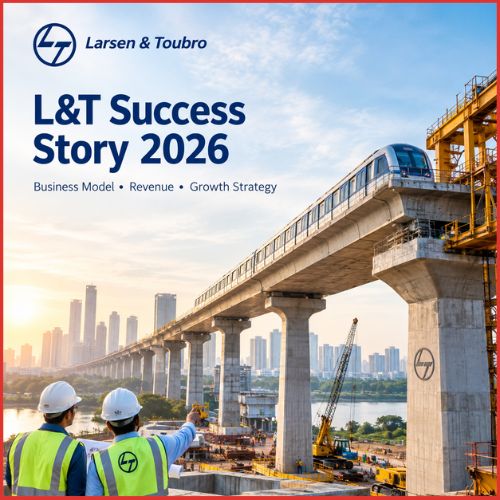
This L&T Success Story 2026 traces how a wartime pivot from importing to manufacturing turned into a ₹7,40,327 crore order book eight decades later. The founders’ names still sit on the letterhead, but the business they run today spans infrastructure, defence, hydrocarbons, IT services and financial services sectors neither man could have imagined from a one-room office in Ballard Estate.
It is how the company kept re-adapting its business model every decade from ship repair to cement plants to metro rail to defence manufacturing – without losing the engineering-first culture the founders set up. What follows is a business breakdown: the model, the numbers, the strategy calls that worked, and the ones that did not.
Quick Glance
| Field | Detail |
| Founders | Henning Holck-Larsen and Søren Kristian Toubro |
| Company | Larsen & Toubro Limited (L&T) |
| Founded | 1938 (incorporated 1946, listed 1950) |
| Sector | L&T engineering and construction, infrastructure, defence, IT, financial services |
| Key Stat | Consolidated order book of ₹7,40,327 crore as of March 2026 |
| Current Status | India’s largest engineering and construction group; Chairman & MD S N Subrahmanyan |
The Early Journey
Holck-Larsen arrived in India in 1937 as a chemical engineer posted by the Danish firm FLSmidth. Toubro, a college friend from Denmark, joined him soon after. The Larsen & Toubro history that most profiles skip past starts here – two employees on a foreign posting who decided to build something of their own on the side.
- 1938: Set up a small partnership office in Ballard Estate, Mumbai, to represent Danish dairy and machinery makers.
- 1939: World War II cut off European imports, forcing the founders to manufacture equipment locally instead of trading it.
- 1940s: Took up ship repair work at Bombay docks, building the engineering base that later defined the company.
- 1946: The partnership was formally incorporated as Larsen & Toubro Limited.
- 1950: L&T went public, raising capital that funded its first heavy engineering plants.
There was no dramatic pitch deck or venture round involved. Growth came from taking on jobs too complex for smaller local contractors, then reinvesting the margins into new capability.
Building The Business: The L&T Business Model
Diversified Project Portfolio
The L&T business model rests on running several distinct businesses under one balance sheet: infrastructure EPC, hydrocarbons, power, defence manufacturing, IT services, and financial services. Each division absorbs a different part of the economic cycle, so a slump in one sector rarely drags the whole group down. Infrastructure remains the single largest contributor to the L&T infrastructure business, spanning roads, metro rail, buildings, and water projects.
Revenue Model
Most income comes from executing large, multi-year engineering, procurement and construction contracts rather than one-off product sales. Financial services and IT arms add fee-based, recurring income that smooths out the lumpiness of construction billing. Standalone total income for FY2026 stood at ₹1,61,038.62 crore, up 8.68% over the previous year, per L&T’s FY2026 annual report.
Growth Strategy
L&T’s growth strategy leans on winning large international contracts, particularly in the Middle East, while defending its dominant position in Indian infrastructure. International orders made up 58% of the year’s total order inflow in FY2026, as reported by realtynmore.com (2026). The company has paired this expansion with a parallel move to exit low-return concession assets it had held for years.
Growth & Turning Points
| Year | Milestone |
| 1946 | Partnership incorporated as Larsen & Toubro Limited |
| 1950 | Company lists on Indian stock exchanges, funding expansion into heavy engineering |
| 1990s–2000s | Diversifies into IT services, financial services and infrastructure development as India liberalises |
| 2020s | Pivots toward high-value EPC and defence manufacturing, divesting non-core concession assets |
| FY2026 | Consolidated order book hits an all-time high of ₹7,40,327 crore, up 28% year-on-year (Business Today, 2026) |
Order inflow for FY2026 climbed 22% to ₹4,35,590 crore, and consolidated revenue rose 12% to around ₹2.86 lakh crore, according to Tradebrains (2026). That combination of L&T revenue growth and record order intake gave management enough confidence to call FY2026 the close of its ‘Lakshya ’26’ strategic plan.
L&T Chairman S N Subrahmanyan credited the numbers to a dual-market strategy: a strong domestic base paired with aggressive overseas bidding. It is a framing that doubles as a one-line insight for anyone studying L&T’s business strategy scale at home funds risk-taking abroad.
A conglomerate survives long cycles not by avoiding risk, but by spreading it across businesses that rarely slow down together.
Challenges And Setbacks
The conflict in West Asia disrupted several overseas project sites through FY2026, delaying execution schedules and pushing up input and logistics costs. L&T has told analysts it expects the disruption to weigh on results into the first half of FY2027 (TradingView, 2026).
Core operating margins came in at 8.3% for the year, short of the 8.5% guidance management had set earlier – a gap the company attributed to cost escalations even before the regional conflict added further pressure (TradingView, 2026).
L&T also exited two assets it had operated for years: it sold its Hyderabad Metro stake back to the Telangana government for ₹1,461 crore and divested the Nabha Power plant to Torrent Power for ₹6,889 crore, including debt. Holding onto capital-heavy concessions for too long had tied up cash that could otherwise fund higher-return EPC bidding – a reminder that knowing when to exit a legacy business matters as much as knowing when to enter one.
Key Takeaways
- A conglomerate structure only works if divisions genuinely diversify risk, not just add revenue lines on paper.
- Reinvesting margins into new capability mattered more than raising outside capital in L&T’s earliest decades.
- International contracts now decide the pace of L&T revenue growth more than the domestic order book alone.
- Exiting long-held concession assets can free up more value than continuing to operate them.
- A margin guidance miss is worth watching even in a year when headline order books hit records.
- An engineering-first culture, not capital alone, is what let L&T outlast the businesses that started alongside it in the 1930s.
Conclusion
Founders’ names on a letterhead rarely survive eight decades of Indian industrial history, let alone keep growing through them. What sustained the Larsen & Toubro business model was less about any single contract and more about refusing to stay a one-sector company. From engineering and construction to infrastructure, defence, technology and financial services, L&T continued to adapt its business model as India’s economy and industrial needs changed.
Over the decades, this ability to diversify, build new capabilities and take on complex projects has helped L&T become one of the most valuable Indian brands. Its growth also shows how an engineering-first culture, disciplined expansion and the willingness to exit businesses that no longer fit the strategy can support long-term success.
Investors and operators studying conglomerates elsewhere in 2026 can take a similar lesson from L&T: build businesses that do not share the same downturn, continuously invest in capabilities that create long-term value, and be willing to exit the ones that no longer earn their place on the balance sheet.
Frequently Asked Questions
1. What is L&T’s core business model?
L&T operates as a diversified engineering and construction conglomerate, running infrastructure, hydrocarbons, defence, IT services and financial services under one group. This spread is central to the L&T business model, since a slowdown in one sector rarely affects all divisions at once.
2. Who founded Larsen & Toubro and when?
Danish engineers Henning Holck-Larsen and Søren Kristian Toubro set up the partnership in Mumbai in 1938, and it was formally incorporated as Larsen & Toubro Limited in 1946.
3. How large is L&T’s order book in 2026?
The consolidated order book hit an all-time high of ₹7,40,327 crore as of March 31, 2026, up 28% year-on-year, with international orders making up more than half the total.
4. What risks does L&T face going into FY2027?
Ongoing disruption from the West Asia conflict is expected to affect execution schedules and costs into the first half of FY2027, and core operating margins have already come in below the company’s own guidance.