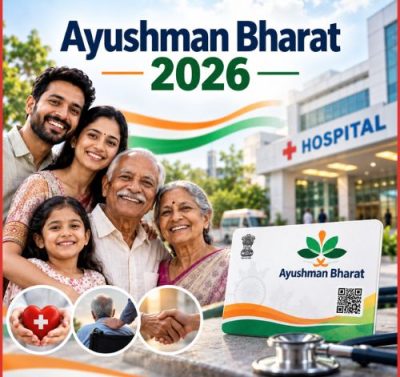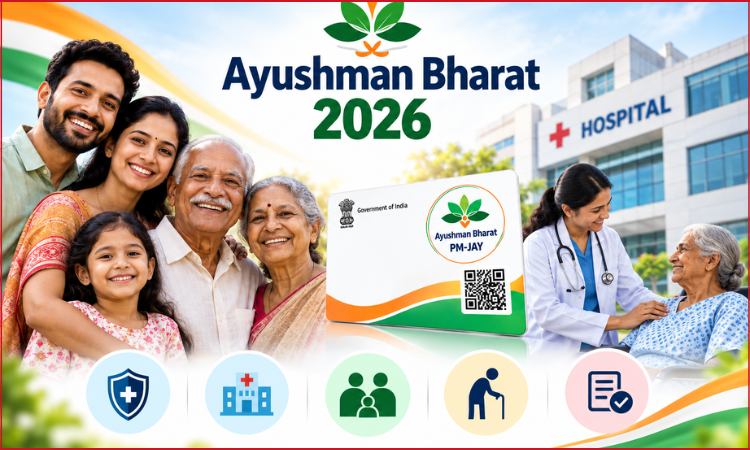
A hospital bill can undo years of savings in a matter of days – that’s the exact problem Ayushman Bharat was built to solve. If you’ve landed here because a family member needs hospital care and you’re wondering whether you qualify for free treatment, or because you keep hearing about the scheme on the news and want to understand it properly, this is meant to answer both. Ayushman Bharat 2026 continues to be India’s largest government-funded health cover, offering ₹5 lakh a year per family for hospitalisation, and this year brought a genuinely significant change: every citizen aged 70 and above is now covered, regardless of income. This article walks through Ayushman Bharat eligibility in plain terms, what an Ayushman Card actually gets you, and the exact steps to apply whether online through the portal or offline at a local centre.
What Is Ayushman Bharat?
Ayushman Bharat is the umbrella name for a health scheme launched by the Government of India in September 2018, and its core insurance component is officially called the Pradhan Mantri Jan Arogya Yojana, or PM-JAY. Most people use “Ayushman Bharat” and “PM-JAY” interchangeably; they refer to the same benefit.
At its heart, PM-JAY provides cashless and paperless hospitalisation cover of up to ₹5 lakh per family, per year, for secondary and tertiary care – surgeries, cancer treatment, cardiac procedures, and other conditions serious enough to need admission. There’s no cap on family size or age, and the amount isn’t fixed per person; it’s a shared pool the whole family can draw from. The scheme is implemented by the National Health Authority, and treatment is available at both government and empanelled private hospitals – currently well over 30,000 across the country, with more being added regularly.
Who Is Eligible for Ayushman Bharat 2026?
Ayushman Bharat eligibility isn’t based on your current income slip it’s largely determined by the Socio-Economic Caste Census (SECC) of 2011, which identified deprived households across rural and urban India. This surprises people: even if you consider yourself lower-middle-income today, you may not be on the list if your household wasn’t flagged as deprived back in 2011, and some families who’ve since improved their situation are still technically covered.
Broadly, a household is likely eligible under the rural criteria if it falls into categories such as:
● Living in a kutcha house with only one room
● Having no adult member between 16 and 59 years of age
● Headed by a woman with no adult male member in that age bracket
● Including a disabled member with no able-bodied adult earner
● Belonging to a Scheduled Caste or Scheduled Tribe household, or a legally released bonded labourer’s family
● Living without shelter, or as a destitute person dependent on alms
For urban areas, PM-JAY eligibility follows an occupational list instead ragpickers, domestic workers, street vendors, construction labourers, home-based artisans, transport workers, and similar occupational categories are generally covered, among others defined by the scheme.
The Big 2026 Update: Ayushman Vay Vandana for Senior Citizens
The most important recent change to PM-JAY eligibility is the Ayushman Vay Vandana Card, approved for senior citizens aged 70 and above. This one drops the income and SECC criteria entirely – age, verified through Aadhaar, is the only requirement. Seniors already in a PM-JAY-covered family get an additional shared top-up of up to ₹5 lakh a year; seniors in families not otherwise covered get their own separate ₹5 lakh shared cover exclusive to those 70 and above. One catch: a senior citizen already holding CGHS, ESIC, or active private health insurance gets a one-time choice between that scheme and Ayushman Bharat; the two can’t be used together.
Key Benefits of the Ayushman Card
Ayushman Card benefits go beyond the ₹5 lakh figure; the terms attached to that cover are what make it useful in practice.
● Cashless and paperless treatment: no upfront payment; the empanelled hospital settles directly with the scheme.
● Pre-existing conditions covered from day one, with no waiting period, unlike most private health insurance.
● Portability across India: a card issued in one state works at empanelled hospitals in another, useful for migrant workers and relocating families.
● Pre- and post-hospitalisation costs, generally up to 15 days after discharge, are included alongside the hospital stay itself.
● No enrolment fee – applying for and receiving the card is entirely free through official channels.
● Around 24 medical specialities are covered, from cardiology to oncology, across roughly 1,900-plus treatment packages with pre-fixed rates.
How to Apply for Ayushman Bharat: Step-by-Step
Ayushman Bharat registration means checking your eligibility first, then generating your card – either online or with in-person help. Here’s the online route:
- Go to beneficiary.nha.gov.in (or mera.pmjay.gov.in) or open the Ayushman App.
- You will be sent an OTP to your registered mobile number and fill in the captcha.
- Check the OTP and then click on the dropdown menu to select your state.
- Enter the Aadhaar number, ration card number, family ID or HHD number depending on the portal of your state.
- If your name is on the beneficiary list from SECC-2011, select the ‘Family Members’ option to find out what other members of your household are covered.
- Full e-KYC – typically Aadhaar-based face authentication via the app (OTP authentication is available).
- e-KYC ensures that the Ayushman Card is generated digitally and can be downloaded instantly, which is not mandatory to avail the treatment services.
Without internet access, visit a nearby Common Service Centre (CSC), an empanelled hospital’s Pradhan Mantri Aarogya Mitra desk, or call the toll-free helpline at 14555 (also 1800-111-565) – the operator can check eligibility using your Aadhaar or ration card number.
Senior citizens applying under Ayushman Vay Vandana follow a similar process through the dedicated senior-citizen link on beneficiary.nha.gov.in or the Umang app; Aadhaar is typically the only document needed since income proof isn’t required.
Documents You’ll Generally Need
● Aadhaar card (primary identity and age proof)
● Ration card or family ID, if your area uses this for the eligibility search
● A mobile number for OTP verification, ideally linked to Aadhaar
● Income or category proof, in some states, for categories that require it – this generally does not apply to the 70+ Vay Vandana cover
Important Things to Know
● PM-JAY isn’t universal health insurance for every Indian – it targets families identified as vulnerable under SECC-2011, plus the newly added 70+ age group. A modest income alone doesn’t make you automatically eligible.
● Coverage runs on pre-fixed package rates. If a hospital’s actual charge exceeds the scheme’s set rate for a procedure, only the fixed amount is paid – worth confirming before admission.
● A name mismatch between Aadhaar and your ration card or SECC record is one of the most common reasons e-KYC gets stuck in ‘pending’ status.
● Not every treatment is covered – see the exclusions below.
● The scheme doesn’t operate identically in every state; some run their own parallel or supplementary health schemes alongside PM-JAY.
What Ayushman Bharat Does Not Cover
Knowing the boundaries of the scheme avoids surprises during a hospital visit. The following are generally excluded from Ayushman Card benefits:
● OPD consultations, tests, or medicines that don’t involve hospital admission
● Cosmetic and purely aesthetic procedures (reconstructive surgery after burns or trauma may still qualify)
● Fertility treatments, including IVF
● Routine dental work such as fillings, root canals, and implants, unless tied to a covered hospitalisation package
● Drug and substance-abuse rehabilitation programmes
● Individual diagnostic tests taken without a hospital admission
● Treatment received outside India
If a procedure falls into one of these categories, it’s worth checking with the hospital’s Aarogya Mitra desk directly, since coverage details are occasionally updated.
Ayushman Card vs Ayushman Vay Vandana Card: Quick Comparison
| Feature | Regular Ayushman Card (PM-JAY) | Ayushman Vay Vandana Card |
| Who it’s for | Families identified as eligible under SECC-2011 criteria | All citizens aged 70 and above |
| Income criteria | Yes – based on deprivation/occupation category | None – universal, regardless of income |
| Cover amount | ₹5 lakh per family per year (shared) | ₹5 lakh per year, largely separate from the family’s existing cover |
| Overlap with CGHS/ESIC/private insurance | Not applicable in most cases | One-time choice – cannot use both simultaneously |
| Application | mera.pmjay.gov.in, Ayushman App, or CSC | beneficiary.nha.gov.in, Umang app, or CSC |
Common Mistakes to Avoid
● Assuming income alone decides eligibility – it’s SECC-2011 data and occupational category that matter for the standard card, not your current pay slip.
● Letting Aadhaar details drift out of sync with your ration card or family ID – the single biggest cause of applications getting stuck.
● Paying anyone to “fast-track” your Ayushman Card – registration and issuance are completely free through official channels.
● Assuming every nearby private hospital accepts the card – confirm empanelment status before admission, on the portal or with the hospital directly.
● Waiting until a medical emergency to check eligibility, instead of verifying status in advance.
● Forgetting to register senior citizens separately for the Vay Vandana top-up if they aren’t already listed under the household’s existing cover.
Conclusion
Ayushman Bharat 2026 remains one of the most consequential safety nets available to Indian families, and this year’s expansion to cover every citizen aged 70 and above regardless of income has meaningfully widened who it protects. The practical takeaway is simple: don’t wait for a medical emergency to find out where you stand. Check your Ayushman Bharat eligibility today through the official portal or by calling 14555, get your Aadhaar and ration card details aligned if they aren’t already, and register any senior citizens in your family separately for the Vay Vandana cover. A few minutes spent verifying your status now could save your family from a financial crisis later.
Frequently Asked Questions
Is Ayushman Bharat 2026 free to apply for?
Yes. Registration, eligibility checks, and card issuance are entirely free through the official portal, Ayushman App, or Common Service Centres, with no government fee at any stage.
How do I check my Ayushman Bharat eligibility online?
Visit beneficiary.nha.gov.in or mera.pmjay.gov.in, verify your mobile number with an OTP, select your state, and search using your Aadhaar, ration card, or family ID.
Are senior citizens automatically covered under Ayushman Bharat?
Not automatically – they still need to register under the Ayushman Vay Vandana Card scheme using Aadhaar-based verification, even though age above 70 is the only eligibility condition.
Can I use Ayushman Bharat along with my private health insurance?
For most beneficiaries, yes. For the 70+ Vay Vandana cover specifically, seniors with active CGHS, ESIC, or private insurance must make a one-time choice between that scheme and Ayushman Bharat.
What is the maximum Ayushman Card benefit amount?
The standard cover is ₹5 lakh per family per year, shared across all members, with an additional ₹5 lakh top-up available for a senior citizen aged 70 or above.
What if my name isn’t showing up during the eligibility check?
You may not be eligible for the central scheme if you’re not in the SECC-2011 database and don’t qualify under the 70+ category, though some states run supplementary schemes worth checking. A name mismatch between Aadhaar and your ration card can also be the cause.
Do I need a physical Ayushman Card to get treatment?
Not necessarily; the digital e-card generated after e-KYC is generally sufficient at empanelled hospitals, though a printed copy alongside your Aadhaar is a sensible backup.