Leave ₹10 lakh in an SBI savings account and you’ll earn roughly ₹25,000 a year at the current 2.50% rate. Move that same ₹10 lakh to Unity Small Finance Bank, which now pays up to 7% on higher balances, and the number nearly triples which is exactly why comparing savings account rates and hunting down the highest savings rates India has to offer is worth a founder’s or a salaried professional’s time, not just a line item to skim past.
Unity Small Finance Bank pushed select balance slabs as high as 7% per annum starting August 1, 2026 (Unity Small Finance Bank, 2026), and that revision alone has nudged plenty of readers to wonder whether their own bank is quietly underpaying them. It usually is, at least on paper. But headline savings rates 2026 rarely tell the whole story balance slabs, minimum-balance rules, and everyday charges decide how much of that advertised number from any of the high-interest savings accounts on the market you actually see.
Best Savings Account Interest Rates in India 2026
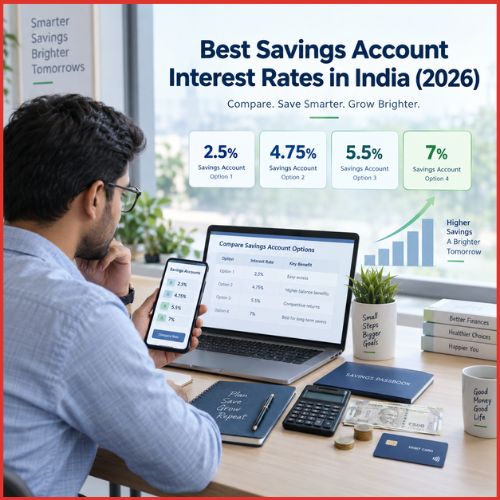
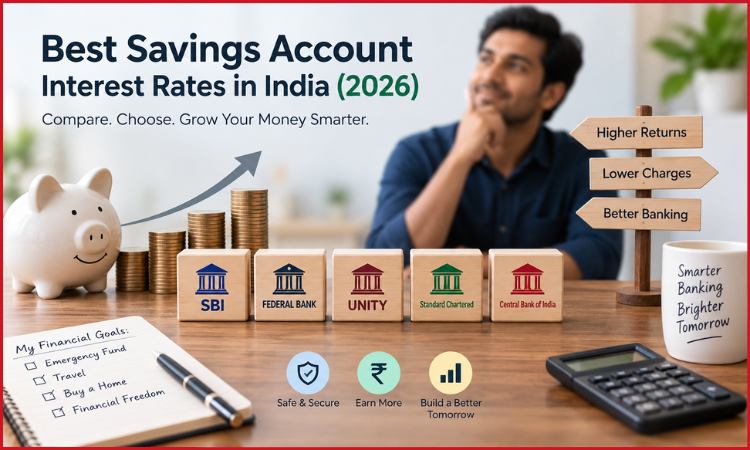
Rates on offer right now stretch from a flat 2.50% at India’s largest public-sector bank to as high as 7% at a small finance bank willing to reward bigger balances. That’s a wide enough spread that where you park your surplus cash can genuinely move your annual interest income, sometimes by thousands of rupees. Below is a quick comparison of standard savings account rates against the higher ones that only kick in once you cross a specific balance a fast way to scan the best savings accounts available today.
| Bank | Interest Rate | Applicable Balance/Slab | Best For |
| Unity Small Finance Bank | 4.5% – 7.00% p.a. | Up to ₹1L: 4.5%; ₹1L–5L: 6%; Above ₹5L: 7% | Highest savings rates India among small finance banks |
| Federal Bank | 2.50% – 5.50% p.a. | Rises with end-of-day balance; Bespoke a/c above ₹3L: 5.00% | Best banks for savings with private-sector digital tools |
| Standard Chartered Bank | 0.50% – 5.00% p.a. | Depends on account type and balance slab (eff. Jan 1, 2026) | High-balance, premium banking customers |
| Central Bank of India | 2.50% – 4.75% p.a. | Slab-based, revised October 2025 | Traditional public-sector banking preference |
| SBI | 2.50% p.a. (flat) | Uniform across all balances | Reliability, branch access, zero minimum balance |
What Is a Savings Account?
At its simplest, a savings account is where most of us park money we might need on short notice rent, groceries, an unplanned repair while earning a little interest along the way. Banks calculate that interest on your daily closing balance and usually credit it every quarter. Keep a steady ₹1 lakh in an account paying 3% and you’d end the year roughly ₹3,000 richer, before you even think about compounding. Beyond interest, though, this is the account doing the heavy lifting day to day: UPI payments, bill pay, ATM runs, salary credits. It’s less an investment and more the working capital of your personal finances which is exactly why savings account rates deserve more scrutiny than most people give them.
How Savings Account Interest Rates Work
Daily Balance Calculation
Most banks look at whatever balance sat in your account at the end of each day, not some average across the month. Pull money out on the 28th and that day’s lower balance is what earns interest, even if you’d carried a fat balance for the previous 27 days. Keep things steady and you come out ahead when it comes to savings account rates.
Balance Slabs
This is where advertised savings rates 2026 get misleading. Take Unity Small Finance Bank: balances up to ₹1 lakh earn 4.5%, the next ₹4 lakh earns 6%, and only money above ₹5 lakh earns the full 7% (Unity Small Finance Bank, 2026). So someone with ₹6 lakh sitting in the account isn’t earning 7% on all of it; they’re earning 4.5% on the first slice, 6% on the middle chunk, and 7% only on the last ₹1 lakh. Do the math before you get excited about a headline number from any high-interest savings accounts list.
Interest Credit Frequency
Quarterly credit is the norm across most Indian banks, though a handful of small finance banks pay out monthly instead. It’s worth checking your own bank’s schedule; monthly credit nudges compounding slightly in your favour, even if the difference is small in absolute terms.
Minimum Balance And Charges
Fall below the required minimum balance and you’ll likely eat a penalty that eats into whatever interest you just earned. Add in ATM charges past the free limit, debit card fees, and SMS alerts, and a high-interest savings account can end up costing you more than it pays. The rate on the homepage rarely accounts for any of this.
Also Read: Home Loan Interest Rates 2026
Top Banks Offering Competitive Savings Account Rates
A closer look at how the best banks for savings in India stack up against each other in 2026 and where each one earns its place on this list.
Unity Small Finance Bank
Right now, Unity Small Finance Bank is hard to beat on paper 7% per annum on balances above ₹5 lakh, following its August 2026 revision (Unity Small Finance Bank, 2026), which currently makes it the benchmark for the highest savings rates India-wide. Interest lands monthly rather than quarterly, which some customers prefer simply because they see it sooner. Being RBI-regulated, deposits here also carry DICGC protection, same as any scheduled bank, making it one of the more credible high-interest savings accounts currently on offer.
Federal Bank
Federal Bank keeps things fairly conventional: 2.50% to 5.50% per annum on resident and NRE/NRO accounts, scaling with whatever balance you hold at day’s end (Federal Bank, 2026). Its Bespoke Savings Account is a bit different cross ₹3 lakh and you start earning 5.00%. Not the flashiest number on this list, but a solid pick among best savings accounts if you want private-sector digital banking without hunting for the absolute ceiling.
Central Bank Of India
Founded in 1911, Central Bank of India is about as old-school public-sector as it gets, and its rates reflect that a slab structure running roughly 2.50% to 4.75% per annum, last revised October 9, 2025 (Central Bank of India, 2026). Customers here are usually optimising for something other than yield: a branch nearby, government backing, decades of familiarity.
Standard Chartered Bank India
Standard Chartered’s savings account rates range from a modest 0.50% up to 5.00% per annum, effective January 1, 2026, with the applicable number depending on account type and balance slab (Standard Chartered Bank, 2026). This one leans toward customers who already carry a sizeable balance and want the premium banking perks that come with it, rather than anyone chasing the single highest rate in the market.
SBI And Other Major Banks
SBI pays a flat 2.50% across every account type and every balance size, unchanged since June 15, 2025 (SBI, 2026), nowhere near the top of any best banks for savings ranking. And yet millions stay put, because branch density, decades of trust, and zero minimum balance requirements count for something that a spreadsheet doesn’t capture.
How To Choose The Best Savings Account In 2026
Comparing savings rates in 2026 is step one, not the whole exercise. A founder with lumpy business receivables needs something different from a retiree who depends on interest income to get through the month. Before switching anything, weigh the rate that actually applies to your balance, minimum balance rules, ATM and debit-card charges, digital banking quality, branch proximity, customer service, and deposit insurance coverage. A framework that actually works: write down your average monthly balance, find where it lands on each shortlisted bank’s slab table, compare the effective rate you’d really earn rather than the number on the ad, then subtract likely charges before ranking any of the best savings accounts you’re considering.
The best savings account is rarely the one with the biggest number on its homepage; it’s the one whose slab matches the balance you actually keep a distinction that separates genuinely high-interest savings accounts from ones that only look that way in an ad.
Savings Account vs Fixed Deposit
These two aren’t really competing for the same job. A savings account is built for access; a fixed deposit is built for return.
| Feature | Savings Account | Fixed Deposit |
| Interest Rate | Typically 2.50%–7% p.a., depending on bank and balance | Typically 6%–8% p.a., depending on tenure and bank |
| Liquidity | High; withdraw anytime | Low; premature withdrawal attracts a penalty |
| Tenure | No fixed tenure | Fixed tenure, from 7 days to 10 years |
| Accessibility | Debit card, UPI, ATM, cheque | Access at maturity, or via loan against FD |
| Suitable Use Case | Daily expenses, emergency fund | Surplus funds, medium to long-term goals |
Anything you might need in the next few weeks stays in a savings account. Money you won’t touch for months, or years, generally earns more sitting in a fixed deposit instead a savings account; even a high-yield one was never designed to compete with locked-in returns.
Common Mistakes When Choosing A Savings Account
The single most common mistake is picking a bank purely because of its headline rate without realising that number often applies to a narrow, high-balance slab most people never reach, a trap that makes plenty of high-interest savings accounts look better on paper than they perform in practice. A close second is glossing over minimum balance rules and service charges the kind of fine print that quietly cancels out a good chunk of the interest you’d otherwise earn over a year.
Tax On Savings Account Interest
Interest from a savings account counts as taxable income under ‘Income from Other Sources.’ Individuals and HUFs who aren’t senior citizens can claim up to ₹10,000 a year under Section 80TTA; senior citizens get a more generous ₹50,000 under Section 80TTB, which also covers deposit interest. Both deductions apply only under the old tax regime, and you can’t claim both. None of this substitutes for personalised tax advice check your own situation before filing.
Conclusion
Picking among the best banks for savings in 2026 comes down to matching a bank’s slab structure to the balance you realistically keep, not memorising headline percentages that mostly don’t apply to you. A founder dealing with unpredictable cash flow, a salaried professional building an emergency fund, and a retiree living off interest all need different answers, and that’s fine. Check your savings account rates once or twice a year, keep an eye on minimum balance rules and charges, and you’ll spend far less effort than you’d lose in forgone interest by not bothering. When weighing a high-interest savings account against the comfort of your regular bank, let the effective rate on your actual balance make the call and remember that the highest savings rates India advertises today rarely apply to every rupee you hold.
Frequently Asked Questions
1. Which bank offers the highest savings account interest rate in India in 2026?
Currently, one of the highest rates around is offered by Unity Small Finance Bank up to 7% per annum after the rate was revised in August 2026 (Unity Small Finance Bank, 2026). This is not applicable to all balances, as balances of up to ₹ 1 lakh earn only 4.5% on this headline.
2. What is the best savings account for ₹1 lakh?
Whereas, if you have a balance of ₹1 lakh, then it’s better to choose a bank with a good entry-slab rate, minimal charges and good digital banking instead of going for the one that quotes a top rate only for balances over ₹5 lakh.
3. What is the interest rate on a savings account?
Generally, banks in India base their interest computation on the closing amount at the end of the day and credit it to your account every quarter, but some pay interest every month. The rate can change when your balance transitions between the various slabs of the account.
4. Is interest on savings account taxable in India?
Yes, it is classified as ‘Income from Other Sources’. The amount of ₹10,000 available under Section 80TTA, and ₹50,000 under Section 80TTB, are all available only under the old tax regime.
5. Should I keep money in a savings account or fixed deposit?
Keep whatever you’ll need soon in a savings account for easy access. Money you can afford to lock away for months or years will usually earn more in a fixed deposit.