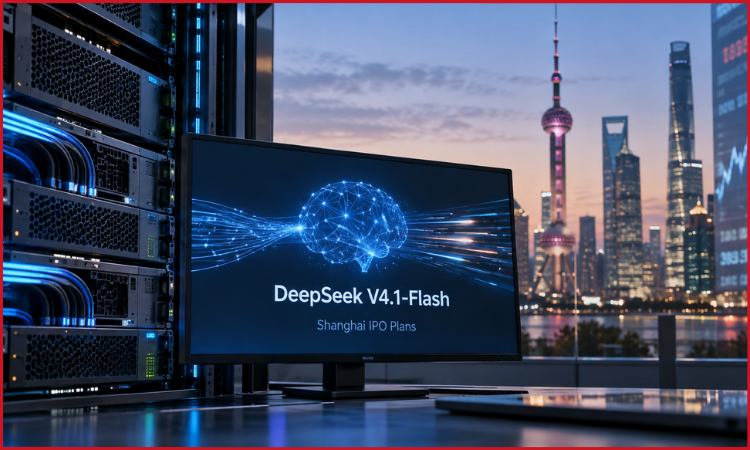
DeepSeek has launched a new artificial-intelligence model called V4.1-Flash, introducing the smallest member of its latest architecture family as the Chinese startup begins preparations for a possible stock-market listing in Shanghai.
The Hangzhou-based company said DeepSeek-V4.1-Flash was designed to offer stronger capabilities, faster inference and higher throughput. Its underlying architecture can also be scaled to support larger models, potentially allowing DeepSeek to build more powerful versions from the same technical foundation.
DeepSeek has not yet provided enough independently verified testing to establish how the new model compares with systems offered by OpenAI, Anthropic, Google or its Chinese rivals. The company’s performance descriptions should therefore be treated as product claims until detailed benchmarks and third-party evaluations become available.
The release is nevertheless significant because it connects DeepSeek’s product roadmap with its growing financial requirements. The company is preparing for a possible initial public offering on Shanghai’s STAR Market as spending on computing infrastructure, model development and research talent rises across the AI industry.
Smaller Model Targets Faster AI Processing
DeepSeek has positioned V4.1-Flash as the smallest model built on its new architecture. A smaller AI model generally requires less computing power and memory than a larger system, which can make it faster and less expensive to operate.
Inference refers to the process through which a trained model receives a request and generates an answer. Higher inference speed can reduce the delay experienced by users, while greater throughput allows the same computing infrastructure to process more requests within a given period.
These characteristics can be valuable for customer-support tools, coding assistants, search services, content platforms and other applications that need to provide responses quickly and consistently.
However, model size alone does not determine usefulness. Customers will also need to assess accuracy, reliability, context handling, software compatibility and the cost of accessing or operating V4.1-Flash. DeepSeek did not disclose these commercial details in the initial report.
The company’s description of the model as the smallest member of a new family indicates that larger versions may follow. DeepSeek has not announced a release timetable, confirmed model names or published the complete specifications of those possible products.
Its decision to begin with a smaller model reflects a wider shift in the AI market. Developers are no longer competing only to produce the largest system. Businesses increasingly want models that deliver sufficient capability while controlling infrastructure costs and response times.
DeepSeek Moves Towards a STAR Market Listing
The product launch comes one day after reports that DeepSeek had appointed CITIC Securities to help prepare for a domestic IPO.
The company aims to begin the listing process during 2026, according to people familiar with the discussions. Neither DeepSeek nor CITIC Securities has publicly confirmed the appointment.
Companies seeking to list in mainland China generally work with a securities firm on pre-listing guidance before formally submitting an application. Appointing an adviser represents an early preparatory step rather than confirmation that an IPO will proceed.
DeepSeek has not determined the size of the proposed offering, its target valuation or a final listing date. No public prospectus has been filed, meaning investors do not yet have audited financial statements, ownership details or a formal explanation of how the proceeds would be used.
The company is reportedly considering Shanghai’s technology-focused STAR Market, which was created to support businesses in areas such as semiconductors, biotechnology and advanced computing.
DeepSeek’s potential listing would be closely watched because it has become one of China’s most prominent developers of large language models. A public offering could provide additional capital for processors, data-centre capacity, research and employee retention.
The company raised approximately $7.4 billion in June at a post-money valuation exceeding $50 billion, according to sources and investor filings cited by Reuters. Founder Liang Wenfeng reportedly committed 20 billion yuan to that round, while Tencent invested 10 billion yuan and battery manufacturer CATL contributed 5 billion yuan.
A subsequent funding round has been discussed at a valuation of approximately 500 billion yuan, or $75 billion. That figure remains a reported private-market target rather than a valuation established through a completed IPO.
AI Companies Seek More Capital
DeepSeek’s listing preparations reflect the rising cost of competing in generative AI. Training advanced models requires large numbers of specialised processors, while operating them creates continuing expenses for electricity, memory, networking and cooling.
Companies must also retain researchers and engineers in a market where larger technology groups can offer substantial compensation. Reports indicate that DeepSeek has lost some employees to better-funded competitors, including ByteDance and Xiaomi.
Other Chinese AI developers have already moved towards public markets. Z.AI and MiniMax listed in Hong Kong earlier in 2026, while Beijing-based Moonshot has reportedly filed confidentially for a Hong Kong offering.
The release of V4.1-Flash gives DeepSeek a fresh product to place at the centre of its commercial story. Its appeal will depend on whether the promised gains in speed and throughput translate into lower operating costs and dependable performance for developers.
For now, the model launch is confirmed, but the larger architecture roadmap and IPO remain unfinished. DeepSeek’s next steps will be measured through detailed technical testing, customer adoption and the formal regulatory documents required for a Shanghai listing.