A payment gateway is easy to ignore when it works.
A customer enters card details, a payment goes through, and the business gets its money. No one stops to think about the technology sitting underneath that transaction.
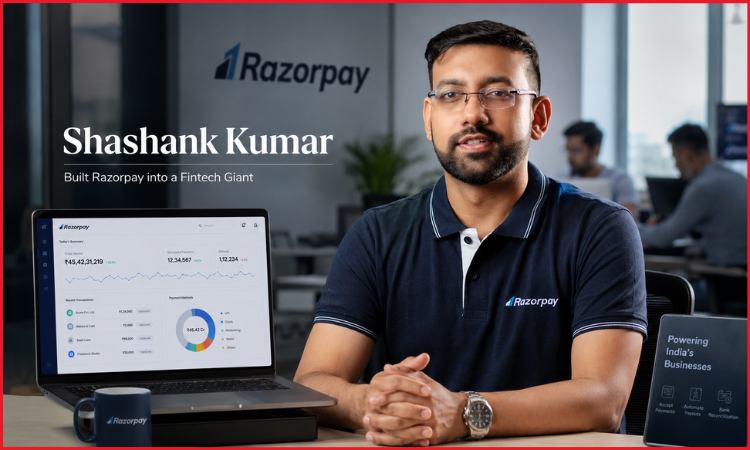
That was precisely the problem Shashank Kumar and Harshil Mathur wanted to solve.
In 2014, the two IIT Roorkee graduates were trying to build a crowdfunding platform. Instead, they ran into the clumsy state of online payments in India. Getting a business onboarded was difficult. Payment integrations were often frustrating for developers. Smaller companies could find themselves dealing with paperwork, deposits and systems designed with much larger enterprises in mind.
So the founders changed direction.
Shashank left his software engineering job at Microsoft. Mathur left Schlumberger. Together, they built Razorpay around a simple idea: accepting payments online should not be harder than building the product being sold.
That idea has taken the company a long way. What began as a payment gateway for startups has grown into a broader payments and financial-services platform serving millions of businesses. Razorpay says it now has more than 12 million merchants and an annualised total payment volume of about $180 billion.
The story, however, is bigger than those numbers. Razorpay’s rise is also a story about developer experience, timing, product expansion, regulation and, perhaps most importantly, a co-founder partnership that survived the pressures of building a major fintech company.
Here is how Shashank Kumar and Harshil Mathur built it.
The origin: From IIT Roorkee to a broken payment experience
Kumar’s journey into entrepreneurship did not begin with a grand fintech plan.
He studied computer science at IIT Roorkee, where he met Mathur. The two worked together on coding projects and were involved with SDS Labs, the software development section at the institute. After college, their careers took them in different directions. Kumar moved to the US to work as a software development engineer at Microsoft, while Mathur joined Schlumberger in the Middle East.
They continued working on ideas together from a distance.
One of those ideas was a crowdfunding platform. That project quickly exposed them to a much bigger problem.
The founders found that existing payment gateways were difficult to deal with, particularly for startups and smaller organisations. According to their account to Y Combinator, companies could be asked for operational records, physical-office requirements, security deposits and high setup fees. The technical integrations were not particularly developer-friendly either.
The original product was soon forgotten. The payment problem became more interesting.
In 2014, Shashank and Mathur founded Razorpay with the aim of making online payments simpler for startups, small businesses and other organisations. Y Combinator later described the company’s origin in much the same way: the founders had discovered a gap in the market while trying to build something else.
Razorpay was not initially built around a vision of becoming a financial super-app. The company started with one very practical problem: helping a business get paid online without forcing its engineering team through a maze of unnecessary complexity.
The lesson from the early years: Razorpay’s first advantage was not scale. It was focus.
The Y Combinator boost and the developer-first bet
Getting a good idea was only the beginning.
The founders still had to convince banks, investors and potential customers that two engineers with limited experience in financial services could build reliable payment infrastructure.
Obviously it was not easy to sell.
The turning point came when Razorpay was accepted into Y Combinator’s Winter 2015 batch. The company became one of the early India-focused startups to go through the accelerator, giving the young business both credibility and access to a much stronger startup network.
Razorpay’s approach to the product was different from the way many traditional payment companies sold their services.
The founders focused heavily on developers.
They built cleaner APIs, improved documentation and tried to reduce the amount of back-and-forth required to get a payment integration working. Razorpay says its initial product was built around pain points such as multiple redirects and a lack of developer-friendly APIs.
This sounds like a technical detail but it was actually a growth strategy.
A developer choosing a payment gateway might not control the entire company’s budget, but that developer could strongly influence which product the business adopted. A good integration could therefore lead to something much more valuable than one customer: familiarity.
An engineer who used Razorpay at a small startup could carry that preference into the next company they joined.
Instead of spending all its energy convincing every business from scratch, Razorpay was creating a product that developers were willing to recommend.
The company’s early fundraising reflected that momentum. Over time, Razorpay attracted investors including Sequoia Capital, Tiger Global, GIC, Ribbit Capital, Mastercard and others. By the time the company had matured into a major fintech player, its funding had reached hundreds of millions of dollars.
The important part, though, was not simply the money.
YC gave Razorpay credibility. Developer adoption gave it distribution.
From payment gateway to financial platform
A payment gateway can get a company into a merchant’s technology stack.
The bigger question is what happens after that.
Razorpay gradually realised that businesses had plenty of other financial problems that needed solving. Accepting a payment was just one part of the financial workflow.
The company began expanding.
RazorpayX added tools for business banking, payouts, payroll and treasury management. Razorpay Capital moved into merchant lending. The acquisition of Ezetap strengthened its position in offline payments and point-of-sale technology. Curlec, acquired in Malaysia, gave Razorpay another foothold in the cross-border payments market.
The strategy changed the company’s relationship with merchants.
Instead of simply handling incoming payments, Razorpay could become part of a wider financial workflow: collecting money, moving it, paying employees and vendors, managing cash flow and eventually providing credit.
That is a much deeper position than a standalone payment gateway.
It also explains why the company’s expansion into international payments matters. In December 2025, Razorpay announced that it had received the RBI’s Payment Aggregator-Cross Border licence. The company said Indian businesses could accept payments in more than 130 currencies, while its international payments infrastructure covered more than 180 countries.
By 2026, Razorpay had also secured RBI approval for its offline payment aggregator operations, giving it online, offline and cross-border payment authorisations.
This is a very different company from the one Kumar and Mathur started in 2014.
And that evolution may be one of the most important reasons Razorpay has remained relevant as fintech competition intensified.
Shashank Kumar and Harshil Mathur: A partnership that lasted
There is a temptation to turn founder stories into stories about one exceptional individual.
Razorpay’s history doesn’t really support that version.
Mathur is the CEO and co-founder. Kumar is the Managing Director and co-founder. Razorpay’s own leadership material identifies Mathur as CEO and Kumar as MD.
Their roles have changed as the company has grown, but the basic division has remained clear.
Mathur became the company’s more visible business and fundraising leader. Kumar’s roots remained deeply technical, reflecting the engineering culture that shaped Razorpay’s early product.
Kumar eventually moved out of the CTO role in 2022. That did not mean stepping away from the company. Instead, his responsibilities broadened as Razorpay became less of a single-product startup and more of a financial platform.
The fact that the partnership has survived for more than a decade is significant.
Founders can disagree over product direction, hiring, fundraising, ownership or even their own roles in the company. Razorpay has had to deal with all the usual pressures of a fast-growing startup while operating in one of the most tightly regulated parts of the technology industry.
Yet Kumar and Mathur have continued to run the company together.
That stability has been an asset in itself.
When regulation became part of the job
Fintech founders do not get to build in a regulatory vacuum.
That became especially obvious to Razorpay in 2022.
The RBI granted the company in-principle approval to operate as a payment aggregator in July that year. But in December, the regulator temporarily stopped Razorpay and several other payment companies from onboarding new merchants until their licensing requirements were completed.
For a business built around merchant acquisition, that was a serious restriction.
The company had to work around it while continuing to serve its existing customer base. The episode also made something clear: scale in financial technology brings regulatory responsibilities that ordinary software companies rarely face.
Razorpay eventually received final payment aggregator authorisation in December 2023, allowing new merchant onboarding to resume. Its FY24 results later showed that the company had still managed to grow during the period of restricted onboarding.
There was another controversy in the same year.
In 2022, Razorpay shared transaction and donor information with Delhi Police during an investigation involving Alt News. The payment gateway said it was complying with a legal request and applicable regulations. The incident raised questions about privacy, law-enforcement requests and the responsibilities of companies that sit inside the financial system.
Neither episode destroyed Razorpay’s business.
But both changed the context around it.
Razorpay was no longer simply a software company helping startups integrate payments. It was becoming financial infrastructure, which meant regulation, compliance and legal scrutiny were going to be part of the business.
The numbers: From startup experiment to scaled fintech
The financial trajectory tells the story just as clearly as the product does.
Razorpay’s domestic payments business reported total income of ₹2,501 crore for FY24 and a net profit of ₹34 crore. Its annualised total payment volume had reached roughly $180 billion.
But FY25 brought an important qualification.
Consolidated revenue rose 65% to ₹3,783 crore, while gross profit increased to ₹1,277 crore. At the same time, the company reported a ₹1,209 crore loss after ESOP expenses and costs associated with its move of the corporate domicile back to India.
That distinction is worth making because describing Razorpay simply as a “profitable fintech” today would be misleading.
The underlying payments business has demonstrated profitability. The consolidated company, however, has had significant costs tied to its restructuring and expansion.
That is typical of a business still investing heavily in new products.
It also shows why revenue growth alone does not tell the complete story. Razorpay is trying to build several businesses at once: online payments, offline payments, business banking, payroll, lending and international payments.
Each adds potential revenue. Each also adds complexity.
The company’s market position remains significant. Industry estimates have put its share of India’s online payment gateway market at around 55%.
The bigger achievement may be that Razorpay managed to turn a technical integration problem into a broad business relationship.
A merchant that originally came for payments can eventually use the company for several other financial functions.
This creates switching costs and it gives Razorpay more opportunities to earn from the same customer.
The IPO is no longer just a distant ambition
For years, the Razorpay IPO was discussed as something that would happen eventually.
In 2026, the process became much more concrete.
Razorpay confidentially filed draft IPO papers with SEBI in June 2026. Reports said the proposed issue could be worth roughly ₹5,000 crore to ₹6,000 crore, although the company had not publicly disclosed the final size at the time of filing. Reuters reported that Razorpay was targeting a public listing by the end of 2026.
The filing follows another major corporate move: Razorpay completed the process of shifting its parent structure from the United States back to India.
This reverse flip was designed in part to make a future Indian listing easier.
Razorpay raised its profile in the private markets during the technology boom of 2021, when it reached a reported valuation of $7.5 billion. The company has since pursued a more diversified business model while preparing itself for public-market scrutiny.
The IPO will ultimately test a different question from the one venture capital investors asked.
Investors once wanted to know how large Razorpay could become.
Public-market investors will want to know how efficiently it can make money at that scale.
Why did Razorpay succeed?
The answer is timing. India’s digital economy expanded rapidly during the same period that Razorpay was building its infrastructure.
But timing alone does not explain the company’s position today.
The first major advantage was product simplicity. Razorpay made payment integration easier at a time when developers were dealing with clunky systems.
The second was distribution. Developers were not merely users of the product. They became an important route into businesses.
Third was expansion.
Razorpay did not stop once it had become good at payments. It used its position inside a merchant’s financial workflow to build adjacent businesses.
At last persistence. The company had to deal with investor scepticism, regulation, competition and a difficult transition from a focused startup into a much broader financial-services business.
None of that happened overnight.
There is also a less obvious lesson in Kumar’s career.
Leaving Microsoft was not, on its own, an entrepreneurial masterstroke. Plenty of people leave stable jobs and build companies that never find product-market fit.
What mattered was what came next.
Kumar and Mathur found a problem they understood well enough to attack. Then they stayed with it long enough to build something that became difficult for customers to replace.
That is the more useful way to understand Razorpay’s success.
It did not begin by trying to become a fintech giant. It began by trying to make one painful task a little easier.
More than a decade later, that small improvement has grown into a major piece of India’s business payments infrastructure.
Frequently asked questions
What did Shashank Kumar do before starting Razorpay?
Shashank Kumar studied computer science at IIT Roorkee and later worked as a software development engineer at Microsoft in the United States before co-founding Razorpay.
How did Kumar and Mathur come up with the idea for Razorpay?
They were initially working on a crowdfunding platform. While trying to integrate online payments, they became frustrated by the complexity of India’s payment-gateway systems. That experience convinced them that payment infrastructure itself was the bigger opportunity.
Is Shashank Kumar the CEO of Razorpay?
No. Harshil Mathur is Razorpay’s CEO and co-founder. Shashank Kumar is the company’s Managing Director and co-founder.
What happened between Razorpay and the RBI in 2022?
Razorpay received in-principle approval for a payment aggregator licence in July 2022. Later that year, the RBI restricted new merchant onboarding while companies completed the licensing process. Razorpay received final payment aggregator authorisation in December 2023.
Was Razorpay profitable?
Its payments business reported ₹34 crore in net profit in FY24. In FY25, consolidated revenue reached ₹3,783 crore, but Razorpay reported a ₹1,209 crore loss after ESOP and restructuring-related expenses connected with its move back to India.
What is RazorpayX?
RazorpayX is the company’s business-finance platform. It provides services such as payouts, payroll, corporate banking-related tools and treasury management. RazorpayX is not itself a bank; its current-account services are provided through partner banks under applicable RBI regulations.
What is Razorpay’s latest reported valuation?
Razorpay was last widely reported at a valuation of about $7.5 billion following its 2021 funding round. More recent figures circulating online have not been as consistently verified, so the $7.5 billion figure is safer to cite as the last clearly established private-market valuation rather than presenting unverified estimates as fact.
Is Razorpay planning an IPO?
Yes. Razorpay confidentially filed draft IPO papers with SEBI in June 2026. Reports put the proposed issue size at approximately ₹5,000 crore to ₹6,000 crore, with a potential listing by the end of 2026.