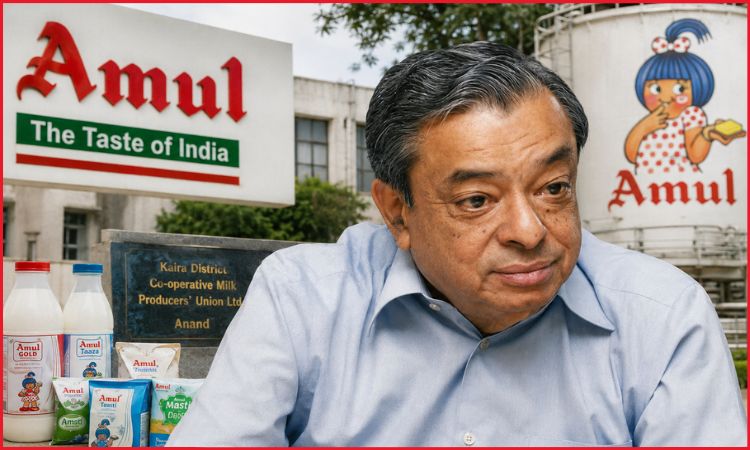
A young mechanical engineer who disliked milk landed a government posting to a dusty creamery in Anand, Gujarat, in 1949, with one plan: finish his mandatory service and leave. He stayed on for over five decades and rebuilt an entire industry instead. That accidental posting is where the Verghese Kurien Success Story actually starts, well before Amul became a household name across India. Kurien, born in Kozhikode in 1921 and trained in mechanical engineering with a dairy-engineering minor from Michigan State University, had no farming background and no early interest in dairying. His turning point came when he watched a small farmers’ cooperative in Kaira district take on a private milk monopoly, and chose to stay and help it win. That decision produced a model, farmer ownership, direct procurement, zero middlemen, that scaled from one district union to a national dairy movement. Cooperative leaders and dairy investors across India still study his playbook. This piece breaks down the model behind it, the milestones that built it, the setbacks along the way, and the numbers that back the claim.
Quick Glance
| Founder | Dr. Verghese Kurien (1921 to 2012) |
| Institution | Amul (GCMMF), National Dairy Development Board |
| Founded | Kaira Union 1946; Kurien joined 1949; NDDB 1965; GCMMF 1973 |
| Sector | Dairy cooperative, FMCG |
| Key Stat | Amul brand turnover crossed Rs 1 lakh crore in FY26, up 11% over FY25 (GCMMF, 2026); India produces close to 25% of world milk output (Government of India, 2024) |
| Current Status | GCMMF remains India’s largest dairy cooperative federation; Amul exports to about 50 countries |
The Early Journey
Kurien was born on November 26, 1921, in Kozhikode, the son of a civil surgeon. He graduated in physics from Loyola College and completed a mechanical engineering degree from Madras University before a government scholarship sent him to the United States. At Michigan State, he studied dairy engineering as a minor, almost by accident, since his real interest was metallurgy.
He arrived in Anand on May 13, 1949, to serve out a bond period at a government creamery, wanting nothing to do with the posting. Around him, farmers of the Kaira district were fighting the Polson company’s monopoly on milk collection, a struggle led by Tribhuvandas Patel and backed by Sardar Vallabhbhai Patel’s cooperative vision. Kurien resigned his government job and volunteered to help the farmers set up their own processing plant instead of walking away. That single choice, more than any credential in his Verghese Kurien biography, decided the rest of his career.
Building The Business: The Amul Model
Product Innovation That Beat Multinationals
India’s milk supply ran mostly on buffalo, not cow. Global dairy majors, including Nestle, had publicly said skim milk powder and condensed milk could not be made from buffalo milk at scale. Kurien and colleague H.M. Dalaya proved that wrong, developing an indigenous process that let the fledgling Kaira Union outcompete established players on quality and price. That same problem of fragmented milk supply chains is what dairy-tech startups such as Stellapps Technologies are still raising funding to solve today.
The Anand Model: Ownership, Not Just Supply
Kurien built a three-tier structure: village cooperative societies at the base, district unions in the middle, and a state federation, GCMMF, formed in 1973, handling marketing. Farmers were not just suppliers; they owned the societies, got paid twice daily based on fat content, and kept middlemen out entirely. That ownership structure still sits at the core of the broader Amul Success Story.
Scaling Nationally Through Operation Flood
In 1964, Prime Minister Lal Bahadur Shastri visited Anand and asked Kurien to replicate the model across India. The National Dairy Development Board followed in 1965, with Kurien as founding chairman. By 1970, that groundwork became Operation Flood India, funded partly by monetising donated dairy commodities from the World Bank and European programmes rather than through conventional loans. Kurien’s blunt pitch to the World Bank president, asking him to hand over the money and not interfere, is still repeated in dairy-sector folklore.
Growth & Turning Points
Operation Flood ran across roughly 26 years in three phases and eventually touched hundreds of districts. Milk production nearly tripled within its first two decades, rising from about 21.2 million tonnes in 1968-69 to more than 55.6 million tonnes by 1991-92, according to Britannica (2026).
| Year | Milestone |
| 1949 | Kurien posted to the Anand government creamery |
| 1955 | Kaira Union adopts the Amul brand name |
| 1965 | National Dairy Development Board formed; Kurien becomes founding chairman |
| 1970 | Operation Flood launched, triggering the Verghese Kurien White Revolution across rural India |
| 1973 | GCMMF established to market Amul products nationally |
| 1998 | India overtakes the United States to become the world’s largest milk producer |
That trajectory is what still gets cited whenever India’s dairy exports, milk pricing policy, or rural income data come up in Parliament and industry reports.
Challenges & Setbacks
Kurien’s institutions did not run friction-free. Early on, farmers who had been cheated by private traders for years were slow to trust a new cooperative. Kurien had to win that trust through consistent, transparent fat-testing and payment rather than promises.
Later, the friction turned internal. Kurien gave up the NDDB chairmanship in 1998 after 33 years, following disagreements with the government over the board’s direction, and his one-time protege Amrita Patel took over. He was then compelled to resign as GCMMF chairman in March 2006, ending another 33-year run, amid a boardroom dispute widely covered in the Indian press. Succession problems are not unique to cooperatives; even celebrated corporate leaders like Kris Gopalakrishnan had to plan deliberately for life after founder-led leadership. The lesson is blunt: durable institutions need a durable succession plan too, and Kurien never fully solved that second problem for himself.
Key Takeaways
- Ownership beats loyalty schemes. Farmer equity in the cooperative created stickier participation than any price incentive alone could.
- Prove the impossible claim first. The buffalo-milk breakthrough earned Amul the right to scale; the cooperative structure came second.
- Funding structure matters as much as size. Operation Flood used monetised donated commodities as working capital instead of straight debt, cutting repayment risk.
- Institutions outlive their builder only with a succession plan. Kurien’s two forced exits prove decades of credibility are not a substitute. The same farmer-ownership logic shows up in India’s other landmark cooperative story, the one behind Lijjat Papad, covered in our piece on Successful Women Entrepreneurs in India.
- Regional models can become national infrastructure. The Anand Model was not exported as advice; it was replicated as policy through NDDB.
Conclusion
Kurien began as a reluctant young engineer with no interest in dairy, yet went on to lead India’s White Revolution. His real achievement wasn’t just producing more milk it was handing farmers genuine ownership of the business, turning suppliers into entrepreneurs and villages into stakeholders in a national economic network. Through Amul and the cooperative model he built, Kurien proved that ordinary people, when given control over their own value chain, can drive extraordinary change. That’s why his legacy endures beyond dairy itself. He’s remembered not only as the Father of the White Revolution, but as one of India’s most influential institution-builders and social entrepreneurs.
Frequently Asked Questions
1. Who was Verghese Kurien and why is he called the Father of White Revolution?
Dr. Verghese Kurien was a mechanical engineer who built Amul and led Operation Flood, turning India from a milk-importing nation into the world’s largest producer. That is why he is widely described as the Father of White Revolution.
2. What is the Anand Model that Kurien built?
It is a three-tier cooperative structure, village societies, district unions, and a state marketing federation, where farmers own the cooperative rather than just supplying it. The model became the blueprint for Operation Flood India.
3. How did Amul compete with multinational dairy companies?
Kurien and H.M. Dalaya developed a process to make skim milk powder and condensed milk from buffalo milk, something global players had said was not possible at scale. That innovation sits at the centre of any accurate Amul success story.
4. Did Verghese Kurien face setbacks in his career?
Yes. He gave up the NDDB chairmanship in 1998 and was compelled to resign as GCMMF chairman in 2006, both following internal disputes despite decades of leadership, as reported by News on Air, Government of India and other outlets covering the period.
5. How large is Amul’s business today?
GCMMF’s own revenue reached about Rs 65,911 crore in FY25, while the wider Amul brand’s unduplicated turnover crossed Rs 1 lakh crore in FY26, per the federation’s public disclosures.
6. What can founders learn from the Verghese Kurien Success Story?
The clearest lesson is that ownership structures and trust-building with primary stakeholders matter as much as product innovation, and that institutional longevity needs an explicit succession plan.