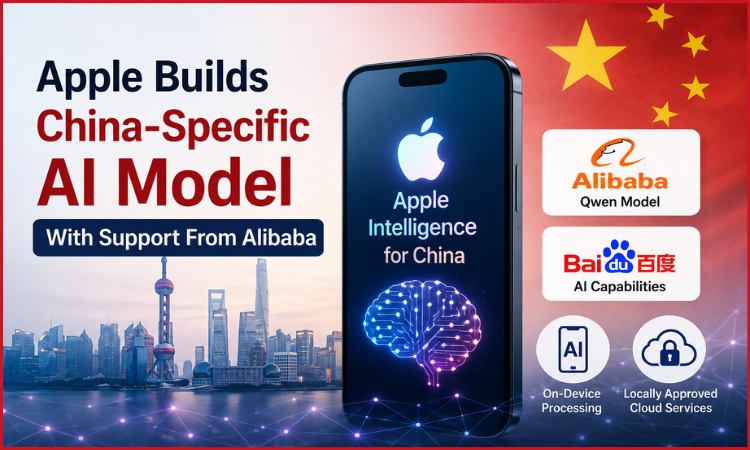
Apple has reportedly developed its own artificial intelligence model for China with technical support from Alibaba, as it prepares to introduce Apple Intelligence in China.
The model has been trained specifically for the Chinese market and will form part of a separate AI system designed to meet the country’s regulatory requirements. Apple is expected to combine its own technology with models and services supplied by Chinese companies.
Apple has not publicly confirmed the development of the model or announced when the AI features will become available to users in mainland China.
Alibaba Supported Model Training
Alibaba reportedly helped Apple train the new large language model. The arrangement marks a change from Apple’s earlier plan to depend primarily on third-party Chinese AI systems.
Apple Intelligence uses Apple-developed models in most international markets. In China, foreign generative AI services must receive regulatory approval and comply with local requirements before being released to the public.
Services such as OpenAI’s ChatGPT are not officially available in mainland China. Apple must therefore use a separate technical and regulatory framework for Chinese devices.
The proposed system is expected to include:
- Apple’s China-specific language model
- Alibaba’s Qwen model
- AI capabilities supplied by Baidu
- On-device processing for selected features
- Locally approved cloud services for larger tasks
The exact division of work between Apple’s model, Qwen and Baidu’s technology has not been disclosed.
Alibaba previously confirmed that Qwen would be integrated into Apple Intelligence across iOS, iPadOS, macOS and visionOS for users in China. Baidu has also said it is working with Apple on AI functions for Chinese iPhone users.
Apple Intelligence Clears Regulatory Step
China’s cyberspace regulator registered Apple’s on-device generative AI service in July 2026. The registration cleared a major requirement for introducing the service in the country.
China requires companies to register large language models and public generative AI services before they can be offered to consumers.
The registration did not include a release date. Apple is still expected to complete technical and product preparations before activating the features on compatible devices.
If Apple deploys its own approved model, it could become the first foreign technology company to operate a proprietary generative AI model for consumers under China’s regulatory framework.
Apple’s official software information earlier stated that Siri AI and other new Apple Intelligence features would remain unavailable in mainland China while the company worked through regulatory requirements.
AI Features Have Been Missing From Chinese iPhones
Apple began rolling out Apple Intelligence internationally in 2024. Chinese iPhone owners have not received the same set of generative AI tools because the required approvals and local partnerships were not in place.
Apple Intelligence includes writing assistance, text summaries, image generation, photo-editing tools and upgrades to Siri. The latest version also allows Siri to use information displayed on the screen, search across apps and perform connected tasks.
The Chinese version may not operate in the same way as Apple Intelligence in other markets. Locally approved models and cloud infrastructure are expected to handle some requests that Apple processes through its own systems elsewhere.
Apple has not published details about data handling, feature differences or device compatibility for the Chinese rollout.
Domestic Brands Already Offer AI Features
Apple is competing against Huawei, Xiaomi, Oppo, Vivo and Honor in China. These manufacturers have already added generative AI tools to their smartphones.
Huawei has introduced AI features across its devices using its own software and models. Xiaomi and other Chinese brands also offer assistants capable of image editing, content generation, search and cross-app tasks.
The delayed availability of Apple Intelligence has left Chinese iPhones without several AI functions offered on the same devices in other markets.
Apple’s China-specific model would allow the company to add these features without relying entirely on a single local provider.
iPhone Shipments Recover in China
Apple’s position in the Chinese smartphone market improved during the second quarter of 2026.
iPhone shipments increased 24.4% from the previous year, while total smartphone shipments in China declined 4.3%. Apple’s market share rose from 13.9% to 18.1%.
Huawei remained ahead with a 22.6% share and recorded shipment growth of 19.4%.
Apple’s Greater China revenue has also recovered during recent reporting periods. For the quarter ending March 28, 2026, the company reported regional sales of $20.5 billion, up 28% from $16 billion a year earlier.
Greater China includes mainland China, Hong Kong and Taiwan.
Discounts on the iPhone 17 series and demand for the Pro models supported Apple’s recent shipment growth. The company continues to face pressure from domestic smartphone makers across premium and mid-range price categories.
Launch Date Remains Unconfirmed
Apple has not announced whether the Chinese version of Apple Intelligence will arrive with a software update or a future iPhone launch.
The company has also not explained how its own model will operate alongside Alibaba’s Qwen or Baidu’s technology.
Reference material linking Qwen with Siri and Writing Tools briefly appeared on Apple’s Chinese support pages before being removed. Apple did not provide a reason for taking down the documents.
The regulatory registration allows Apple to move closer to a public rollout, but final availability remains pending. Pricing, supported devices and the complete feature list have not been disclosed.