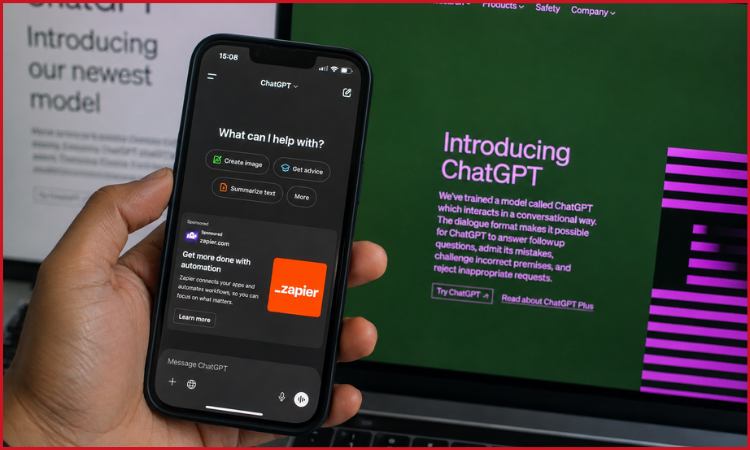
OpenAI has started expanding its advertising test to India, with the company sending emails to eligible users about the change. ChatGPT ads in India will appear on selected adult accounts using the Free and Go plans.
The rollout is being conducted in phases, which means advertisements may not appear on every eligible account immediately. Users included in the test will receive information through email or inside ChatGPT. The India rollout follows advertising tests in several overseas markets.
The ads will appear below relevant ChatGPT responses. They will carry a “Sponsored” label and remain visually separate from the answer generated by the chatbot.
OpenAI said advertisers will not be able to pay to influence, rank or alter ChatGPT’s responses.
Free and Go Users Included in Test
The OpenAI advertising test covers users on the following plans:
- ChatGPT Free
- ChatGPT Go
Accounts on ChatGPT Plus, Pro, Business, Enterprise and Edu plans will remain free of advertisements. Users whom OpenAI identifies or predicts to be under 18 will not receive ads.
Temporary Chats will also remain ad-free. Advertisements will not be placed alongside conversations involving sensitive or regulated subjects, including personal health, mental health and politics. Political advertising is not permitted on the platform.
OpenAI first started testing advertisements in the United States on February 9, 2026. The company later expanded the programme to markets including the United Kingdom, Australia, New Zealand and Canada.
Ads Will Appear Below Responses
ChatGPT advertisements will be displayed after the chatbot has completed its response. A single advertising unit may contain one or more products from an advertiser or sponsored content from multiple advertisers.
Each unit can include:
- The advertiser’s name
- A headline
- A short description
- An image
- A link to the advertiser’s website
Advertisements will not be inserted into the text of ChatGPT’s answer. OpenAI said the chatbot generates its responses independently through systems that operate separately from its advertising platform.
The presence of an advertisement will also not mean that OpenAI has endorsed the company, product or service being promoted.
Current Conversations May Determine Ad Selection
Ads can be matched with the subject being discussed in the current conversation. General information such as a user’s language and broad location may also be used to select a relevant placement.
Users who enable personalised advertising may see ads selected using additional signals, including previous chats, saved memories and earlier interactions with advertisements.
OpenAI said this information remains within its systems. Advertisers will not receive a user’s conversations, chat history, memories, name, email address, precise location, IP address or other personal details.
Advertisers will receive aggregated performance data, such as the number of times an ad was viewed or clicked. OpenAI has said it does not sell ChatGPT conversations to advertisers.
Users Can Hide or Report Ads
Eligible users will receive advertising controls within ChatGPT. The three-dot menu attached to an advertisement will provide options to:
- Hide the advertisement
- Report misleading or inappropriate content
- Check why the advertisement was displayed
- Ask ChatGPT a question about the advertisement
ChatGPT cannot see an advertisement shown to a user by default. Selecting the “Ask ChatGPT” option shares that specific advertisement with the chatbot.
Users can also turn off personalised advertising. Doing so changes the information used to select ads but does not remove advertisements from the account.
Ad-related data can be cleared through the platform’s settings. OpenAI may retain deleted advertising data for up to 30 days before removing it from its systems. The company has detailed these privacy and advertising controls in its user guidance.
Free Users Can Choose a Restricted Ad-Free Option
Free-plan users included in the test can switch to an ad-free version without paying. However, this option comes with lower message limits and reduced access to certain tools, including image generation and deep research.
The setting can be accessed through:
Settings – Ads controls – Change plan – Reduce message limits
Users who want an ad-free experience without lower usage limits can move to ChatGPT Plus or Pro.
The restricted ad-free option is limited to the Free plan. ChatGPT Go subscribers would need to move back to the Free plan and accept lower limits or upgrade to an ad-free paid tier.
OpenAI said advertising revenue will help fund the infrastructure required to operate its Free and Go services. The company has not announced a date for completing the India rollout. Ads will continue to reach eligible accounts gradually during the testing phase.