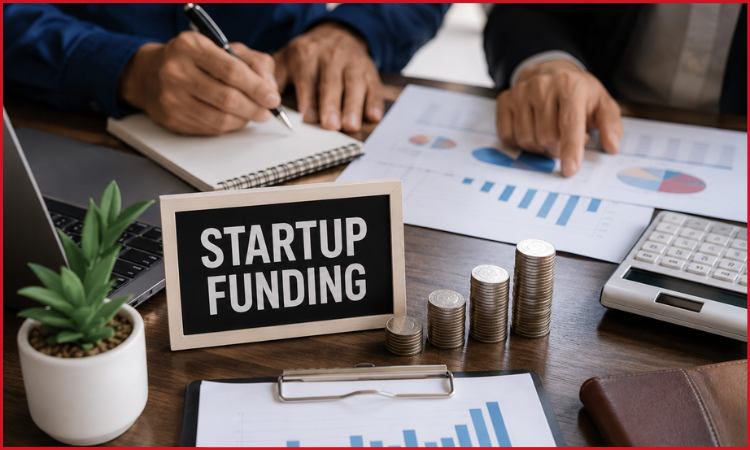
India’s startup scene isn’t dead yet – far from it. Recent trackers place the amount being spent on Indian startups at roughly $10 billion (US) to $11 billion (US), including Inc42’s estimate for $11 billion (US) across over 936+ deals in 2025, and Tracxn reporting $10.1 billion (US) worth in equity funding rounds in India through July 2026.
Startup India describes its nation as the world’s third largest startup ecosystem, where it expects the industry to grow annually by about 12%-15%. While capital availability continues unabated, investors are asking for better pitches these days. They want better products, clearer traction, better unit economics and above all else, they want you, the founder, to be able to articulate your pitch well.
The bright side? India has a broader funding stack today than most new founders realize.
The Real Funding Path in India
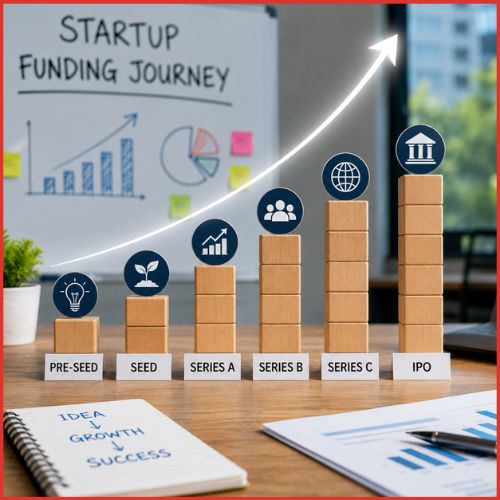
At an early stage, most startups go through a combination of bootstrapping, friends & family investment, angel investors and government-backed seed investment.
Once a startup has some traction, then they can explore incubators, VC/venture debt, or industry-specific schemes.
When we talk about a regulated startup’s journey for funding, the official ecosystem today offers them Startup India Recognition, seed funding, collateral-free credit guarantee schemes as well as funds-of-funds.
It all comes down to this – how do I identify a capital source that is suited for my startup stage? Risk levels? Speed?
How To Access Government Schemes And Tax Benefits?
To get the maximum benefit from the Government of India’s startup incentives, your startup should be DPIIT-recognized first.
Now, know about the eligibility criteria mentioned in the Startup India scheme:
- Your startup must be incorporated as a Private Limited Company, LLP, Partnership Firm or Cooperative Society.
- It must have a Turnover less than Rs 200 Crore (for Deep-Tech Startups – 300 crore) in any of its previous Financial Year(s).
- It must be within 10 Years since its Incorporation. This time is 20 yrs for deep tech.
- It should focus on Innovation, Improvement or Development of Scalable & High Potential Business Model.
- It must NOT be formed out of Splitting Up Or Reconstructing An Existing Business.
Also, you will get all the tax advantages and easy compliance along with IP Right Fast Tracking and a dedicated startup India Portal where your founders can get Investor Connect, Funding Schemes and Policy Updates.
Government Funding Schemes for Startups in India (2026)
Now, once your startup has become DPIIT-recognised, you can start looking into some of these officially sanctioned schemes to get started on your journey to raising money. Let’s break down each scheme and how they could potentially work for your startup:
Startup India Seed Fund Scheme (SISFS)
Once again this is another key part of the government’s funding plans for startups which comes into play during early-stage funding for founders. As outlined by the June 2026 version of the Startup India Playbook, “the Startup India Seed Fund Scheme [is] intended to assist new startups with the necessary resources towards proof of concept, development of prototypes, trials of the product, its entry in the market and subsequent steps towards commercialisation.”
The SISFS is available to DPIIT-recognised startups who have been incorporated within the last two years, and allows them to claim grants ranging from as little as ₹20 lakh to go toward validating their product, right up to being able to raise funds via market entry or scale up using convertible debentures/debt/debt linked instruments worth up to ₹50 lakh.
This scheme is particularly useful if your startup is just getting off the ground and there are not enough financial backers interested in making big bets yet. This is where the small seed investments come into play.
Credit Guarantee Scheme for Startups (CGSS)
For those wanting to attract investors with a debt-based structure instead of relying solely on angel investors or VCs for initial capital needs, then look no further than this scheme which provides credit guarantees to startups without needing collaterals upfront according to reports cited above from StartupIndia about CGSS: “It provides credit guarantee support against loans extended by member Institutions (such as scheduled commercial banks/NBFC/venture debt funds) to eligible Startups.”
In particular It was good to see that under the ‘revised framework’, they raised the level at which one would receive coverage. Previously, this had only been up-to ₹10 crores but now it is up to ₹20 crore per eligible borrower.
Fund of Funds (FoF) 2.0
Founders wanting to chase equity capital would want to be aware of the Startup India Fund of Funds (FoF) 2.0. According to the April 2026 notification by DPIIT, FoF 2.0 has a corpus of ₹10,000 crore but does not invest directly in startups. Rather, it helps to support the investment process by supporting investments to SEBI registered Category I/II startups. It drives alternative Investment Funds into startups through equity, equity linked & selected debt instruments. Sidbi is the Implementation Agency here too. This target category is mentioned in the June 2026 Startup India Playbook, where it says these are “priority sector” and early growth enterprises needing patient capital.
Tax benefits
Equity financing aside, there’s other types of financial help startups get from the Startup India scheme. Recognised startups may apply for a three-year tax holiday under Section 80-IAC during their first ten year period of incorporation. Also, as confirmed by the Income Tax Department, DPIIT-recognised startup entities could claim exemption from Angel tax provided they fulfill certain preconditions. So even though it isn’t actual cash, getting some tax relief means you’re going to have more room to grow your business.
A handful of sector-specific schemes are also worth checking before pursuing general-purpose capital. The June 2026 Startup India playbook highlights PRISM for innovators, BIG and BIRAC SEED for biotech founders, and TIDE 2.0 for eligible digital and IT-based startups. A matching sector scheme is often faster and cheaper to secure than chasing capital through the broader ecosystem.
What Investors and Lenders Look For
“More often than not, our fellow founders don’t have trouble raising funds as much as they do understanding where exactly the missing link lies,” says some venture capitalist in an interview to Times of India.
“The challenge, therefore, was to create a framework that would ensure all these components are articulated clearly. While there might seem to be an abundance of funding options at the moment, the reality remains that most entrepreneurs lose out on funding opportunities due to a lack of clarity around their business proposition.”
A good funding proposal has to articulate a real problem, a solution that’s workable, proof that people care about solving this problem and a realistic use case for what can be done with the capital raised.
One interesting analysis of current startup funding behaviour by experts at Indicative.com suggests investors and lenders in India are focusing more on evaluating the business model, market potential and the cash-flow projections as well as assessing the credibility of founders. “Startups should now start explaining why now was the time to raise money, why their solution was right, why the founding team made sense and why the size of investment makes sense”, said a VC investor we spoke with earlier this year.
Preparing to Raise: A Practical Checklist
Founders who move efficiently through the funding process tend to follow a similar sequence. Getting the company structure right and completing DPIIT recognition, where eligible, comes first, since it opens access to most formal schemes and tax benefits.
Matching capital to stage comes next. Grants and seed schemes suit validation, angel money suits early traction, venture capital suits scale, and debt makes sense only when cash flow can support repayment. SISFS, CGSS, and FoF 2.0 each solve a different problem, so applying to all three without matching them to the right stage rarely works.
Before approaching any investor or lender, founders should have an investor-ready package assembled, including:
- A pitch deck that states the problem, the solution, and the traction to date
- Incorporation papers and a current cap table
- Financial projections and a clear use-of-funds note
- Customer traction data and compliance records
Clean paperwork shortens due diligence and signals that the founder is organised. It also helps to use the official ecosystem: the Startup India portal, the MAARG mentorship network, and investor connect tools are built specifically to move founders from idea to capital more efficiently.
Common Mistakes That Slow Down Funding
Founders often wait too long to formalise the company, or approach investors before they have any traction or a credible market story. Many also skip government schemes because they assume the process is too complex, when the larger risk is usually not applying at all.
A second common mistake is confusing funding types. Grant money, equity capital, debt, and revenue-based financing carry different costs, different speeds, and different levels of control, and treating them interchangeably tends to backfire later. A third mistake is weak storytelling: investors do not fund documents alone. They fund conviction that is backed by evidence.
Matching Capital to Stage
Getting funding for a startup in India is not about finding one source of money. It is about matching the right capital to the right stage. Early-stage founders should start with DPIIT recognition, seed funding, mentorship, and proof-of-concept support. Startups that need debt without collateral should study CGSS closely. Startups ready for scale should look at venture capital and the Fund of Funds ecosystem, and those that qualify for tax relief should use it to extend runway and reduce pressure.
The founders who raise money fastest tend to be the ones who understand their stage clearly, know their numbers, and can explain exactly why the funding will unlock the next milestone.
Frequently Asked Questions (FAQ)
Is DPIIT recognition necessary to raise money?
It is not mandatory, but it significantly improves access to government schemes, tax benefits, and formal startup support.
Can a startup get funding without collateral in India?
Yes. The Credit Guarantee Scheme for Startups is built specifically to support collateral-free debt funding through eligible lending institutions.
What is the best government scheme for early-stage startups?
For most early-stage founders, SISFS is the most relevant scheme, since it supports proof of concept, prototypes, trials, market entry, and commercialisation.
What should a founder prepare before approaching investors?
A clear pitch deck, traction proof, financial projections, a current cap table, and a precise use-of-funds plan. Investors want clarity before they commit capital.