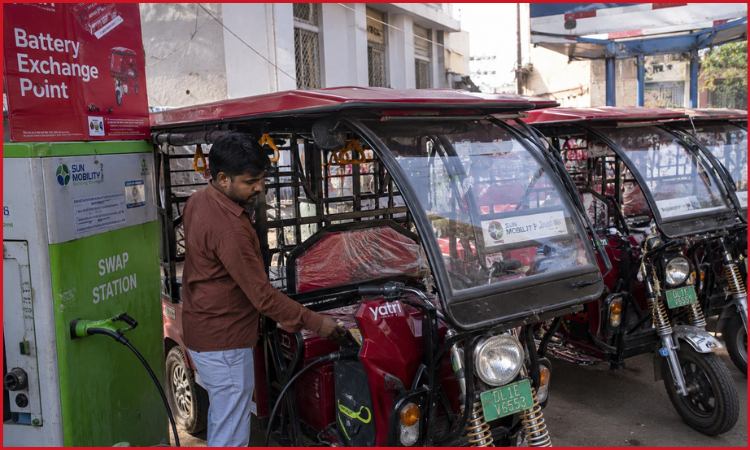
Pune-based deeptech-fintech startup BatteryPool said its battery-control architecture locks all commands to the charging point, making mid-ride shutdowns impossible — a safeguard that arrives just as India’s Ministry of Electronics and Information Technology (MeitY) cracks down on rogue battery management system (BMS) apps blamed for stranding e-rickshaw drivers mid-route.
The trigger: Bluetooth hacks and an app ban
BatteryPool says its architecture already rules out the kind of mid-ride shutdowns that have stranded Delhi’s e-rickshaw drivers and triggered a government app ban.
The announcement follows weeks of incidents in which strangers used Bluetooth-enabled BMS apps to remotely cut power to moving e-rickshaws in Delhi, leaving drivers stuck in traffic with passengers onboard.
MeitY ordered Google and Apple to pull three apps — BAT-BMS, Epoch Li-ion and Lossigy — from their app stores after the incidents surfaced. Affected drivers reportedly lost ₹400–500 a day in earnings each time it happened.
How BatteryPool’s architecture differs
BatteryPool’s control layer runs on encrypted firmware embedded in both the battery and the charger, which talk to each other only through an encrypted handshake over the CAN bus — not open Bluetooth.
That closes off the exact wireless opening exploited in the recent hacks: there’s no channel for an outside phone to find or pair with. Its batteries are also configured to work exclusively with its own charging infrastructure, and about 90% run India-made BMS hardware rather than imported systems.
Founder Ashwin Shankar said the company made a deliberate call to keep control anchored to charging rather than to a vehicle in motion, framing connected batteries as digital assets that need security built in, not bolted on.
He said the underlying handshake was actually built about 1.5 years earlier — originally to enforce BatteryPool’s pay-per-use EMI model for drivers — and only later turned out to double as a fix for a safety problem nobody had asked the company to solve.
BatteryPool works across 15 fleet operators in 11 cities, partnering with NBFCs Finayo and AMU and OEMs including Livguard, ipower, Numeros, Jitendra and Odyssey.
It cites sub-1% NPAs against an industry norm above 10%, and residual battery values of roughly 85% even years past standard OEM warranty periods — numbers it’s using to argue that security-by-design and financial performance can go hand in hand as India’s EV push scales up.