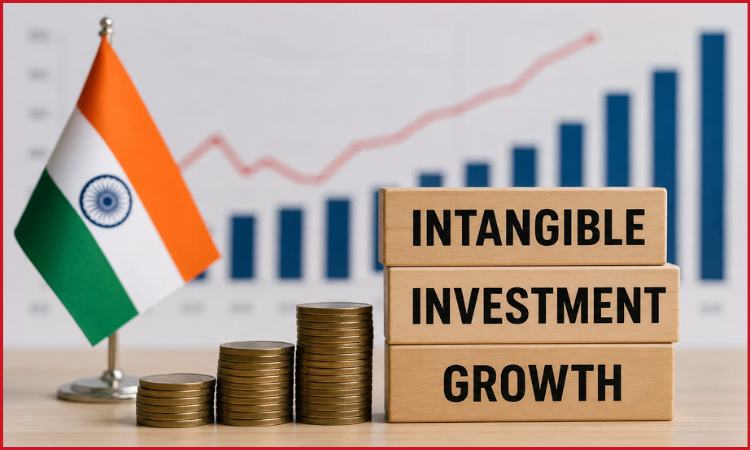
India recorded the fastest growth in intangible investment among the world’s 15 largest economies in 2023, expanding 7.9 percent to touch USD 78.2 billion, according to the World Intangible Investment Highlights 2026, jointly published by the World Intellectual Property Organization (WIPO) and Luiss Business School (LBS) this week.
India’s pace outstripped Japan (4.8 percent) and the Philippines (4.6 percent), the next-fastest growing major economies in the sample.
What is intangible investment?
Intangible investment covers spending on assets with no physical form — software and databases, research and development (R&D), brands, design, organisational know-how and other intellectual property — as opposed to tangible investment in factories, machinery and buildings.
The report’s own framing captures the shift starkly: much of an electric car’s value now lies in its battery technology, software and brand rather than the steel and the bodywork, while a large language model has almost no physical form at all, with its value resting entirely on research, data and software.
Commerce Minister Piyush Goyal calls it proof of an innovation-led future
India’s Commerce and Industry Minister Piyush Goyal amplified the findings in a post on X on Wednesday, saying India is “powering the next era of innovation-led growth.”
He wrote that the report highlights India’s growing intangible investment in areas such as software, R&D, intellectual property, innovation and organisational capabilities that are shaping the economy of the future, and credited the numbers to sustained policy reforms, digital transformation and startup support under Prime Minister Narendra Modi’s leadership.
Software dominates India’s mix
The report found that software and databases accounted for nearly 45 percent of India’s total intangible investment in 2023 — the highest share recorded among all 29 economies covered, reflecting the country’s large information technology and software services sector. Organisational capital contributed a further 21.8 percent, while brands made up 9.3 percent.
Even so, India remains a tangible-intensive economy at its current stage of development: intangible investment stood at 10 percent of GDP in 2023 against 19.3 percent for tangible investment, as large-scale infrastructure build-out continues.
Gross capital formation in India rose from 32 percent of GDP in 2021 to 33 percent in 2023, the report noted, even as tangible investment growth (7.8 percent) still outpaced intangible growth in the same period.
How India compares globally
At USD 78 billion in 2023, India’s intangible investment now exceeds that of several European Union economies, including Denmark, the Czech Republic and Finland, though it remains far behind the United States (nearly USD 5 trillion), Japan (USD 810 billion) and Germany (USD 695 billion) in absolute size.
On brand investment specifically, India grew at 7.2 percent annually between 2013 and 2023 — among the faster rates in the sample, though still concentrated in software rather than consumer branding.
India outpaces Japan, Philippines in intangible investment growth, Piyush Goyal cites WIPO report
The WIIH 2026 is the third edition of the annual report and draws on the Global INTAN-Invest Database, which now covers 29 economies accounting for 57 percent of world GDP.