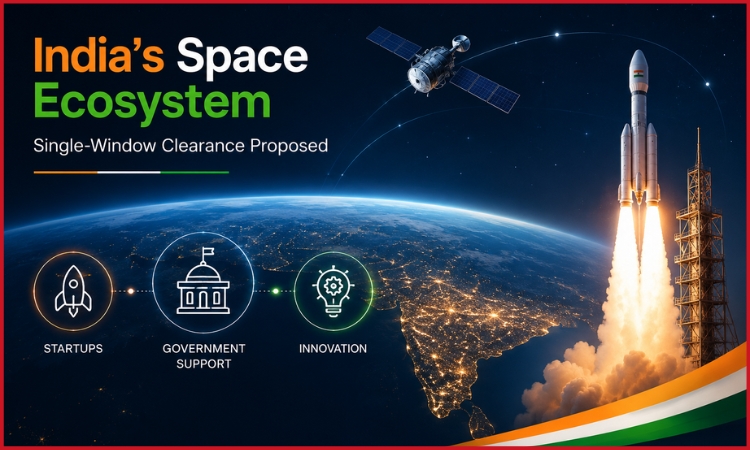
India is having its space moment. Anil Prakash, Director General of SIA-India — India’s premier space industry body — says the process for building a spacetech startup in India needs to be simplified.
“Our ask is that let IN-SPACe be the single window for the space sector. Whatever permissions are required, that should be channelled through IN-SPACe,” he told Business Outreach on the sidelines of India Space Congress 2026 — SIA’s flagship conference on the space sector in India.
Speaking about what comes next for India’s booming space sector, Prakash underlines the need to cut red tape.
The biggest friction point, he said, is regulatory fragmentation.
“Right now, a space company needs separate clearances from the Ministry of Information and Broadcasting, the Wireless Planning and Coordination wing and IN-SPACe — all for what is essentially one business. “Our ask is that let IN-SPACe be the single window for the space sector,” he said.
The second major ask is for the government to step up as an anchor customer — providing the demand certainty that early-stage deep-tech companies need to attract private capital and scale.
On the self-reliance front, Prakash acknowledged that India remains heavily import-dependent, but said SIA-India has identified 608 technologies in the space sector that India could — and should — build domestically to secure a reliable supply chain. It is a long road, he conceded, but the direction is set.
Momentum in Indian space sector
Skyroot Aerospace recently raised $60 million and became India’s first space tech unicorn, valued at $1.1 billion — a watershed moment for an ecosystem that barely existed a decade ago. Prakash said the momentum was unmistakable: with nearly 400 space startups, India now hosts the largest such ecosystem in Asia, with names like Agnikul, Skyroot and Digantra leading the charge.
India Space Congress itself, he said, was designed to channel that momentum into tangible outcomes. SIA-India is actively taking Indian startups to international forums — most recently to the Space Symposium in the US, and next to Japan — to forge partnerships and open commercial doors.
“The key of our address is collaboration,” he said. “Slowly we are building that capability.”
SIA-India has been taking Indian startups to international forums — the Space Symposium in the US last month, Japan is next. The idea is straightforward: get Indian companies in front of foreign collaborators and buyers on their home turf, not just at conferences in Delhi.
Prakash, a veteran professional with 37 years of experience, concludes: “In just four or five years, we have seen unprecedented growth. The seed has been sown, the appetite is growing — and now we must accelerate.”
India Space Congress 2026 concludes on June 17 with sessions on space security, strategic autonomy and resilient space infrastructure.