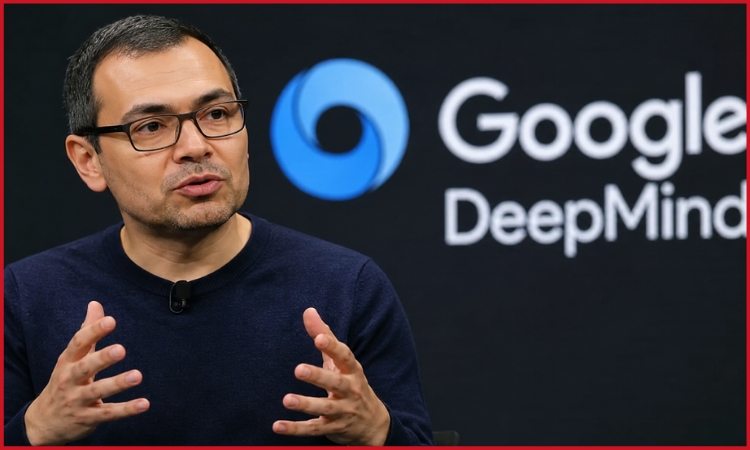
Demis Hassabis, CEO of Google DeepMind and Nobel Prize-winning AI researcher, has warned that artificial intelligence (AI) capable of matching and surpassing human intelligence across every domain is only a few years away and that society is running out of time to prepare for what he described as one of the most consequential shifts in human history.
Speaking at a Stanford Graduate School of Business event, Hassabis said he expects artificial general intelligence or AGI (the point at which AI is capable of performing a broad range of intellectual tasks at or beyond human levels) to emerge by the end of the decade. “I believe that we’re only a few years away from that, maybe like 2030 plus or minus a year, which is astounding to think, really,” he said.
He framed the present moment as the start of an entirely new chapter for humanity. “When we look back at this time, I think that maybe 10 years from now, we’ll realize that we were standing in the foothills of the singularity now,” Hassabis said.
A prediction that carries a warning for mankind
Hassabis went beyond timelines to stress the urgency of collective action. “Society needs to hear that because we don’t have long to prepare for what that means. It’s going to be enormously profound. The future, in my view, is still to be written, but these next few years are going to be very critical as to which way that will go and how we collectively want that to look like,” he said.
He noted that 2026 marked a turning point, with AI agents and tool-use capabilities becoming genuinely useful in people’s work and giving developers a clearer view of the remaining steps needed to reach AGI, while arguing that preparation for its arrival can no longer be left to technologists alone.
OpenAI CEO Sam Altman has claimed his company knows how to build AGI and suggested AI agents could begin joining the workforce.
Anthropic CEO Dario Amodei and Elon Musk have also predicted AGI-level systems could arrive within a few years. Musk said in December that he expected AGI by 2026, adding he was “confident by 2030, AI will exceed the intelligence of all humans combined.”
Some argue the milestone has already been crossed. Eliza Labs founder Shaw Walters has said current systems already qualify. “I think that we’re at the inflection point where we have AGI. I completely believe that this is general intelligence,” Walters said.
Skeptics push back
Not everyone shares the urgency. In March, the ARC Prize Foundation released its ARC-AGI-3 benchmark, which tests whether AI systems can learn and adapt in unfamiliar environments. Leading models from Google, OpenAI, Anthropic, and xAI scored below 1%, while human participants achieved perfect scores.
The absence of a shared definition of AGI further complicates the debate. Machine Intelligence Research Institute CEO Malo Bourgon noted: “There’s a bunch of different definitions. When we start to talk about, is this system AGI? Is that system AGI? What precisely qualifies as AGI by what definition? I think that’s kind of difficult to do.”
Hassabis acknowledged the uncertainty but held firm on the broader trajectory. “Everything is going to change in the next 10 years, probably more than people assume,” he said.