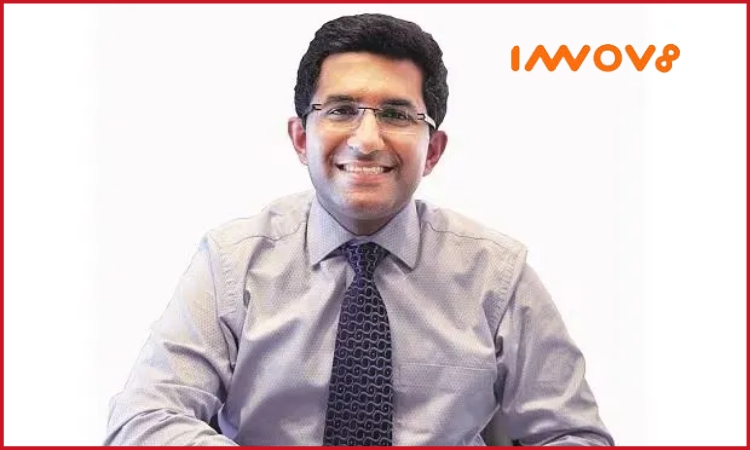
Originally, the Indian coworking market was quite simple. The majority of the operators placed their primary emphasis on office space planning, WiFi, and the feature-rich rows of workspace, designed for freelancers, startups, and other small companies looking to eschew traditional office leases.
Then came Ritesh Malik.
Malik saw coworking from a fresh perspective. Instead of approaching it as just another real estate venture, he believed it was a way of establishing contemporary workplaces based on adaptability, partnership, and a sense of belonging.
He felt startups were not merely seeking office accommodations. What they sought were workplaces that fostered interaction, inspiration, expansion, and the company’s culture.
This vision was instrumental in positioning Innov8 as one of India’s most rapidly expanding coworking brands, with strong traction that eventually saw the brand being acquired by OYO in 2019.
Today, Innov8 owns, manages, and operates more than 30 centers across over 10 cities in India and continues to expand its footprint.
Who Is Ritesh Malik?
Ritesh Malik’s story is very different from most startup entrepreneurs. Before starting his own business, he qualified as an MBBS doctor.
But his fascination eventually led him toward technology, startups, and entrepreneurship. As his horizon broadened within India’s startup universe, he started working hands-on with startup founders, investors, and early-stage companies.
While working there, he realized a challenge. Most startups faced difficulties in obtaining an office space that was not only affordable and flexible but also easy to get started. Existing commercial leases necessitated high deposits, lengthy leases, and extra operational costs.
Malik recognized that there was an opportunity to create something new and improved.
Ritesh Malik’s Entrepreneurial Journey
Before Innov8, Malik had already been involved in India’s startup ecosystem as an entrepreneur and investor. This experience of witnessing the scaling of startups enhanced his understanding of the pain points faced by early-stage entrepreneurs.
One persistent pain point came up time and again: startups needed office space, but traditional leasing options could be costly, rigid, and hard to grow.
Eventually, this led the team to launch Innov8 in 2015.
Malik wanted to move beyond traditional office layouts and create workspaces that encouraged collaboration, interaction, and business growth.
This was an ambitious concept, especially as the coworking market in India was still evolving. It was quite difficult to make the landlords, corporates, and professionals aware of the considerable potential of the matter in the long run.
Although faced with difficulties, Innov8 managed to grow in popularity. Its design and community-oriented approach, combined with a flexible design, allowed it to differentiate itself.
Within a short span of time, Innov8 shifted from a startup-centric coworking business to a larger workplace solutions provider catering to a diverse range of customers.
Innov8 Timeline
2015
Ritesh Malik founded Innov8 to provide startups, entrepreneurs, and freelancers with agile, community-based workspaces.
2016
Upon entering Y Combinator (one of the best startup accelerators in the world), the company is more widely recognized.
2017-2018
The company expanded into multiple locations and strengthened its presence in India’s growing coworking market.
2019
OYO enters the coworking industry with the acquisition of Innov8 at what is said to be a valuation of approximately 220 crore.
2020-2022
Hybrid work’s growth leads to an escalated need for adaptable workplace solutions and opens new avenues for coworking players.
2023-2025
Innov8 broadens its managed office offerings and deepens its penetration among enterprise customers.
2025
The company will also seek to raise additional capital and announce plans for expansion into multiple new cities, leveraging the dividend payment to make an investment of this scale at a valuation of around 1000 crore.
How Innov8 Positioned Itself Differently
When Innov8 launched in 2015, coworking was still mostly seen as a rote provision of services in much of India. The majority of coworking operators, back then, were offering desks, internet, and office infrastructure on a shared platform.
Innov8 chose to adopt a contrasting strategy.
Rather than establishing itself as an unstable option for traditional office space, the company emphasized high-quality offices built around the demands of modern companies.
Its centers included well-designed interiors, group collaboration lounges, café-style areas, and events, all of which allowed members to interact.
The concept was especially attractive for startup ventures and small- and medium-sized firms. The office became more than just a place for work for many organizations. It carried an important component of employers’ branding of culture and employee experience.
Through uniting flexibility, design, and community all in one place, the company set itself apart from the typical coworking playbook and created a powerful brand within India’s startup community.
The Innov8 Business Model Explained
On the surface, it appears as a fairly typical coworking company. However, very quickly you begin to realize that its business model is significantly more evolved and goes far beyond a simple renting of a desk or a working space.
The business unifies the following operating models: workspace management, flexible leasing, managed office services, occupancy optimization, and a hospitality-centered experience.
This combination has been one of the major reasons for its growth.
Innov8 not only caters to a single customer segment but also to freelancers, startups, SMEs, and corporates, depending on several workspace formats. This strategy enables the company to have a variety of revenue streams as well as pooled efficiency across locations.
Asset-Light Model
An integral reason for the success of Innov8 has been its asset-light model.
Instead of purchasing commercial real estate, the company leases office spaces and transforms them into premium coworking environments.
This dramatically diminishes capital requirements and facilitates rapid expansion into multiple markets.
Additionally, the model allows the company to focus on its core, workspace design, customer experience, community, and operations.
In coworking, profitability is more related to occupancy and utilization than to property ownership. Thus, by concentrating on operations rather than on real estate ownership, Innov8 has been able to grow more quickly than most real estate companies.
Multiple Revenue Streams
A further advantage of Innov8’s business model is its diversified revenue structure.
The company makes money with hot desks, dedicated desks, private cabins, meeting rooms, managed offices, enterprise workspaces, virtual offices, and more workplace-related services.
Various customer groups utilize these products differently. Freelancers might lean towards short-term memberships, whereas startups tend to rent out private cabins. Enterprise customers usually look for a managed office package with tailored infrastructure and long-term lease periods.
By having this spectrum of offers, organizations are not totally depending on any one customer segment and can also keep occupancy in locations.
Furthermore, it offers increased stability in diverse market circumstances; this helps to enable Innov8 to respond more readily to a shifting work environment compared with a company depending upon a sole method of earnings.
Why Community Is the Core Strength Behind Innov8’s Business
Many coworking operators simply focused on office infrastructure. Innov8 was aware that for a sustainable model, something else was needed.
Innov8 realized that its customers were not simply paying for a desk and meeting room, but also for opportunities to connect with like-minded entrepreneurs, investors, and professionals.
Thus, the community became an integral part of Innov8.
Innov8 provided an environment where members could begin developing relationships and grow their businesses through networking sessions, startup-focused courses, a series of workshops, and a co-working space.
Members who felt “part of the ecosystem” stayed longer, brought in others, and were more actively involved in the workspace. This increased the value proposition, as well as leading to improved retention and occupancy.
For the vast majority of startups, participation in a larger entrepreneurial community may have proved to be just as invaluable as the working environment.
Innov8 vs Other Major Coworking Players
Over the years, the Indian coworking industry has become very competitive, and a number of players compete for startups, SME & enterprise customers.
Awfis has established one of India’s largest coworking networks and is significantly focused on enterprise clients. Its biggest advantage is scale and geography.
WeWork India has a reputation for high-end, state-of-the-art office environments and has gained worldwide brand recognition. WeWork India has gained considerable appeal among MNCs and larger organizations.
Smartworks has a penchant for managed office solutions mainly targeted at enterprises and caters to organizations with larger office requirements.
Innov8 has taken a somewhat varied route.
Instead of competing based on scale alone, its differentiation effort has centered on integrating top-tier design, adaptability, nurturing a community atmosphere, and providing a startup-friendly environment. Such strategic positioning has allowed it to carve out a unique position in the midst of intensifying competition.
Challenges and Risks in the Coworking Business
The coworking industry presents an exciting growth potential as well as difficult business hurdles.
Occupancy remains one of the most important factors in the coworking business. Profitability depends heavily on maintaining high utilization levels across workspaces.
Long-term lease commitments can also be a stress factor. Many operators commit to long-term property agreements while catering to customers who may need shorter and more flexible lease arrangements.
The competition is getting more and more aggressive, with new entrants joining and current operators extending their footprint in all large cities.
What lies ahead in terms of workplace behavior is also open to debate. Hybrid work may have facilitated the growth in flexible offices, but evolving employee needs and corporate policies could altogether change this evolving usage pattern.
In order to address these risks effectively, a high level of operational discipline, effective occupancy management, and being flexible to the trends in the workplace is needed.
Why OYO Bought Innov8
In 2019, OYO bought over Innov8 in all cash transaction-rumoured at an investment of Rs 220 crore.
OYO saw this as a way to do something beyond hotels, in the fast-emerging coworking market and managed office space market in India. The company had gained experience handling a large network of properties in the hotel business and saw parallels between the two avenues.
Both sectors are equally reliant on maximising occupancy levels, delivering a satisfying customer experience, efficient day-to-day operations, and a technologically facilitated operation management.
Instead of building a coworking business from scratch, OYO acquired an established brand that had already built credibility among startups and growing companies.
For Innov8, the acquisition provided not only resources of capital and operations, but a wider business network as well.
Scaling coworking centers is capital-intensive in terms of infrastructure, design and fit-outs, technology, product offerings, and workspace management. The support of OYO allowed Innov8 to expand rapidly and sustain its premium brand position.
As funding became more robust and market penetration increased, the value-based proposition shifted toward larger private sector clients. Particularly valuable were the bulk contracts with enterprise clients requiring managed off-the-shelf solutions.
The long-term impact of the acquisition is reflected in Innov8’s continued growth and expansion. What started as a startup-focused coworking brand evolved into a broader workplace solutions company serving startups, SMEs, and enterprises across multiple cities.
The Advantage of Hybrid Work Provided for Innov8
The shift to the hybrid was a huge boon for coworking and managed office providers.
Conventional office leases mandated long-term contractual obligations, leasing of huge office spaces, high operational and management costs, etc. On the other hand, the rise of remote working posed problems of collaboration, corporate culture, and staff motivation.
Many organizations began looking for a middle ground between traditional offices and fully remote work.
Hybrid work provides flexibility to employees to work both at home and in the office and provides flexibility to businesses to plan their space needs.
This led to a heightened requirement for adaptable office accommodations that could expand or contract with business demands.
Innov8 was already a popular option to meet such needs. Its offer of coworking spaces, serviced offices, flexible memberships, and enterprise solutions allowed companies to adapt their workspaces without locking into awkwardly long leases.
As an increasing number of organizations implemented hybrid work policies, flexible workspaces stopped being a startup concept and became a solution for the mainstream workplace.
How Innov8 Grew Beyond Startups
As an initial phase, Innov8 attracted freelancers, entrepreneurs, and startups.
As more and more companies began feeling at ease with the changes flexible office offers to the old-style office, the trend extended itself to larger entities. Bigger companies were looking for greater flexibility, lower real estate commitments, and the ability to scale office space based on changing business needs.
The company moved into non-coworking memberships and started selling Managed Office services tailored for bigger companies. These offices provided more flexible space arrangements, dedicated infrastructure, and business support, compared to permanent leases.
Enterprise clients brought several advantages, including larger office requirements, longer engagements, and more predictable revenue streams.
This was how Innov8 transitioned from being a coworking provider aimed at startups to a more comprehensive workplace infrastructure company catering to organizations of all sizes.
Future Outlook for Innov8
The future of Innov8 is closely tied to the continued growth of India’s flexible workspace industry.
As hybrid work becomes more prevalent and enterprise demand for flexible workspaces picks up pace, India’s coworking sector is likely to expand further. Enterprise adoption has emerged as one of the key growth drivers, with several organizations now adopting managed offices as part of their workplace strategies.
The brand aims at leasing not just flexible coworking offices but also managed offices, enterprise space, and customised workplaces.
Multiple trends could sustain upward growth in the coming years, with the emergence of hybrid work, the growth of GCCs, a rise in the number of startups, and the increasing need for a flexible office framework in Tier 2 cities.
Despite stiff competition, Innov8’s focus on design, community, and operational flexibility positions it well for future growth.
Conclusion
Innov8’s emergence represents an evolution also underway in the Indian workplace and commercial real estate sectors in general.
Ritesh Malik identified a gap in the market at a time when many companies were struggling with traditional office models. Instead of just launching another coworking company based on desk renting, he created a brand built upon flexibility, community, design, and working experience.
Over time, Innov8 evolved from a startup-focused coworking provider into a larger workplace solutions company serving freelancers, SMEs, and enterprise organizations.
Its asset-light strategy, multiple sources of income, established community culture, and responsiveness to evolving workplace trends-all have helped it and will continue to grow.
The acquisition of OYO helped to propel the company’s growth even further and establish Innov8 as one of the leading flexible workspace brands in India.
FAQ
Who is Ritesh Malik?
Ritesh Malik is the founder of Innov8, one of India’s largest coworking and managed office companies. He is a doctor-turned-entrepreneur and startup investor.
What is Innov8?
Innov8 is a coworking and managed office provider catering to startups, SMEs, freelancers, and corporate users.
Why did OYO acquire Innov8?
In 2019, OYO acquired Innov8 to capture the emerging market of coworking and flexible workspaces in India.
How does Innov8 make money?
Innov8 earns revenue through coworking memberships, private cabins, managed offices, meeting rooms, and enterprise workspace solutions.
How is Innov8 different from Awfis and WeWork India?
Innov8 differentiates itself through its focus on premium design, community building, and flexible workplace experiences rather than competing solely on scale.
What is the future of Innov8?
Innov8 intends to explore new markets and further develop its managed office and enterprise workspace offerings as demand for flexible workspaces continues to grow.