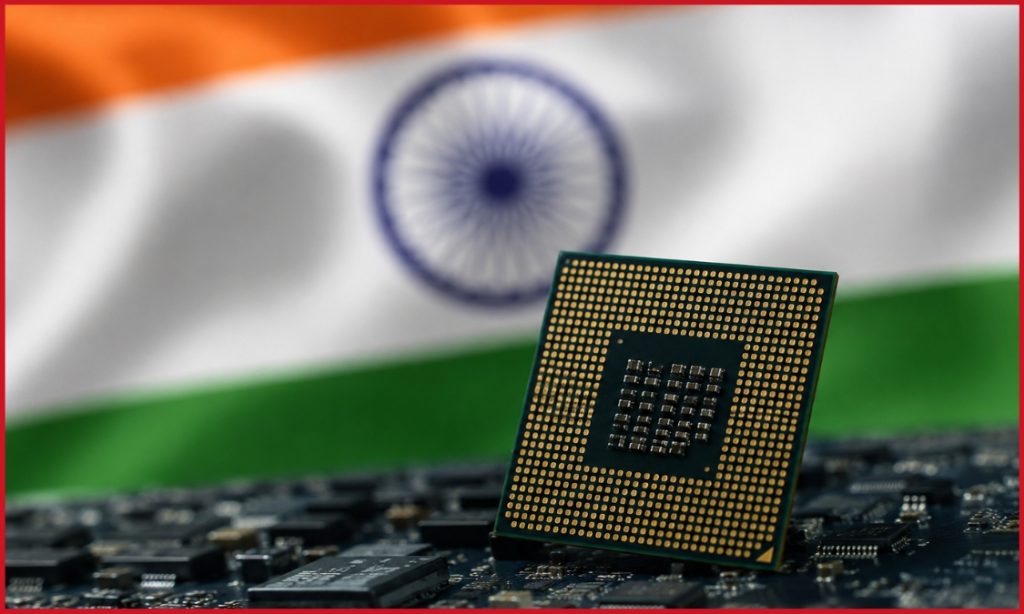
India will only achieve 15-25 percent self-sufficiency in semiconductor chips by 2030, with a longer path to 35-50 percent by 2035, according to a policy roadmap released by NITI Aayog titled “Future of India’s Semiconductor Industry.”
The report, prepared jointly with KPMG and global chipmakers, reveals that even after a decade of heavy investment, India could remain dependent on imports to meet more than half its semiconductor demand.
The roadmap positions India’s semiconductor strategy not as a race to lead in advanced chip manufacturing, but as a bid to become “an indispensable node in the global semiconductor ecosystem” through strength in design, advanced packaging, and materials science.
The self-sufficiency targets form a cornerstone of Vision 2035, which aims to build a USD 120-150 billion semiconductor value chain and capture 10-13 percent of the global chip market.
The import crisis that framed the roadmap
India currently imports 90-95 percent of its semiconductor demand, having spent USD 150 billion on semiconductor imports during FY17-FY25. Without domestic production capacity, annual import costs could reach USD 240 billion by 2035, according to the NITI Aayog analysis. This dependency poses “national security risks, especially for defence and critical infrastructure,” the document notes.
The roadmap identifies six major barriers to building self-sufficiency: technological complexity, talent scarcity, high resource requirements, market acceptance challenges from entrenched East Asian suppliers, long gestation periods for manufacturing facilities, and capital intensity that will require USD 135-180 billion in investment over the next decade.
A phased expansion with value over volume
The path to 15-25 percent self-sufficiency by 2030 hinges on a deliberate focus on mature-node logic fabs (28-65 nanometer), specialty analog and mixed-signal chips, and compound semiconductors like silicon carbide and gallium nitride. The roadmap emphasizes that India should focus on where it can “leapfrog” rather than chase the cutting-edge node race dominated by Taiwan and South Korea.
Beyond self-sufficiency in chip production, the roadmap stresses “value retention” in the supply chain. India aims to retain 35-40 percent of value by 2030 and 55-70 percent by 2035, meaning that design, intellectual property, advanced packaging, and assembly work remain within India even as it builds fab capacity. This approach signals that the strategy is about capturing high-margin activities, not just volume production.
Government and private stakes in semiconductor technology
The government will provide USD 45-60 billion of the USD 135-180 billion required, with the remaining two-thirds dependent on private investment. The roadmap calls for an “autonomous national nodal agency” with single-window clearance to streamline investment and a “full-stack incentive regime” covering design, fabs, outsourced semiconductor assembly and test (OSAT), materials, and equipment.
The talent pipeline is framed as the real constraint. While fabs can be built in 4-5 years, the roadmap notes that “talent development is slow.” India plans a four-tier pyramid: fab-ready technicians through a National Fab Academy and polytechnic network; manufacturing and packaging engineers trained in process and yield; global talent infusion targeting the Indian diaspora; and advanced researchers in materials science for frontier work in quantum and photonic chips.
The roadmap explicitly frames India’s semiconductor ambitions as contingent on partnerships. Without access to advanced chipmaking tools like extreme ultraviolet lithography systems and without proven reliability in supply chains, India cannot build an independent ecosystem. Instead, the strategy is one of “trusted nation” integration into US-aligned semiconductor networks.
The 2030 checkpoint
The 15-25 percent self-sufficiency target by 2030 represents a midpoint in what the roadmap calls the “medium-term” phase (years 3-5). Institutional setup and policy frameworks are due in the short term (0-2 years). By 2030, India should have operational fab clusters, advanced packaging centers, a talent pipeline in place, and demand anchoring from defence, telecom, railways, and electric vehicle sectors.
The roadmap notes that phased domestic chip adoption mandates will be critical. Without anchor customers willing to adopt Indian-made chips over established suppliers, the entire self-sufficiency strategy will stall. This demand creation challenge remains largely unaddressed in public discourse.
The 35-50 percent self-sufficiency target by 2035 falls in the long-term phase, by which time the roadmap expects IP leadership, materials dominance, secure manufacturing for defence applications, and deeper global supply chain integration.
India’s USD 135-180 billion total investment, with only USD 45-60 billion from the government, signals that the weight of building self-sufficiency rests heavily on private capital and geopolitical partnerships.