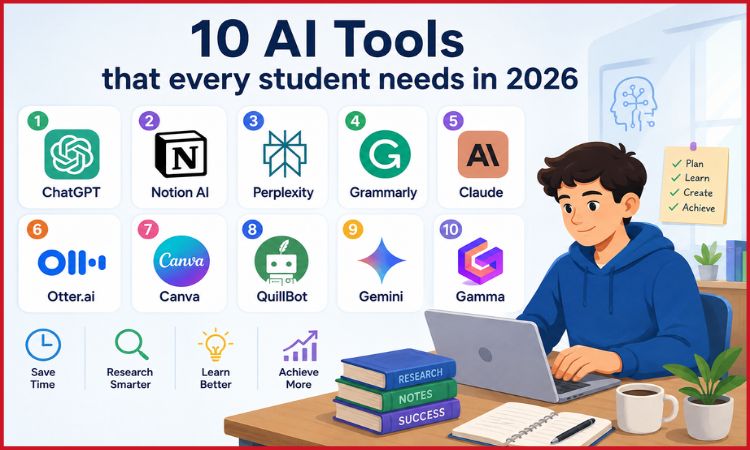
AI tools are becoming inseparable from student study routines, from doing homework, conducting research, completing assignments, creating presentations and managing stress. While chatbots were the basic tool a few years back, today we are seeing a new era of productivity workflows driven by AI assistance.
With lectures, assignments, internships, certifications, projects, presentations, and placements, students today have a wide range of responsibilities. Hence, most students are turning to AI tools so they can get tasks done more efficiently without affecting their learning outcomes.
In this article, we explore 10 AI tools that students in 2026 are increasingly depending on for research, writing assistance, note organisation, productivity, and academic workflows.
1. ChatGPT
In 2026, many students begin their learning journey with ChatGPT, before textbooks, YouTube, or a Google search. It helps students learn a complex topic, or get immediate explanations instead of spending hours on complex definitions.
The conversational nature of ChatGPT has increased its popularity. Rather than reading long texts, students can get instant follow-up responses and repeatedly ask questions until the explanation is clear. This is especially useful when learning complicated topics like coding, math, finance or data structures.
Engineers use it to debug code, clarify technical documentation, and get help in coding interviews.
Management students use it to break down case studies, prepare presentations and get ideas during projects, while also turning long lecture notes into concise summaries, quizzes, and simpler study material.
2. Notion AI
Today’s students are doing more than just submitting assignments for their respective courses. They juggle internships, certifications, placement preparation, academic projects, submission deadlines, group tasks, and personal study plans all at once. Due to busy schedules, the organisation itself has emerged as a huge academic challenge.
This is where Notion AI comes into its own. It is much more than a notes application and functions as an overall academic platform.
Students are using it to set up semester dashboards, assignment trackers, study systems and placement preparation strategies.
Lecture notes, deadlines, project specifications and research materials can be stored in this system while its AI capabilities help students tidy rough notes, generate summaries, organize study material and provide structure.
Group projects utilize the platform as a communal workspace where progress, roles and deadlines can be managed.
Productivity systems are now part of student study and Notion AI is a widely adopted tool for achieving this.
3. Perplexity
With AI-generated information becoming increasingly common, students have been showing more concern over the accuracy and credibility of such information. Universities are more focused on academic research quality, source verification and factual accuracy while grading essays, reports and research papers.
Perplexity AI is becoming a preferred choice for many students as it operates quite differently from standard chatbots. While other bots generate AI-based answers without much verification, Perplexity AI places a lot of emphasis on source-backed answers with references to web sources.
Students are using Perplexity AI widely for essay writing, technical topic research, collecting references and exploring recent studies related to fast-evolving subjects. It allows them to gather summarized information along with citations showing where it was derived from.
This greatly speeds up the research process without completely eliminating transparency.
While manual checks require researchers to go through tens of web pages, students can simply view a summary in a few seconds while also checking supporting research data.
It is becoming a useful platform for students who require AI assistance while ensuring a much higher standard of research reliability than what can be found in most conventional chatbots.
4. Grammarly
For many students, the problem is not the ideas they produce, but with how they communicate these ideas in terms of polished academic prose.
This is the main reason why Grammarly remains such a popular application at the university level and in vocational learning environments, It is becoming more of a refinement layer than just a basic spelling checker.
Students use it to write essays, reports, scholarship applications, CVs, internship emails, term papers, and research papers. It not only corrects errors in spelling, sentence clarity and readability but it also helps them maintain consistent tone, and the overall flow of their writing is smooth.
It appears to be very useful for students who do not feel fully confident when writing in English for academic or professional purposes.
Instead of completely reworking their assignments, they simply use Grammarly to improve communication while retaining the original concepts of their work.
In a situation where competition in terms of academic achievement and placements is increasingly fierce, students are beginning to understand that the presentation of their work impacts how seriously it is perceived.
Clear, logical writing can be a competitive advantage.
5. Claude
One of the biggest academic problems students currently face is having to deal with so much information; research papers, academic journals, technical PDF files, extensive documentation etc.
All of these can become overwhelming during university study.
Claude has become popular because of its ability to handle vast amounts of data much more effectively than many previous generations of AI tools.
Its ability to process extended documents and maintain consistency over very lengthy, detailed conversations is one of its major strengths.
Students are using it to analyze research papers, break down complex academic subjects, and compare contrasting points of view across different texts, as well as explain complicated theories in simplified terms.
However, it is also used to help with more advanced tasks, such as helping students extract and connect ideas between different texts, and assisting with structuring arguments for academic analysis.
By 2026 students are not only looking for answers but for an AI tool that can help them process large-scale data intelligently and this is where Claude stands out.
6. Otter.ai
Many students struggle to listen attentively whilst simultaneously trying to note down as much as possible in lectures before the information disappears from their minds.
Otter.ai appears to be gaining popularity as it relieves some of this pressure via an AI powered transcription service. Students do not need to solely focus on taking notes and can listen more closely to what is being said during live discussions.
The service is also useful for recording interviews, seminars, workshops and classroom discussions; transcribing spoken conversations into an easily searchable written document, avoiding the need to spend time re-watching videos of lectures.
This tool can become particularly useful when revising, as lectures can be quickly searched for particular points or explanations instead of going through numerous separate pieces of notes.
As blended learning is becoming more common, a tool such as Otter.ai which supports it can have far-reaching academic benefits and contribute to efficient student work and revision management.
7. Canva
Modern learning is becoming increasingly visual; students have been tasked with creating presentations, posters, portfolios, infographics, pitch decks, visual reports and more across many subjects.
However, the reality is that students are not designers and producing visually engaging presentations may require up to three or four hours each.
The user-friendly design platform Canva is among the most popular with students because of its ease of use and how its AI-powered design tools enable users to generate design templates and visuals far faster than traditional software.
By helping them bypass time-consuming adjustments in color, spacing and formatting, students can focus more on communicating their information effectively.
Canva is particularly popular in subjects such as media, business, communications, entrepreneurship and marketing as in these fields, presentation quality will have a greater impact on the success of a student’s work.
8. QuillBot
QuillBot continues to be one of the most recognised AI writing assistants, however, students are using the tool differently.
Initially, many students relied heavily on paraphrasing tools to help them rapidly rewrite essays. In 2026 students are becoming more hesitant as universities are becoming more aware of the patterns in AI-generated content.
QuillBot is therefore being increasingly used as a writing assistant instead of an essay generator.
Commonly, students use the tool to improve readability, reword poorly constructed sentences, restructure sentences or as an additional proofreading tool.
Instead of helping students fully write content for them, the platform is primarily being used to create smoother written work.
Many students struggle to formulate ideas as fast as they write, and so the platform helps generate better flowing sentences without needing students to reconstruct entire paragraphs by hand.
9. Gemini
A major advantage Gemini has over most AI platforms is its integration within the school ecosystem.
Students are spending the majority of their time already working within Google Docs, Gmail, Drive, Sheets, Meet and Classroom and workflow convenience is important to academic performance. Also, using Gemini as a brainstorming tool, for generating text, summarising notes, organizing academic data and improving productivity workflow within Google’s ecosystem.
This saves students from having to copy and paste information from one site to another, which makes working on group assignments much easier, as groups can work on shared documents while using the AI writing assistant at the same time.
As education systems become increasingly cloud-based, this ability to integrate AI into existing systems will be highly beneficial for students.
10. Gamma
A significant portion of students’ time goes into formatting the presentation, rather than improving the quality of the ideas within it.
Organizing the slides, maintaining consistency throughout the presentation, and the layout are all time-consuming factors in the production of presentation work, and students increasingly need help with this aspect of assignments.
Gamma’s strength lies in addressing these time-consuming aspects through an AI-generated presentation format.
The platform allows students to transform ideas into full presentations more quickly than typical presentation software.
Rather than adjusting each slide and the position of every text box, students can instead focus more on storytelling than presentation appearance.
This makes it incredibly useful for seminar work, case studies, business pitches, and research presentations.
Gamma differentiates itself from typical presentation software by ensuring that narrative order is paramount. Students do not simply get a faster-produced presentation, but a faster, coherent, and well-organised presentation.
The importance of responsible AI use remains
Although AI tools are proving valuable in improving student productivity, universities are also stressing responsible use.
Students are expected to fact-check, avoid plagiarism, and have a true understanding of concepts rather than simply copying and pasting from AI tools.
The students who truly benefit from AI are those not outsource learning but use it as a tool to maximize time, avoid tedious work, understand things faster, and manage the stress of university.
AI is becoming more integrated into education than ever before, and thinking critically about what is learned remains an integral part of education.
Conclusion
In 2026, students can see their study, research, writing, and productivity workflows being completely transformed by the capabilities of AI tools.
Whether students are using AI as a research assistant, a writing companion, a transcript generator, or a presentation tool, they now have tools readily available to significantly reduce repetitive academic work.
Students who know how to balance the use of AI with critical thought, creativity, and real learning are those who are most likely to be in a stronger position, both academically and professionally, in the coming years.
FAQs
1. Which is the most useful AI tool for a student to have access to in 2026?
The best AI tool to use really depends on where the student needs help. The most widely used tool for study sessions and learning tends to be ChatGPT, while in terms of research, students would probably use Perplexity. For productivity and organisation, many use Notion AI, and enhancement of writing is possible through Grammarly.
2. Are students being replaced by AI tools?
AI tools are certainly changing how students learn; however, traditional studying methods are far from extinct. For the most part, students still need to consult textbooks, attend classes for independent learning and problem-solving, and learn to grasp concepts on their own. AI is used primarily to assist with tasks that may be time-consuming or difficult.
3. Why are students in universities increasingly using AI tools?
Today’s students juggle classes, homework, presentations, projects, internship opportunities, certifications, and placement training all at once. AI tools provide students with resources to save time, learn concepts faster, and gain better understanding in an academic environment.
4. What is the best AI tool to have access to for academic research?
Students frequently suggest Perplexity and Claude for research-related projects. Perplexity AI provides users with information that can be cited and used for research on the web. Claude is well-suited for analysis of long research papers and PDFs.
5. Is it appropriate for students to use AI tools for assignment writing?
Students can and should use AI tools for brainstorming, research, proofreading, generating ideas, and improving the writing of their assignments. It is however not advisable to blindly copy work generated from an AI tool due to potential accusations of plagiarism and academic integrity violations.
6. Do students need to pay to access useful AI tools?
For the most part, students find it feasible to use the free versions of various AI tools for learning support and basic productivity needs. However, those who engage in advanced academic research, large research papers, or higher-volume tasks may find paid programs worthwhile for their needs.