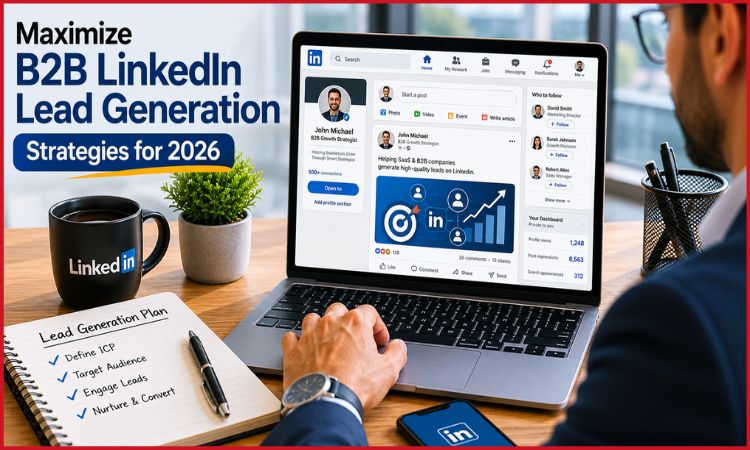
The B2B customers are flooded with information related to generic data, and LinkedIn is definitely a standout among all in being the best medium to get relevant leads. There are more than 1 billion people in the network who have been identified as the #1 B2B platform for lead generation on LinkedIn. As per the latest report from HubSpot, four out of five LinkedIn profiles influence the decision-making process in their company.
The successful organizations in today’s time are focusing more on data-based techniques and ads to attract and connect with prospects. In this blog post, we will discuss some advanced methods that would help you generate relevant leads through LinkedIn.
The Problem Statement: Traditional Outreach Isn’t Working
A Forbes Council survey shows that 42% of marketers currently experience reduced ROI through emails. Additionally, 8% of marketers consider email marketing to be an ineffective tool for lead generation.
Why LinkedIn B2B Marketing Matters?
According to 77% of business tycoons, LinkedIn creates the best organic results. The complex filters enable marketers to identify and reach specific audiences.
93% of content marketers adopt organic social media marketing techniques. LinkedIn is expected to generate up to 4 times more clicks and interactions than other social media sites.
Top 3 Tools for LinkedIn Lead Generation in 2026
1. Sales Navigator – The Sales Navigator on LinkedIn is an advanced filtering tool that will help you to find your perfect customer. The most important filters include:
(company-related criteria like:) size, industry, role, seniority, recency, location, and keyword to target accurately
2. LinkedIn Campaign Manager – LinkedIn Campaign Manager can be used to precisely target people by their job title, their industry, and company size. LinkedIn claims that Lead Gen Form campaigns provide a double conversion rate. LinkedIn uses Sponsored Content, InMail (Direct Messaging Ads), and Insight Tag (Website Visitor Ads) for measuring CPL, CTR, and CVR
3. KPI Dashboard for Lead Tracking – LinkedIn integrates with CRMs, and therefore provides tracking of Impressions, CPL, CVR & MQL Marketing Qualified Leads and Click-Through Rate (CTR). It also facilitates lead synchronization, custom field population, and cohort creation
LinkedIn Lead Generation in 2026: 4 Strategic Paths to Consider
In 2026, there are four key approaches to LinkedIn lead generation.
1. Creating an Ideal Customer Profile (ICP) – A valid ICP is crucial to any successful LinkedIn marketing campaign. Once you’ve identified your ICP, you will then be able to use LinkedIn’s advanced search capabilities, such as Boolean search, and identify important decision makers in your target organizations. ABM will help you get in touch with your desired clients.
2. Account-Based Marketing (ABM) – You can do Account-Based Marketing (ABM) using LinkedIn Matched Audiences, Sales Navigator, and Sponsored Content. You will be able to reach key decision makers and develop personalized messaging. Remember to ensure that your ABM goals align with the objective and increase conversions.
3. Organic Storytelling With Value Proposition – Be an industry expert through the magic of organic storytelling. Make sure you have an optimized LinkedIn profile with a value proposition, insights, and results.
4. Performance Analytics & Optimization – Monitor key performance indicators such as CTR, CPL, conversion rate (CVR), and probability of leads. Utilize UTM parameters in customized URLs for tracking campaigns. You can also use CRM integrations to achieve accurate attribution. A/B tests allow you to improve your messaging strategy.
5. LinkedIn Lead Gen Forms & Sponsored InMail Campaigns
Native Lead Gen Forms are one of the most seamless and effective ways to generate high-quality leads on LinkedIn. The forms are pre-filled with data from a prospect’s LinkedIn profile, so the submission process is greatly simplified: name, job title, company, and email. Use these templates with Sponsored InMail campaigns to send customized, one-to-one messages right into a prospect’s LinkedIn inbox.
6. Web & Social Media Marketing
It can increase your organic reach dramatically as your team members and current customers engage with and share your company’s LinkedIn content, without needing to spend any extra money on advertising. When people respond to, repost, or publish material about your brand, it shows that your company is credible and trustworthy to prospects who may be evaluating your business for the first time. Similarly, LinkedIn natively includes client reviews, case studies, and success stories that have a much greater impact than self-promotion messages.
7 LinkedIn Events & Webinar Marketing
Businesses can build, promote, and run virtual events straight from LinkedIn using LinkedIn’s own Events feature. Each registrant is then a “trackable lead” that can be contacted before, during, and after the event. Post-event follow-up sequences (personalized connection request + value-driven InMail messages) are one of the most effective methods to take prospects deeper down the sales funnel. Additionally, LinkedIn’s algorithm can be used to encourage users to view events on the platform that will be relevant to them later.
8. Using LinkedIn Matched Audiences for retargeting
Using LinkedIn Matched Audiences, re-engage website visitors, uploaded contact lists, and video viewers with exceptionally relevant follow-up ads. The multi-layered approach helps keep your brand relevant throughout every step of your prospect’s buying journey and also greatly helps boost campaign ROI by targeting those who are already warm and familiar with your brand and product.
How to Create a LinkedIn Profile that Generates Leads
Your LinkedIn profile is one of the first places that a potential lead will turn to when they have an impression of you or your brand. A not well-optimized profile can ruin even the best targeted outreach campaign. Taking your profile beyond the digital resume and making it a landing page can make the difference between someone reaching out and someone ignoring you.
1. Create a compelling headline – What is the name of your job? Consider changing the title from “Sales Manager at XYZ Corp” to “Helping Saas Companies Reduce Churn by 30% | B2B Growth Strategist. Write in “keyword” language that resonates with the needs of your ideal customer profile.
2. Capture the story in the About Section – The About section provides you with 2,600 characters to tell your story. Put the value, not your history, in the lead. End with a call to action (CTA): Ask prospects to call you, download a resource, or send you a direct message.
3. Make use of the Featured Section – This is a section that is not used by many, and allows you to showcase case studies, lead magnets, testimonials, or demo videos right on your profile. This piece of social proof can be strategically placed to significantly boost inbound enquiries.
4. Collect and Display Recommendations – Third-party recommendations from clients and colleagues are true social proof. Target 5 or more relevant recommendations relevant to the outcomes you produce. Researching you before responding to an outreach will get noticed.
5. Regular LinkedIn Publishing – Posting regularly, even daily, two or three times a week, lets the algorithm and the community know you are a knowledgeable and active voice in your industry. Keep it interesting by posting a variety of thought-leading articles, client success stories, industry statistics, and behind-the-scenes updates.
Conclusion
It’s no surprise that LinkedIn has become the best platform for B2B lead generation, and the difference between LinkedIn and all of the other platforms is becoming more significant by the day. With 1 billion professionals, unmatched targeting capabilities, and a host of purpose-built tools such as Sales Navigator and Campaign Manager, LinkedIn provides B2B marketers with the necessary tools to reach their right audience, engage, and convert high-quality leads at scale.
But LinkedIn results never just happen. The companies making the most money are the ones that have an optimised profile, a well-defined ICP, a steady organic content strategy, and precision-targeted paid campaigns, all backed up by solid performance monitoring and constant optimisation.
These strategies offer a clear path forward, whether you are just starting with LinkedIn lead generation or you’re trying to grow a successful program. Focus on your ICP, make it a conversion asset, invest in the proper tools, and let data be your guiding star for all decisions. The leads are found on LinkedIn, but the question is, can your approach be sophisticated enough to get to them?
FAQ
1. What is LinkedIn lead generation?
LinkedIn lead generation involves systematically researching and engaging potential customers on LinkedIn. Businesses use LinkedIn tools like advanced filters, organic content, Sponsored Content, InMail campaigns, and lead-gen forms to create a continuous flow of qualified prospects.
2. Why should you invest in B2B lead generation on LinkedIn?
There are over 1 billion professionals on LinkedIn with advanced targeting capabilities. Therefore, businesses enjoy up to 4× conversion rates when using traditional email outreach techniques.
3. What are the main capabilities of LinkedIn Campaign Manager?
LinkedIn Campaign Manager is an ad platform that allows you to:
- Campaign Management for Sponsored Content, InMail, Text Ads
- Build Lead Generation forms
- Audience Segmentation by applying filters
- Monitor impressions, clicks, CTR, CPL, conversion rates, etc.
4. What are the LinkedIn strategies for lead generation?
- Outreach Automation & Engagement
- Social Proof through optimization of personal profiles
- Tactical Audience Engagement
- Generating value-based content
- Key Performance Indicators & daily action plan creation
- Participation in relevant groups for your clients
- Use of existing customer connections
- Buying & use of search filters
- Sponsored Content ads
- Lead Generation forms