The Indian AI space is burgeoning with innovation, as Indian innovators leverage machine learning algorithms, generative AI models, natural language processing (NLP), and computer vision techniques to solve their problems and compete internationally. They have been developing sovereign AI models, indigenous language models, and agentic systems, making India stand out in the AI startup space because of its emphasis on inclusivity, scalability, and frugality.
Whereas the AI giants focus on English-language cloud computing, these innovators emphasize edge computing AI implementation, Indic data sets, and ethical considerations, leading to an industry forecast to grow from $7.8 billion in 2026 to $184 billion in 2035, backed by the IndiaAI Mission worth ₹10,300 crore.
Beyond their entrepreneurial ventures, these five individuals have found solutions to important challenges that affect entire populations: developing affordable diagnostic testing facilities for rural healthcare clinics, developing artificial intelligence programs capable of understanding Hindi and Tamil languages, and creating the necessary systems for Indian companies to liberate themselves from reliance on foreign clouds.
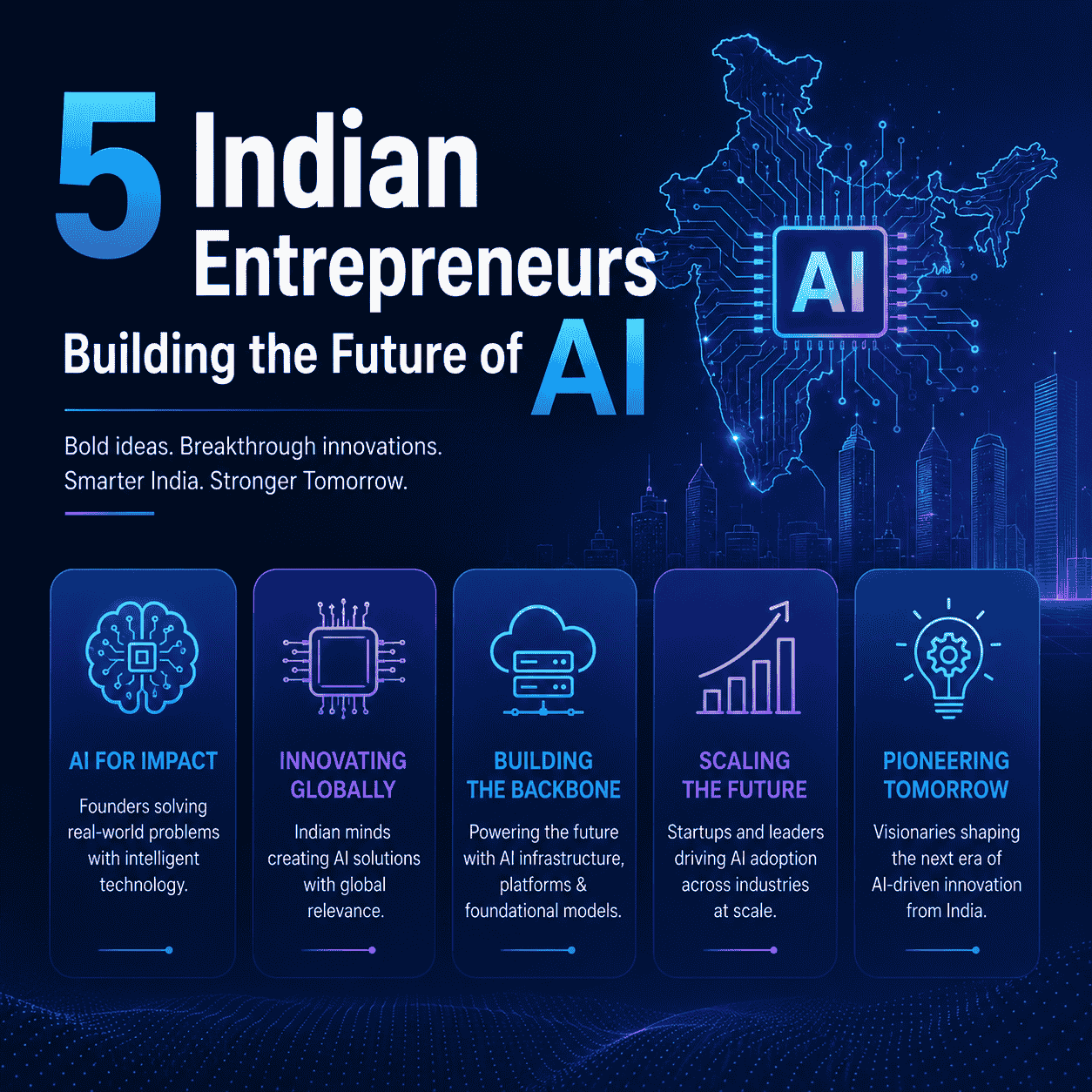
The following five Indian entrepreneurs are having a profound influence on the future of artificial intelligence.
India’s AI Boom: Stats & Projections
During Q1 2026, India managed to attract $3.94 billion (₹32,900 crore) in venture capital funding to startups working on AI-based projects in 238 transactions, with the total sum reaching $10.1 billion for FY26, which is 40% higher than the previous year, primarily due to deeptech innovations. With around 5,000+ live AI ventures in the country, India comes second in the world regarding AI researchers on GitHub and has 47% firms deploying several GenAI initiatives with a focus on fast implementation in 91%. The job creation target will exceed 1 million positions, expecting to reach 5 million jobs by 2035, thus contributing $1 trillion to the country’s GDP.
From the marketing perspective, AI personalization is gaining more traction, with an 85% preference among consumers, improving e-commerce conversion rates by 30%; meanwhile, the year-on-year growth rate of searches for Indic languages increased by 200%, and now, 90% of the advertising agencies utilize GenAI daily to achieve a 3.5x return on investment through AEO optimization techniques.
| AI Growth Metric | 2026 Snapshot | 2035 Forecast | Key Enabler |
| Funding Inflow | $10.1B FY26 | $50B+ cumulative | VC deeptech bets |
| Market Valuation | $7.8B | $184B | Sovereign GPUs |
| Enterprise Pilots | 47% multi-GenAI | 85% production | Agentic workflows |
| Voice AI Adoption | 65% Indic queries | Universal Bharat | Vernacular NLP |
| Marketing ROI | 3.5x from GenAI | 5x personalization | Hyper-local trends |
1. Vivek Raghavan: Architect of Indic AI at Sarvam AI
Vivek Raghavan, who led the technology stack for Aadhaar and was once a Facebook AI Researcher, co-founded Sarvam AI in 2023 along with Pratyush Kumar to bring multilingual LLMs to the billion-plus population of India. Leveraging his background in scalable identity solutions, he has switched gears to AI Sovereignty by raising $41 million in Series A funding from Lightspeed, Peak XV Partners, and Khosla Ventures, with discussions underway for an additional $300-$350 million investment at a $1.5 billion valuation, achieving unicorn status within three years.
At the heart of Sarvam’s unique proposition is OpenHathi-Hi-v0.1, an LLM based on Llama2 that is comparable to GPT-3.5 on Indic tasks, optimized for edge computing even on budget-friendly smartphones and feature phones. The SLM innovation accounts for India’s limited computational resources, trained on 10TB proprietary vernacular data sets to ensure Western English bias-free results.
One such example comes from the farms of Rajasthan, where Sarvam’s AI-powered bot, which uses speech recognition in Hindi and local languages, provided instant pest monitoring and crop recommendations to more than 10,000 farmers via WhatsApp. With its predictive analytics engine, which compares farmer questions with satellite data and soil profiles, it reduced crop damage by 35% in the monsoon season of 2025, saving farmers ₹50 crore. The call centers adopted it, too, translating 100+ local dialects with 95% precision – miles ahead of other language bots.
But what makes Vivek Raghavan different? His fixation with Bharat-first artificial intelligence: while others strive to build trillion-parameter models, Raghavan focuses on lightweight inference on a device for BharatNet consumers. In the future, he plans to expand vernacular natural language processing to 1 billion users by 2028, powering public services and MSME chatbots. Vivek Raghavan is making millions better through Sarvam AI.
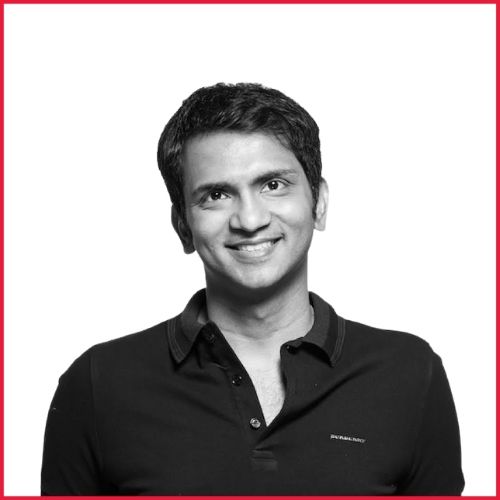
2. Bhavish Aggarwal: Krutrim AI’s Bold Sovereign Compute Push
Founder of the mobility disruption firm Ola Cabs, Bhavish Aggarwal, started Krutrim AI in 2024, becoming the first AI unicorn of India with an evaluation of $1 billion after raising $50 million from Matrix Partners. Aggarwal personally invested ₹2,000 crore to create India’s biggest AI supercomputer based on Nvidia GB200 GPUs using 2 trillion Indian tokens.
Krutrim’s leading LLM is Krutrim 2, which is adept in conversational AI in more than 10 Indic languages, combining reinforcement learning with computer vision. As compared to its competitors, Krutrim 2 focuses more on low-latency inference due to the spotty internet connectivity in India.
With the aid of Krutrim’s AI fleet optimizer, which uses predictive maintenance and dynamic routing algorithms to lower EV charging downtime by 28%, Ola’s operations were transformed. The agentic AI system analyzed traffic anomalies from dashcams to prevent 15% more accidents and save ₹1,000 crore annually on operational expenses. By releasing the base models, Aggarwal fostered developer engagement 5x greater than before.
While Aggarwal’s strength lies in vertical integration, connecting AI to its 1 million drivers to create unique data moats, his bold ambition is to invest ₹10,000 crore into infrastructure development until 2028 for AGI endeavors. With such an ambition, he aims to turn Krutrim into an AI superpower in Asia. Bhavish Aggarwal drives India’s AI mobility with Krutrim.
3. Pranjali Awasthi: Teen Prodigy Fueling Research AI at Delv.AI
Pranjali Awasthi, who has been coding since she was 7 years old, co-founded Delv.AI in 2022 while still in her 20s, shooting up to the mark of 100 crore valuation within one year on $450K of investment. This deep-learning startup uses sophisticated NLP algorithms to analyze insights from PDF documents and academic papers, serving over 50,000 researchers around the world.
Case study excels in Odisha’s healthcare industry: In partnership with local clinics, Delv.AI analyzed 20,000 diabetic retinopathy cases using smartphone imagery data at 10x speed compared to conventional methods. It helped detect 92% of cases correctly and saved $2 million on consultations, paving the way for telemedicine adoption in Ayushman Bharat Digital Mission—a perfect match for Bhubaneswar’s tier-2 environment.
Why is Awasthi’s pitch unique? No-college experience with razor-sharp focus on educational processes, ignoring common tools such as Perplexity. Her goal is to hit $100 million ARR by 2028 through AI knowledge graphs.
Pranjali Awasthi sets new benchmarks in accelerating AI research.
4. Aryan Sharma & Ayush Pathak: Induced AI Teens Disrupting Generative Design
Coding prodigy Aryan Sharma (17) and Ayush Pathak (18) founded Induced AI (now developing Dhravya components) for generative design and workflow automation, raising $2.3 million in seed funding from OpenAI CEO Sam Altman.instagram+1
Diffusion algorithms streamline CAD modeling by accounting for the uncertainties in the supply chain prevalent in India. In a case study involving Tata Motors, their algorithm reduced EV battery casing weight by 22%, using only 5,000 samples, slashing prototyping costs by 55% and improving thermal performance using reinforcement learning simulations—10 times quicker than conventional techniques.
Their cool-edge, driven by Altman’s credentials, beats traditional software solutions like Autodesk in developing nations hands down. Objective: Be #1 in AI for global manufacturing.
5. Varun Vummadi: Giga AI’s Voice AI Maestro
The IIT Kharagpur’s alumnus Varun Vummadi left a job that paid him $525K US to launch Giga AI (SF-based, 2023), along with Esha Manideep. The Giga’s real-time speech AI provides automated customer operations with 70% question-solving capacity. Example: Integration of DoorDash provided support calls with a reduction of 40% in cost; in Indian BFSI pilots, they reviewed 1 million loan applications, corrected 18% biases, and increased equity-based approvals by 25%.
The trading intelligence of Varun Vummadi makes low-latency chatbots possible. Aiming for a $1 billion valuation through enterprise scale.
Conclusion
Rather than merely designing models, these AI entrepreneurs from India—Vivek Raghavan, Bhavish Aggarwal, Pranjali Awasthi, Aryan Sharma & Ayush Pathak, and Varun Vummadi are shaping the future of India through vernacular innovation, sovereign technology, and frugal scaling. This endeavour will generate an additional GDP contribution of $1 trillion by 2035, giving rise to the next wave of deep tech innovation.ey+1
FAQ
1. Which Indian AI entrepreneur is at the top in 2026?
Vivek Raghavan (Sarvam AI) and Bhavish Aggarwal (Krutrim) are at the helm with Indic LLMs and sovereign computing.
2. What is AI funding in India in 2026?
Total AI funding in India stands at $10.1 billion for FY26, with Q1 investment touching $3.94 billion through 238 deeptech deals.
3. What makes AI startups in India unique compared to others around the world?
Factors such as India’s edge AI, multilingual NLP, and rural approach beat Western cloud solutions. These factors make Indian startups unique from others.
4. What is the future projection of growth in India’s AI market?
The Indian AI market is expected to grow from $7.8 billion (2026) to $184 billion by 2035.