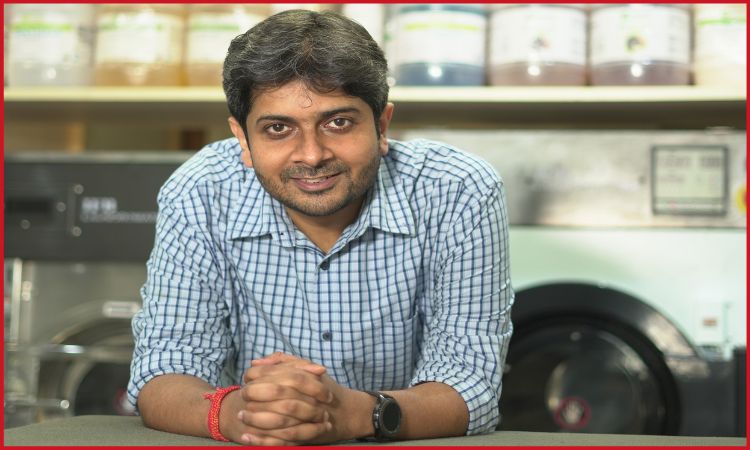
Have you ever handed your jeans to a dhobi and wondered where exactly they went? Or weighed a pile of soiled clothes by the kilogram, the way you would mangoes at a sabzi mandi? That is precisely what Arunabh Sinha, Founder and CEO of UClean, hopes more and more Indians will begin to do. And with 800+ outlets across 200+ cities in nine countries, he is well on his way to making that a reality.
Arunabh Sinha, the IIT Bombay metallurgy student who became the ‘Laundry Man of India’, is betting that India’s $36 billion laundry services market is ready to come out of the backyard and into a storefront near you.
The idea, when it came, arrived from two directions at once. Sinha was working as Director – North India at Treebo Hotels when the signal became impossible to ignore. “While managing operations at Treebo, I noticed constant complaints about dirty linens. Laundry was a major source of guest dissatisfaction,” recalls Sinha, who is based in Delhi NCR.
He says: “I realised the laundry sector was a massive, 99% unorganised market in India, dependent largely on traditional dhobis, which signalled an opportunity to offer a reliable, professional service.”
Around the same time, his wife, Gunjan was struggling with the same absence of options at home. A trip to Japan — where neighbourhood laundromats are as unremarkable as a chai stall — turned observation into conviction. UClean launched in 2016.
It was, admittedly, an unusual destination for an IIT Bombay metallurgy graduate. But Sinha does not see the irony. “Metallurgy is about efficiency and process,” he says. “I applied that mindset to a fragmented service sector.” The discipline had prepared him, perhaps more than an MBA might have, for the particular challenge of organising something messy and sprawling into something clean and scalable.
Washing dirty linen in public, on purpose
The mess Sinha walked into was considerable. India’s laundry service market was valued at $36.34 billion in 2024 and is expected to reach $44.67 billion by 2030  — yet the overwhelming majority of it remains fragmented, informal, and invisible. Competitors in the organised segment — Tumbledry, Dhobilite, Pick My Laundry, Fabricspa — have each carved out niches, but none have matched UClean’s footprint or franchise ambition. The online laundry service segment alone, valued at $2.16 billion in 2024, is projected to reach $30 billion by 2033 — a number that underscores just how early this market still is.
“The gap was standardisation,” Sinha says. “While dhobis offer convenience, they lack hygiene and predictability. Household machines, on the other hand, are time-consuming for the modern urbanite. UClean bridges this by offering industrial-grade hygiene with the personalised care of a neighbourhood shop.”
The business model he built to address this is, by design, asset-light. UClean provides the technology, brand, and supply chain — the intellectual scaffolding — while the local franchise partner invests in the physical store and equipment. “It is a partnership of expertise and capital,” Sinha explains.
“This allows the brand to scale rapidly without the capital intensity of owning every location.” First-time business owners are handed what he calls a “Playbook” — site selection, staff training, marketing, technical support — so that the learning curve of entrepreneurship is compressed into a system. “The partner doesn’t need to be a laundry expert,” he says. “They just need to be a disciplined operator of our system.”
For the customer, the experience is engineered to eliminate the oldest frustration in the category: the black box. “You get real-time tracking of your clothes via an app, digital invoicing to prevent pricing disputes, and automated notifications,” Sinha says. “It removes the black box of traditional laundry — you know exactly where your garment is and when it will return.”
From India’s backyards to Africa’s high streets
The international expansion — into the UAE, Africa, and the GCC — follows the same logic that drove UClean’s domestic growth: find the gap, fill it with process. “These markets were chosen due to their high density of bachelors and working professionals, coupled with a lack of organised, mid-market laundry chains,” Sinha explains.
The pitch to these markets is deliberate. “We aren’t just selling ‘Indian laundry’; we are selling a digitally-tracked, professional ecosystem.” Trust, he says, is built through global certifications and transparency — not brand nostalgia.
The response, he adds, has been consistent across geographies. “In India, customers value the door-to-door convenience; in international markets like Africa and the GCC, there is a massive appetite for our business-in-a-box model among local entrepreneurs.”
Back home, quality control across 800+ outlets runs entirely on data. “Every wash cycle, detergent dose, and customer feedback point is recorded on our proprietary platform,” he says. “This data allows us to identify and correct performance dips at any outlet, anywhere in the world, from our headquarters.”
It is an operational architecture that the competition has struggled to replicate at scale. While players like Tumbledry have built a tech-enabled presence primarily in north India, and Dhobilite has maintained an online-first model in metros, UClean remains the only Indian laundry brand with a verifiable multi-country footprint built entirely on franchising.
The disruption question — is UClean doing to dhobis what Blinkit did to kirana stores? — gets a considered answer. “We are organising the unorganised. Much like quick commerce didn’t eliminate groceries but changed how we buy them, we are upgrading the consumer’s expectation. We are moving the industry from a hidden backyard process to a front-end, tech-driven professional service.”
In five years, Sinha wants UClean to be the world’s largest laundry chain by store count. More than that, he wants a particular kind of cultural recognition. “A true win will be when UClean becomes the generic trademark for professional laundry services globally — synonymous with trust and accessibility in every major emerging economy.”