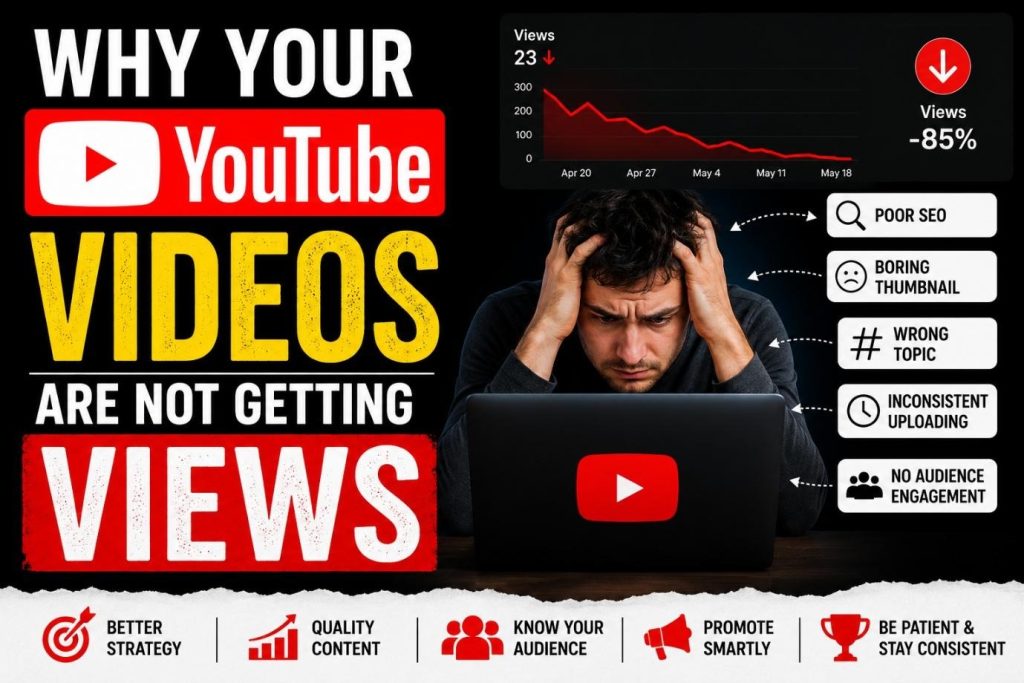
You did the work. Wrote a script, set up the camera, spent way too long editing, picked some tags, hit publish. And then… 53 views in four days. Half of those were probably you checking whether the number moved.
It’s frustrating. But low views aren’t random. There’s almost always something specific going on. Maybe several things at once. YouTube’s algorithm is constantly making decisions about which videos to show people and which ones to bury. It looks at click-through rates, watch time, retention, engagement. If your videos aren’t performing well on those signals, the algorithm just quietly stops trying.
The good news is that once you figure out which pieces are broken, most of the fixes aren’t complicated. They just require you to be honest about what’s not working.
8 Reasons Why Your YouTube Videos Are Not Getting Views
1. Video Titles Are Not Attractive Enough
Let’s start with something that takes 30 seconds to write but determines whether thousands of people click or scroll past. Your title.
“Vlog #12” is not a title. Neither is “New Video” or “Check This Out.” Those tell a potential viewer absolutely nothing about what they’d get from watching. Why would anyone click on a mystery when there are fifty other options on the same screen that clearly explain what they’re offering?
A title needs to do two things fast. Explain the value and make someone curious. From a technical standpoint, your titles also need to include the phrases people actually search for on YouTube. If you’re making a video about fixing a slow computer, the words “fix slow computer” or “speed up PC” need to be in the title somewhere because that’s what real people type into the search bar. A clever title that doesn’t match any search terms might sound good to you but it’s invisible to everyone looking for that topic.
2. Thumbnails Are Reducing Clicks
Here’s a question worth sitting with for a minute. How much time did you spend on your last thumbnail? If the answer is “I grabbed a frame from the video and added some text in Canva,” that might be a big part of your view problem.
Thumbnails display at about 320 by 180 pixels on a phone. That’s tiny. Anything you put in that space needs to read instantly at that size. One focal point. Bold text, three or four words maximum. High contrast colors. An expressive face if you’re on camera. That’s basically the formula.
What kills thumbnails: trying to cram too much in. Six different text elements. A busy background. Small details that look fine on your laptop but turn into an unreadable smudge on someone’s phone screen while they’re scrolling at speed.
Your click-through rate data in YouTube Studio will show you exactly which thumbnails are working and which aren’t. I’d bet you can see the pattern within five minutes of looking. Some creators have completely turned around underperforming videos just by swapping the thumbnail. Same video. Same title. New image. Different result entirely.
3. Not Giving Videos an Initial Push
One mistake many creators make is uploading videos and waiting for YouTube to magically find an audience. In reality, new videos often need an early boost to generate momentum and stronger engagement signals.
That’s why many creators choose to give their videos an initial push through buy YouTube views from trusted providers like Media Mister to help increase visibility during the critical first 24 to 48 hours after publishing. A steady flow of high-retention views can improve social proof, encourage more organic clicks, and make videos appear more active to potential viewers. Combined with strong thumbnails, SEO, and audience retention, this early boost can make a noticeable difference in overall video performance.
4. Videos Have Low Audience Retention
This is the one most creators don’t want to confront. But it’s probably the most important factor in whether YouTube decides to recommend your video to a wider audience or not.
YouTube tracks the exact percentage of viewers still watching at every point in your video. That data generates a retention graph you can see in your analytics. If that line drops steeply in the first 30 seconds, you have a problem. It means people are clicking on your video and then immediately deciding it’s not worth their time. The algorithm interprets that as your content disappointing the viewers it sent you. So it stops sending more.
Why does early retention drop? Usually one of three reasons. The intro is too slow and doesn’t get to the point. The content doesn’t match what the title and thumbnail promised. Or the first few seconds just aren’t interesting enough to compete with the next video that’s one swipe away.
Kill your intro. Seriously. Whatever “hey guys welcome back to my channel” routine you’ve been doing, cut it or move it to after the hook. Open with the most compelling part of the video. The result. The conflict. The question. You need to earn someone’s attention in about eight seconds. That’s the window.
And don’t stop paying attention after the opening. Every dip in your retention graph is a timestamp where you lost people. Study those dips. They’re telling you exactly what was boring or off-track enough to make someone leave.
5. Ignoring YouTube SEO
Time to switch gears into something more mechanical. YouTube is a search engine. Not just a video platform. The second largest search engine in the world. Millions of people type queries into that search bar daily. If your video is optimized for those queries, it shows up. If it’s not, it doesn’t exist as far as search is concerned.
A surprising number of creators upload videos with a one-sentence description, two generic tags, and no keyword strategy at all. That’s like opening a store with no sign on the front and wondering why nobody walks in.
Research what your audience searches for. TubeBuddy and VidIQ both show search volume data. Find keywords with reasonable volume that aren’t completely dominated by huge channels. Put your primary keyword in the title. Write a description that’s several sentences long and naturally includes related terms. Add relevant tags. Include timestamps for longer content. Name your video file something descriptive before uploading.
Each of these steps is small on its own. Together they give YouTube the information it needs to match your video with people actively looking for your topic. Videos with good SEO keep pulling in search traffic for months or years. Videos without it fade away within days.
6. You Upload Videos Inconsistently
Think about a channel you watch regularly. You probably know roughly when they post. Maybe it’s every Tuesday. Maybe twice a week. That predictability is part of why you keep going back.
Now think about a channel that posted four videos one month and zero the next. Did you notice when they came back? Probably not. You moved on.
Inconsistency hurts in two ways. Your audience loses the habit of checking for new content. And YouTube stops treating your channel as reliably active. Both reduce how many people see your videos when you do finally upload.
Once a week works for most creators. The frequency itself matters less than your ability to maintain it for months straight. Set your schedule based on your busiest, most chaotic week. Not your ideal productive week. Your realistic worst case. Then stick to that rhythm.
7. Promoting Your Videos Properly
Publishing a video and waiting for the algorithm to bring you viewers is a passive strategy. Sometimes it works. Often, especially for smaller channels, it doesn’t.
The first day or two after upload are when YouTube pays the most attention to how a video performs. Outside traffic during that window signals to the platform that people are interested in your content beyond YouTube itself.
Cut a short clip and post it on TikTok and Instagram Reels pointing people to the full video. Share in Reddit communities where your topic fits naturally. Post in Discord servers. Put it on X with a hook that creates curiosity. Use your blog or email list if you have one.
“New video just dropped” is not a hook. Nobody clicks that. “I found out why my videos were flopping and the reason was embarrassingly simple” is a hook. Give people a reason to be curious enough to tap through.
8. Content Does Not Match Audience Interest
This one can sting but it matters. Sometimes the issue isn’t your title or your thumbnail or your SEO. Sometimes it’s the video itself. You made something you were excited about and your audience just didn’t share that excitement.
It happens to everyone. But if it keeps happening, there’s a pattern worth examining. Are you choosing topics based on what you find interesting or based on what your audience has shown they want to watch?
The channels that grow fastest balance both. They check search trends. They look at which of their past videos performed well. They read their comment sections. They study what competitors are covering. They use YouTube Analytics to understand which topics brought in views and subscribers and which ones didn’t move the needle at all.
You don’t have to abandon your creative instincts. But spending two minutes on a keyword search before committing ten hours to production can save you from making a video nobody was looking for.