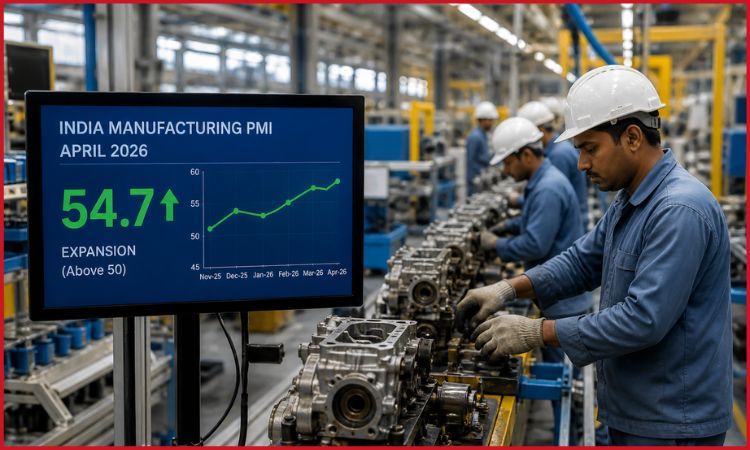
India’s manufacturing sector picked up pace in April after two months of slowdown, but the relief comes with a warning: costs are rising at their fastest rate in nearly four years, squeezing margins across the factory floor.
The HSBC Flash India Manufacturing Purchasing Managers’ Index (PMI) is a monthly survey of procurement managers across hundreds of factories that tracks new orders, output, employment, prices, and supplier delivery times to gauge the health of the sector.
The PMI rose to 54.7 in April from 53.9 in March. Any reading above 50 signals expansion. PMI data is watched closely by investors, policymakers, and the Reserve Bank of India because it is one of the earliest indicators of where the economy is headed — released weeks before official GDP or industrial output data.
Orders and hiring rise, but growth is still the second-weakest since 2022
Output, new orders including exports, and employment all grew moderately in April, pointing to continued resilience in India’s manufacturing sector. Encouragingly, employment increased at a 10-month high as firms expanded staffing in response to stronger order inflows, and finished goods stocks rose for the first time in six months at the fastest pace since 2015 — a sign that factories are gearing up for more business ahead. Export orders were a particular bright spot, growing at their fastest pace since last September.
Yet the recovery is uneven. Rates of increase were still the second-weakest since 2022, with growth hampered by competitive conditions, the war in the Middle East, and a reluctance among clients to approve pending quotes.
The Iran war is pushing up costs
Here lies the central paradox in April’s data. The same conflict that is inflating India’s import bill is also rerouting global supply chains in its favour. “Spillovers from the Middle East conflict are becoming more evident, particularly through inflation: input costs increased at the fastest pace since August 2022, and output prices rose at the quickest rate in six months,” said Pranjul Bhandari, Chief India Economist at HSBC.
Fuel, gas, chemicals, metals, and rubber are all feeding into production costs.
At the same time, the disruption is pushing global buyers to seek suppliers outside the conflict zone. New export orders grew at their fastest pace in nine months, partly linked to supply constraints affecting key trade routes including the Strait of Hormuz.  Manufacturers are absorbing much of the cost pressure rather than passing it on — the rise in selling prices remained more moderate than input cost inflation, suggesting firms are absorbing part of the cost burden to stay competitive. 
What this means for India
India has spent years positioning itself as an alternative manufacturing hub to China. The April data suggests that positioning is starting to convert into actual orders. Manufacturers remained optimistic, with confidence pinned on hopes that marketing efforts will bear fruit and that pending projects will be approved.
The risk is that margin pressure from elevated input costs erodes profitability before those pending orders fully land.