
Very few people expected Uber to grow into the leader of the global transportation industry and completely change how people travel when the company started in 2010 as just a ride-hailing app for finding local taxis.
The way Uber has developed from simply providing a way for customers to connect with drivers has changed dramatically over the past decade. Uber has transformed its model from providing only transportation services to becoming a Global Mobility Company (GMC), providing food delivery services through Uber Eats, and becoming a Logistics Provider with the establishment of Uber Freight and other services.
This article will outline Uber’s evolution from a startup to a dominant force in global taxi and delivery markets, detailing how the company generated its initial revenues, the challenges the company faced along the way, the company’s global growth strategy and plans for further expansion.
Uber Company Overview and Founding Story
How Uber Started as a Startup Idea
Founded in 2009 by Travis Kalanick and Garrett Camp, Uber originated from a simple idea born out of frustration with the difficulty of finding a taxi at busy times of day. With this in mind, the founders created a new type of transportation system that would allow riders to connect with drivers via their smartphones.
Uber started as UberCab, a service for black premium drivers. Today, Uber offers many different types of transportation to accommodate a wider variety of customers.
Key Early Milestones
| Year | Milestone |
| 2009 | Uber founded in San Francisco |
| 2011 | International expansion begins |
| 2014 | Launch of UberX (low-cost rides) |
| 2019 | Uber IPO |
| 2023–2025 | Focus on profitability and platform diversification |
Uber Business Model: How Uber Makes Money
(Image Source: collidu)
Commission-Based Revenue Model
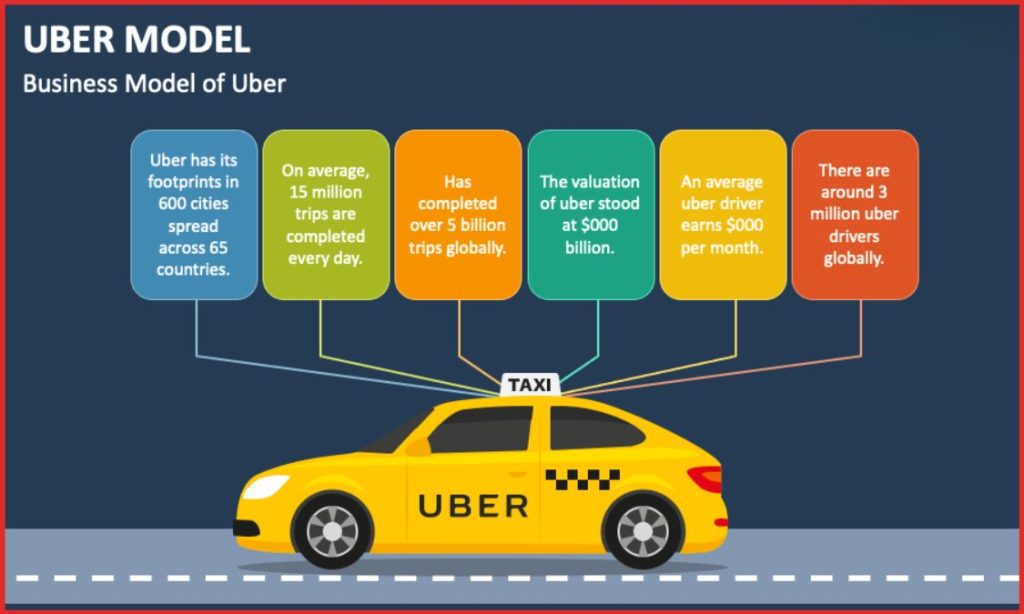
Uber has a platform-based business model that connects drivers and riders through technology and therefore does not own any vehicles. Uber earns revenue by charging drivers a commission (generally 15% to 30%) for each ride.
Multiple Revenue Streams
To lessen its reliance on ride-hailing, Uber has also grown its revenues by adding additional sources of income:
- Uber Rides – Core mobility service
- Uber Eats – Food and grocery delivery
- Uber Freight – Logistics and trucking
- Advertising & Subscriptions – Uber One membership
Uber’s Global Expansion Strategy
Entering New Markets Quickly
Uber used an aggressive international expansion strategy to quickly enter new countries, positioning itself to compete against potentially stronger local organizations. Localizing its services was achieved by changing prices and payment methods, and they also had a variety of vehicle options to meet the demands of the various countries.
Challenges in International Markets
Uber has been very successful and yet has experienced many challenges with the regulatory environment, becoming banned in Germany and China and facing protests in many of the Southeast Asian countries. In several markets, after struggling with regulations, Uber exited that country or found a local partner to be successful.
Technology and Innovation Behind Uber’s Success
Data, AI, and Smart Algorithms
The use of data analysis, machine learning (ML), and AI by Uber has helped it to better manage and control its fleet of vehicles. Surge pricing is one way that Uber continually adjusts pricing based on current demand and supply.
Mobile App Experience
The functionality of the Uber mobile app is a key component of its success. The ability to track rides in real time, pay digitally, rate drivers and vehicles, and provide safety features enhances user experience and demonstrates trust.
Uber Revenue Growth and Financial Performance
Revenue Growth Over the Years
| Year | Revenue (Approx.) |
| 2019 | $14.1 billion |
| 2021 | $17.5 billion |
| 2023 | $37+ billion |
| 2025 | Strong profitability focus |
Uber Eats: A Game-Changer for Uber
Why Uber Eats Became Crucial
Uber Eats was created as a strong growth driver, mostly due to the COVID-19 crisis. It enabled Uber to enter food delivery and grocery logistics markets while decreasing reliance upon ride demand.
Competitive Advantage
Using existing driver networks, logistics technologies, and customer bases, UberEats was able to leverage these components for operational synergies.
Leadership Changes and Corporate Culture
(Image Source: research-methodology)
Dara Khosrowshahi became the CEO of Uber in 2017 after years of aggressive leadership from the company that was riddled with controversy. Under his leadership, Khosrowshahi implemented new ethical practices, ensured that Uber complied with all applicable laws, and maintained sustainable business practices.
Because of Khosrowshahi’s commitment to ethical business practices, Uber rebuilt its brand reputation and gained investor confidence.
Key Challenges Faced by Uber
Regulatory and Legal Issues
Uber has been forced into litigation concerning driver classification, safety, and local transportation laws, forcing the company to change their business model, pricing practices, and policies.
Competition from Local and Global Rivals
Uber competes with other companies such as Lyft, Didi, Ola, Bolt and Grab, which makes developing new ideas and being an efficient business a priority.
Future Growth Strategy of Uber
Uber’s future strategy includes:
- Electric vehicles and sustainability
- Autonomous mobility partnerships
- Subscription-based services
- Expansion in logistics and B2B mobility
Why Uber Is a Global Mobility Leader Today
Uber’s successful growth is attributed to its ongoing development, diversification and innovation agenda. This continues to be true as the business has developed into a vast network of services, including ride services, food distribution, and supply chain management, all supported by a platform that is constantly evolving and meeting consumer demands.
Conclusion
The success of Uber is an example of how a small, yet strategic idea combined with technology, big data analysis, and executing on a vision can have an extreme impact on existing economic paradigms. Because of this ability to adapt and evolve, Uber has achieved the stature of a global mobility leader, despite facing many challenges and setbacks.
For new startups and business builders, the lessons learned throughout Uber’s development and growth include innovation, adaptability, and a commitment to long-term vision and sustainability.
FAQs
Q1. Why do we refer to Uber as a technology firm rather than a taxi business?
Uber utilizes technology to provide a connection between individuals needing transportation and the individual providing that service; It does not supply the vehicles or hire the drivers.
Q2. What techniques does Uber employ to balance supply and demand?
Uber utilizes real-time information, advanced algorithms, and pricing that fluctuates based on actual usage to create an equilibrium between supply and demand for rides.
Q3. What characteristics allow Uber to expand into new countries?
The minimal amount of capital needed for their operations, the technical structure (digital infrastructure) supporting their activity, and their strategy for localization cause them to be capable of rapidly scaling into new locations.
Q4. Currently, is Uber now making a profit?
They are focusing on achieving operational profitability rather than meeting a predefined level of net income. They have received more substantial income as a result of the UberEats option, and will grow financially as they optimize their business model and reduce expenses.
Q5. What industries will Uber possibly enter next?
Uber has additional possibilities for entering into the electric vehicle, autonomous vehicle, logistics, and urban mobility segments.