The Indian stockbroking industry has matured significantly over the past decade, evolving from traditional full-service houses to technologically advanced platforms that cater to the needs of a new generation of investors and traders.
India’s stockbroking sector is expanding due to rising retail participation and digital innovation in the market, with leading organisations dominating, serving millions of active clients, and reporting robust financial performance. In 2026, Indian stockbroking companies attract over 100 million retail investors, who discount brokers and technology platforms drive.
Leading companies such as Angel One and Zerodha are characterised by large active client bases, strong market share, and significant assets under management.
Background of Stock Broking Companies in India 2026
India’s stockbroking companies shifted from full-service models to discount brokerage after 2015, reducing fees and increasing accessibility. SEBI regulations and surges in demat account numbers have exceeded 150 million, thereby intensifying competition. The sector’s total assets under management exceed ₹100 lakh crore, with discount brokers accounting for nearly 80% of market share.
India’s equity markets, represented by indices such as the NSE Nifty 50 and the BSE Sensex, continue to attract retail participation and institutional investment.
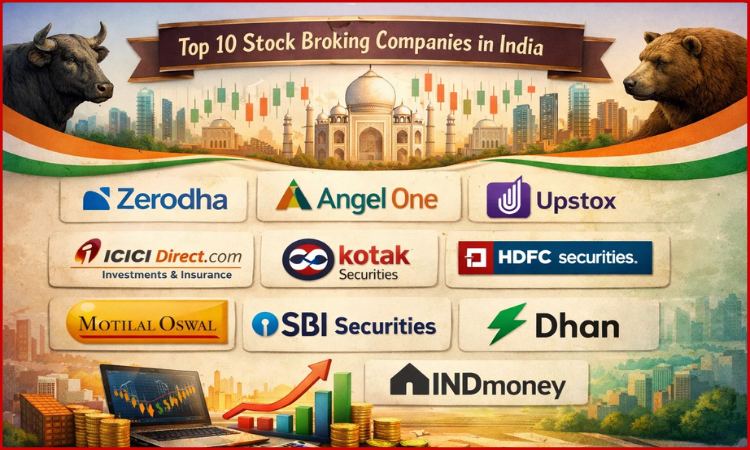
Top 10 Stock Broking Companies in India 2026
| Rank | Broker | Active Clients (Approx.) | App Rating |
| 1 | Zerodha | 7,957,128 | 3.8 |
| 2 | Angel One | 7,649,188 | 4.4 |
| 3 | Upstox | 2,789,896 | 4.5 |
| 4 | ICICI Direct | 1,938,192 | 4.6 |
| 5 | Kotak Securities | 1,491,998 | 4.4 |
| 6 | HDFC Securities | 1,488,982 | 4.6 |
| 7 | Motilal Oswal | 1,019,877 | 4.3 |
| 8 | SBI Securities | 982,704 | 4.3 |
| 9 | Dhan | 967,410 | N/A |
| 10 | INDmoney | 828,966 | N/A |
Note: Active client data is approximate and based on publicly available NSE disclosures.
Zerodha:
Zerodha is the largest stockbroker in India by active client base and is recognised for its pioneering discount brokerage model, zero brokerage on equity delivery, and a strong platform. Zerodha accounts for approximately 10% of retail AUM. Zerodha offers a clean, fast, and reliable trading experience through platforms such as Kite for trading and Coin for mutual fund investments. The company emphasises transparency, low costs, and investor education through initiatives such as Varsity, which makes it popular among both beginners and experienced investors and traders.
Angel One:
A well-established brokerage firm that successfully transitioned from a traditional full-service model to a technology-driven digital platform. This is an integrated financial services firm that offers both full-service and discount brokerage options. Angel One was praised for its seamless online trading platform and research insights. It is the most chosen among individuals because of its AI-based recommendations, strong presence across India, and integrated advisory features.
Upstox:
Upstox is one of the leading and fastest-growing discount brokers among active traders and millennials. The organisation is supported by robust technology and competitive pricing and is best known for its user-friendly mobile app, competitive brokerage structure, and advanced charting and analysis tools. It focuses on usability and performance, positioning itself as a modern alternative to legacy brokerage firms.
ICICI Direct:

A prominent full-service broker offering an all-in-one investment ecosystem, backed by the ICICI Bank. It is known for its convenient 3-in-1 account, i.e., savings, trading, and demat account. It remains a trusted choice for investors who prefer a full-service broker backed by a large private bank. Its strong customer support and comprehensive research reports made it a preferred option for most individuals.
Kotak Securities:
It offers a balanced mix of trading, investment, and research tools, supported by Kotak Mahindra Bank. Its strong advisory, research-oriented, and broad product offering make it the most well-grounded and authentic trading platform. It is best known for its strong customer support, banking integration, and reputation for institutional trust. Kotak Securities meets both traditional investors and modern traders through a blend of advisory services and digital platforms.
HDFC Securities:
HDFC Securities, a division of HDFC Bank, is a full-service brokerage and a prime choice for investors seeking stability, in-depth research, and a bank-backed ecosystem on a single platform. It is known for its extensive research and trusted brand reputation. This platform offers a wide variety of financial products, including equities, mutual funds, bonds, and IPOs.
Motilal Oswal:
It focuses on fact-based investing and wealth management, providing insightful reports and investment recommendations. Its high-quality equity research and consultative approach make it suitable for long-term wealth creation. The firm caters to retail investors, high-net-worth individuals, and institutional clients. The offerings extend beyond broking to include portfolio management and wealth advisory, making it suitable for investors seeking guidance and research-driven investment strategies.
SBI Securities:
It offers a comprehensive suite of investment products and services designed to meet multiple financial objectives. Its products have a wide range of asset classes, including equity, derivatives, mutual funds, corporate fixed deposits, bonds, insurance, loans, and Non-Convertible Debentures (NCDs). SBI Securities focuses on providing secure, reliable, and accessible investment services across India.
Dhan:
Launched in November 2021 by Raise Financial Services, it is a new-age discount brokerage designed for active traders and tech-savvy investors. It is a technology-driven financial services platform in India that offers online trading and a range of investment services for both short- and long-term traders and investors. Dhan is gaining recognition for offering professional-grade tools while maintaining a straightforward trader-focused user experience.
INDmoney:
An all-in-one Indian financial app rather than a traditional broker, for tracking, saving, and investing, which offers services like India/US stock trading, mutual funds, NPS, and family finance management for goals like wealth creation, net worth tracking, and financial planning. It was founded by a serial entrepreneur to democratise finance with a single platform. This platform is particularly popular among young professionals looking for holistic financial management and global diversification.
Analysis of Stock Broking Companies in India 2026
Market Trends
While discount brokers dominate client volumes, full-service brokers continue to capture higher per-client revenue through advisory-led models.
- Platforms such as Zerodha and Angel One collectively manage approximately 50% to 60% of active clients, who are attracted by the app’s easy mobile interface and seamless onboarding.
- Full-service brokerage platforms such as ICICI Securities and HDFC Securities are valued for their research, advisory, and institutional support services.
- SEBI’s standardisation of exchange fees and compliance enhancements have made brokerage economics more sustainable, but compressed commission rates for high-volume F&O trades.
Profit and Revenue Metrics
According to the D&B India BFSI report, the following brokers posted substantial profits and net margins in FY24:
- ICICI Securities: Approx ₹1,694 crore net profit
- Angel One: ₹1,133 crore net profit
- Kotak Securities: ₹1,311 crore net profit
- HDFC Securities: ₹950 crore net profit
- SBI Securities (SBICAP Securities): ₹452 crore net profit
Future Outlook of Broking Companies in India 2026
AI-driven trading, IPO bonuses, and U.S. market access will drive growth at a CAGR of approximately 20%. The regulatory ease of index trading facilitates expansion, and leading firms are seeking international growth.
- Integration of AI or Automation: The integration of AI will enhance market insight and automate trading recommendations.
- Wealth Management: Some major broking companies are diversifying into funding, mutual funds, and wealth management services.
- Global Market Access: The growth of US stocks and access to international assets through an Indian brokerage.
- Consolidation: Smaller brokers may merge with larger organisations to reduce rising compliance costs.
Conclusion
India’s leading stockbroking companies will provide millions of investors with low-cost access in 2026, characterised by dynamic competition, technological transformation, and strong investor participation. Stockbroking companies, such as Zerodha and Angel One, lead in scale, but full-service houses like ICICI Securities and research-focused HDFC Securities continue to offer valuable advisory and research services. As India’s investor base continues to expand, the winners in 2026 will be brokers that combine low costs, intelligent technology, and trusted advisory, rather than competing solely on price.
FAQs
Q1. What criteria define the top 10 stock broking companies in India 2026?
A: Rankings are based on NSE active clients, assets under management (AUM), revenues, and app stability in 2026.
Q2. Which Indian brokers are the best for beginners in 2026?
A: Upstox is among the most preferred platforms for beginners because of its seamless and easy app interface and user-friendliness.
Q3. What trends will be shaping the Indian broking industry beyond 2026?
A: The major trends shaping the future of stock broking in India are AI-driven insights, global trading access, wealth management offerings, and regulatory evolution.
Q4. How has AI changed stock broking in 2026?
A: AI has shifted the role of the broker from an ‘order taker’ to a ‘financial co-pilot.’ Platforms now use predictive analytics to warn users about overexposure to specific sectors, automate tax-loss harvesting, and provide real-time sentiment analysis of news.