Source: SugerMint
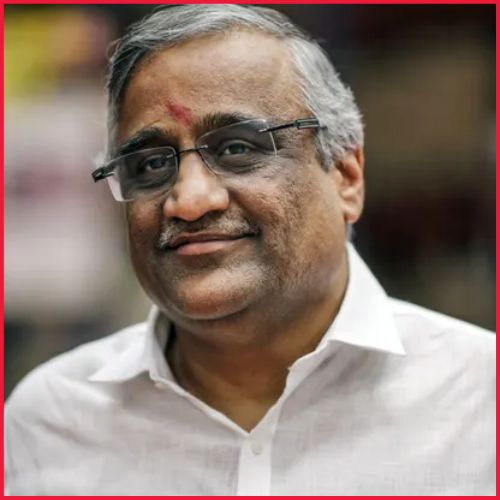
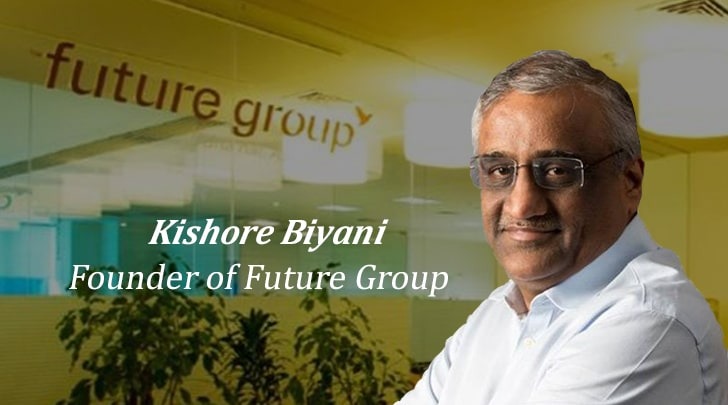
Kishore Biyani, a person who was once known as the ‘retail king’ of India, has lost everything because of his one mistake. The owner of billions has vanished from the market. Kishore Biyani is the founder of well-known brands such as Big Bazaar, India’s first retail store, and Pantaloons, a clothing brand.
The retail king of India once had a chain of retail stores that earned good profits and often registered daily earnings of more than ₹30 crores. However, a single mistake overturned the retail empire, bankrupted him, and sent him to the bottom of the insignificant.
Let’s delve deeper into the Kishore Biyani business journey: his rise, fall, and lessons to learn for Indian retailers!
Kishore Biyani Business Journey
The success story of his journey began in 2001 with Big Bazaar. During his prime era, Big Bazaar had 250+ stores across India and reevaluated the values of retailing for the Indian consumers.
| Milestone | Year | Key Achievement | Stats |
| Pantaloon launch | 1997 | First large-format store | 10,000 square ft, Kolkata |
| Big Bazaar debut | 2001 | Hypermarket format | 100 stores by 2007 |
| Future group formation | 2006 | Holding company | 1,500 stores by 2020 |
| Peak revenue | 2017 | Combined groups | $4.4 billion |
| Store network | 2012 | Nationwide expansion | 3M square ft, 35 cities |
Birth and Rise of Pantaloons
Birth
The story of Pantaloons began in 1983. After finishing college, Kishore Biyani decided to start his own business journey instead of joining his father’s business. During his college days, Biyani found that stone-wash trousers were very popular among young men, and the demand for fabric was increasing day by day in India.
After realising the demand, Biyani purchased 200 meters of fabric and sold it with a hefty profit. This made him come across the idea of manufacturing and trading fashionable stone-wash trousers instead of selling fabrics to other manufacturers.
Therefore, this idea and observation of Kishore Biyani led to the establishment of the clothing brand, Pantaloons.
Rise
Pantaloons grew at a rapid rate, and it soon opened its first retail showroom in Kolkata, where the brand launched women’s and kids’ clothing, along with men’s. The store’s colours and interior were designed to evoke a sense of calm in the shopping experience. Soon, Pantaloons made Kishore Biyani an undisputed king of fashion retail in India.
The Launch of Big Bazaar
Source: DigitalYug
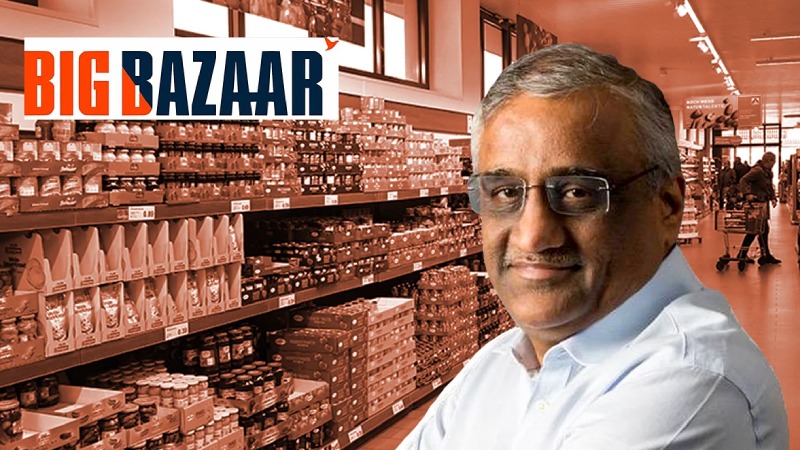
After succeeding in the fashion retail with Pantaloons, Kishore Biyani set his sights on capturing the grocery market and established Big Bazaar. He observed that people spend only 8% of their income on clothes. The necessity is still food and groceries at the top of the list.
Hence, he decided to sell groceries, stationery, food items, and jewellery, with his clothing brand.
His unique plan was to make everything available under a single roof that a human needs in their life. From clothes to groceries and kitchen essentials, and thus, Big Bazaar, India’s first retail store, was launched.
The target people of Big Bazaar were the growing middle class. So, instead of building a store that looks premium and expensive, he decided that his retail store would have the feel of a regular grocery shop.
The name ‘Big Bazaar’ was chosen to resonate with the general public and attract the middle class. The brand grew giant minted over ₹30 crore on a daily basis in no time. The aim of Kishore Biyani is to compete with local grocery shops, so his strategy is to always offer lower prices than the traditional grocery shops.
His unique plan and aim to provide every necessity under one roof established another physical footprint in Bengaluru. In 2004, he opened the 20,000 square meters Central Mall, which had everything from footwear to home decor, food, groceries, jewellery stores, food courts, restaurants, pubs, and movie theatres. An all-in-one package.
Reasons for Kishore Biyani’s Business Success
The reasons for the rise of Kishore Biyani’s Retail King Empire are as follows:
- The ideal locations of stores with good parking facilities make it easier for people to shop without worrying about their vehicles.
- The introduction of Big Bazaar Membership Cards, with appealing benefits, led consumers to prefer Big Bazaar stores over other general grocery stores.
- Innovative promotions and marketing of Big Bazaar stores, promoting offers like Buy groceries worth ₹750 and get 1 kg sugar FREE. In Chennai, another brilliant concept: Bring unwanted clothes or kitchen scraps and get discounts, which leads to long traffic queues. This type of promotion primarily targets the growing middle class.
- The building strategy of malls, with restaurants on the top floor, in select stores, and other facilities available in a single structure, is the reason for the success of Big Bazaar.
- Aggressive 1+1 offers and FREE offers, made shutters had to be pulled down due to overcrowding, which increased the sales rapidly.
- At Big Bazaar, consumers experienced true value shopping, from groceries to household goods, and apparel, all at competitive prices with shopping pleasure.
- Kishore Biyani attempted a smaller format of Big Bazaar, i.e., “Big Bazaar Daily”, which unfortunately did not succeed.
These are the factors that contribute to the massive growth of Kishore Biyani’s brand, Big Bazaar.
Biyani’s Future Group, the holding company that had all his brands like Big Bazaar, Central Mall, Easy Day, and Pantaloons under its umbrella, had the largest share in India’s retail sector and made Biyani the ‘retail king’ of India.
Reasons for the Fall of Kishore Biyani’s Business Empire
Below are the reasons for the fall of Kishore Biyani’s business and where things started to go wrong:
- The entry of large corporate players and local supermarket stores offering similar discounts has reduced differentiation.
- Failure to read the changing market dynamics and evolving consumer expectations.
- Abnormal delays in distributor payments result in stock shortages and empty shelves, which lead to disappointment in customers.
- Over-diversification into fashion and accessories diverts funds from the profitable core retail business.
- Competitors such as DMart and strong local retailers capitalised on these weaknesses, and regional chains such as Nilgiris, Ratnadeep, and Varkeys gained popularity.
- International formats like Walmart and Metro also offered a new experience for a few years.
- Finally, Reliance acquired and rebranded Big Bazaar, but even they could not revive the original magic.
After conquering the retail industry and witnessing the massive success, Kishore Biyani desired to advance into every business that directly dealt with the consumer, but this proved to be his downfall because his expansion was unplanned, which resulted in mounting debt that ultimately expanded to over ₹12,000 crore.
For that reason, he was forced to sell the Central Mall for ₹476 crore, while Big Bazaar kept going for a year despite large debts. But soon after its sales crashed, and so did Biyani’s retail empire, during the 2008 downturn. In March 2019, Biyani sold the Pantaloons brand to the Aditya Birla Group for ₹1,600 crore, while banks froze the assets and shares of the Future Group after he failed to repay his debts.
Later, Kishore Biyani sold his Big Bazaar to Reliance Retail, India’s largest retailer run by billionaire Mukesh Ambani’s daughter Isha Ambani. Reliance has now renamed Big Bazaar to Smart Bazaar.
Challenges faced by Kishore Biyani before the Fall
Let’s have a look at the key risks faced by the brands before their failure, which Future Retail didn’t consider, but it may have been the cause of its meltdown. They underestimated the significance of:
- Financial Risks: Kishore Biyani became ambitious in core retailing, and he invested heavily in ventures like EasyDay, Nilgiris, Hypercity, Ezone and Heritage, but these failed, which made him lose ₹7,000 crore in revenue. All these investments were financed with debt, which led to a heavy debt burden over the years, and the company struggled to service its obligations.
- Project Planning Risks: Future Retail entered the online business in 2007 (futurebazaar.com) and in 2013 (Franchisee-based model). Unfortunately, the model never took off, and Biyani had to shutter operations in 2016 after losing almost ₹350 crore, due to the lack of availability of low-cost internet and its usage among people.
- Over-Diversification Risks: The group’s core business was retail, but it diversified into related and unrelated businesses by entering segments such as film production, insurance, furniture, malls, real estate, supermarkets, electronics stores, and online shopping. This impacted their core business, as the group aggressively focused on expansion.
- Competition Risks: There was a rise of other strong players, such as Reliance Retail, DMart and other online giants like Big Basket, Grofers, Snapdeal, Flipkart, etc., which impacted the revenue and growth of the Future Group.
- Liquidity Risk: Future Group has incurred significant debt over the years and has struggled to pay the interest payments. In addition, there was also a significant drop in share value, which affected its liquidity.
Kishore Biyani’s Net Worth
At the peak time of his business success, Kishore Biyani had a net worth of around USD 1.78 billion in 2019, according to Forbes. However, following his bankruptcy, his current wealth is estimated to be a fraction of the fortune he once owned.
Key Lessons for Indian Retailers
Kishore Biyani’s journey is not only an example of the rise and fall of a business journey, but also inspired other retailers to learn from him.
Some of the key lessons are:
- Never become self-satisfied when the business is at its best.
- Do not diversify into unfamiliar businesses by diverting funds and consumers.
- Continuously understand consumer needs, value, convenience, and experience to evolve and deepen trust.
- Be alert to premium and efficient competitors who are entering your market space.
Big Bazaar will always remain a case study in Indian retail history. A bold vision, brilliant execution initially, and powerful lessons for the future leaders.
Conclusion
Kishore Biyani’s business journey is exceptional and stands as a major chapter in India’s retail history, marked by both the highs of vision and the eye-opening lows of ambition. For Indian retailers today, Biyani’s tale has refined into enduring lessons that echo across local markets to Delhi’s malls.
FAQs
Q1. Why did Kishore Biyani leave the retail business?
A: Kishore Biyani suffered significant losses in the last few years that forced his company into a state of liquidation. It was his impulsive decision to play on debt that cost him so much.
Q2. Who is the father of retail in India?
A: Kishore Biyani, the head of Future Group, is also referred to as the Father of Modern Retail in India, and has evolved as one of the most successful businessmen of the country.
Q3. What is the new business of Kishore Biyani?
A: Nikhil Kamath and Kishore Biyani launch The Foundery, a 90-day co-founder factory to mentor, fund, and build India’s next startup leaders.
Q4. What challenges do Indian retailers face?
A: Lack of Technology Adoption, Inefficient Supply Chain Management, Lack of Infrastructure and Logistics, Understanding customer, High Cost of Operation, Scarcity of Skilled Workforce, Price War, Frauds in Retail, and Ever-increasing customer demand are the major challenges.