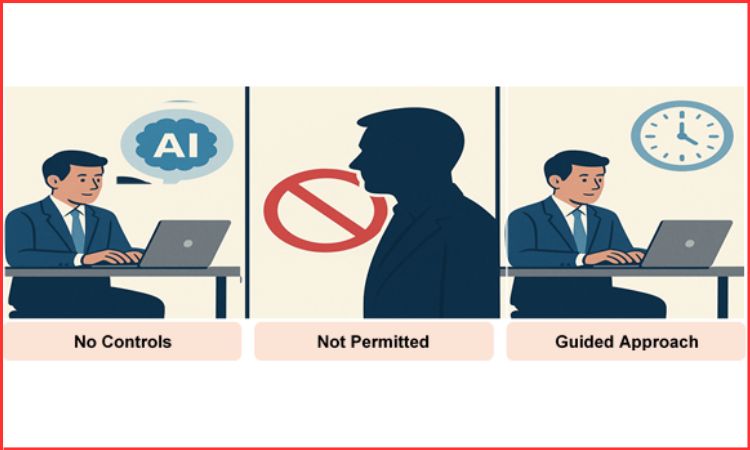
When Generative AI emerged in Dec 2023, companies responded in different ways. From banning it outrightly to taking no action at all.
Management teams discussed the pros and cons in meetings. However, no middle ground could be found at that time. Hence, it was either fully embraced or fully rejected it.
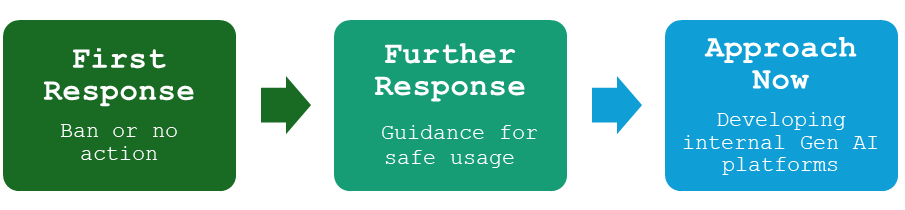
After almost two years, companies have come out of their illusion. They now believe in the potential of AI and corporates are bending the rules of the game accordingly.
Most companies have at least rolled out their first Gen AI usage policy, outlining the dos and don’ts at a broader level. The finer nuances are expected to be added in the coming months and with each evolution of Gen AI platforms.
At the core of these policies lies one clear rule that using the company’s secret recipe as a prompt is a complete no-go. However, refining it is acceptable. Instead of creating a document from scratch manually, a base draft can be generated using Gen AI and then customized to the company’s requirements.
Other important aspects of these policies are –
- Platform clearance from information security
- Prompts approval from the Risk Management Team
- All outputs are being reviewed by humans
Unless these processes are built into a customized workflow or rule engine, companies are controlling the use of Gen AI and asking employees to own their piece.
Why was there resistance in the first place?
The resistance could be categorized in three ways –
- The fear of the unknown– Before committing to it, companies wanted to observe and assess the outcomes. There were no early-mover advantages, while the potential side effects were many. So, adopting a ban approach seemed prudential.
- Data Security Concerns- The idea of data being stored in an unknown territory was a key concern. Either business models or regulatory frameworks permit many large players to store their data in foreign lands.
- Missing Clear Use case– Initially, there were no strong use cases built in. All Gen AI was one one-click search and refinement of language. Hence, it did not hold much appeal for corporate users.
How is it transformed?
While conglomerates continued to resist, many small players had nothing to lose. Hence, no guardrails were introduced at their level.
Additionally, several small technology firms built their business playbooks entirely on these Gen AI platforms. They were quick to design their infrastructure on top of generative AI platforms and try to solve real business use cases.
And boom, that pulled the key players into the game. Meanwhile, individuals began adopting GenAI models in their personal capacity. And they could discover at least one personal use case that Gen AI could help them with to improve their daily life.
And hence, GenAI became a household tool for improving productivity.
What is allowed now?
PwC in Germany has defined clear guidelines for permissible usage for Gen AI.
Similarly, Samsung has advised employees to exercise caution before sharing any data with GenAI models.
Many Indian Banks have initiated guidelines on responsible use of Gen AI models. Detailed examples and FAQs are in place for users to determine what to share with bots and what must not be.
What’s on stake?
- Data Security vs Productivity à The act of balancing this. Many tech companies have started eliminating human intervention on account of having AI in place. Significant gen AI usage is still to be recorded. At the same time, fear of data security is looming in front of industry stalwarts.
- Legal Risk àWith unknown guidelines, what it will cost to the companies is unknown. Free flow usage may tamper company’s image in the future. There is more to establish before a free pass can be issued.
- Employee Capabilities and Trust. àIt is difficult to question new joiners to the industry as they are completing their education using Gen AI models. Leaving it for corporate culture may not be easy for them. A strict no by an employer may cause concern.
- Accuracy à Models are still learning; human intervention is needed.
Conclusion
AI’s true potential is still unknown. As tech giants are turning one page at a time, businesses need to keep their guard on. It is not only for avoiding misuse of it, but also for making the best of it.
With regulators evolving each day, setting new guardrails for business. Hence, Businesses must have to be more in wait & watch situations to avoid business risk.
So far, Businesses are making vigilant moves and embracing the technology at the same time.