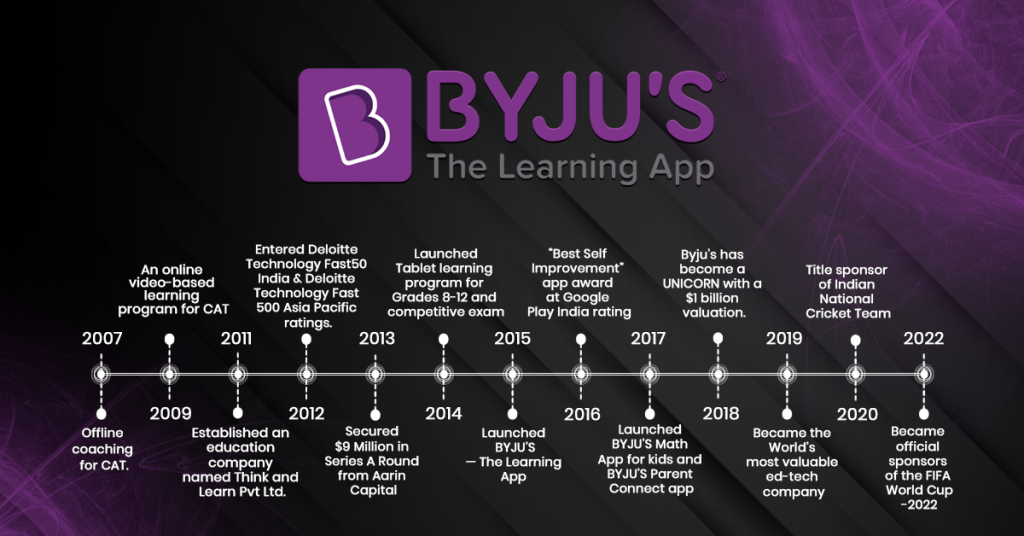
When we talk about India’s startup revolution, Byju’s often comes to mind. Founded by Byju Raveendran, a passionate teacher with a knack for simplifying complex concepts, the company grew from a small coaching class in 2011 to the world’s most valuable EdTech startup by 2021.
Byju’s changed the way millions of students learned—through animated lessons, gamified quizzes, and personalized study paths. But the story is not just about meteoric growth. It is also about financial strain, aggressive expansion, and the challenges of sustaining scale in a post-pandemic world.
This article takes you through Byju’s rise, peak, and current struggles, offering lessons for entrepreneurs and business leaders.
The Beginning
Byju Raveendran grew up in Azhikode, Kerala, where both his parents were teachers. He was a self-learner who enjoyed solving problems and even managed to score 100 percentile on the CAT exam two times, not to get his MBA, but simply as a test. Shortly afterward, he began teaching friends preparing for different competitive exams. His classes soon began to grow in popularity, from small groups to stadiums filled with thousands of students.
What was evident in these live sessions was two things: Byju was a gifted teacher, and there was a large gap in India for easily accessible, high-quality education. And from that came the idea for Byju’s.
Birth of the Byju’s App
In 2015, Byju’s Learning App was launched, which marked a watershed moment. For the first time in India, students could learn through animated videos, play gamified quizzes, and complete personalized learning paths on their mobile devices, breaking away from the rote learning culture that reigned supreme in classrooms in the country.
The app was an immediate hit. Within a year, Byju’s had 2 million users. The app brought together visual images, storytelling, and real-life examples that made complex subjects easier to understand, therefore proving that technology-based learning was indeed possible in India.
Funding and Valuation Growth
As its popularity soared, Byju’s attracted some of the world’s biggest investors. Each funding round gave the company fuel to expand further, whether by developing new features, entering new markets, or acquiring companies.
| Year | Investor(s) | Funding Amount | Impact |
| 2016 | Sequoia Capital, Sofina | $75 million | Expanded app features and reach |
| 2018 | Tencent, Chan Zuckerberg Initiative | $100 million | Added global credibility |
| 2019 | General Atlantic, Tiger Global | $540 million | Strengthened acquisition plans |
| 2020 | Silver Lake, DST Global | $500 million | Valuation hit $10.8B |
| 2021 | Multiple global investors | $1B+ | Valuation peaked at $16.5B |
This journey made Byju’s not just a unicorn but also the world’s highest-valued EdTech startup.
Strategic Acquisitions
Source:tradebrains
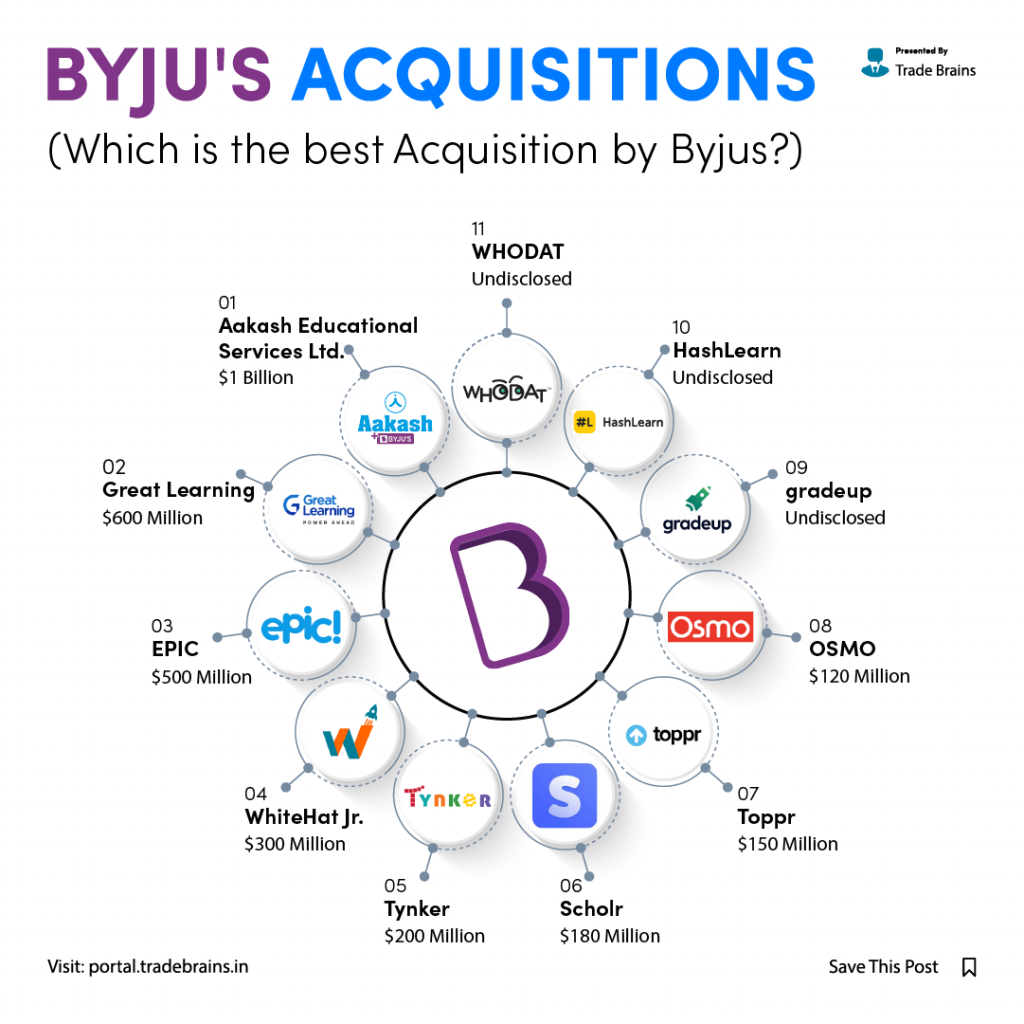
Byju’s embarked on acquisitions to grow their ecosystem. These acquisitions were also not random at all but purposely targeted acquisitions to fill gaps and to scale up across states.
- TutorVista and Edurite (2018): Established credibility in online tutoring.
- Osmo (2019): Gave Byju’s a gamified, physical-learning experience for young children.
- WhiteHat Jr (2020): Established coding and programming education for children.
- Aakash Institute (2021): Provided Byju’s entry into India’s test prep market with a $1B acquisition.
- Epic (2021): Provided onboarding into U.S. digital reading for children.
Across STEM, test prep, reading, and early learning, all have seamlessly knitted Byju’s portfolio together and finally transitioned Byju’s from a school-learning app to a profitable, diversified company.
Transforming the Education System in India
Byju’s influence on India’s education system has been revolutionary. For the first time, students from tier-2 and tier-3 cities gained access to high levels of education as their peers in metro cities. As per a KPMG report (2021), close to 80% of Byju’s users were from outside India’s top 10 cities, illustrating Byju’s pivotal role in education democratization.
Byju’s adaptive learning system allowed for a student struggling with math to go back over the topics at their own pace, whereas another student preparing for exam readiness could do endless practice until the concepts stuck. This personal approach is what sets Byju apart from traditional coaching.
Challenges
While Byju’s experienced rapid growth, the business had some significant bumps in the road. The company spent money on advertising that was too expensive on a cost-per-user basis, including ad spots with Bollywood actor Shah Rukh Khan, and there was backlash for reportedly burning too much cash. There were even reports of parents complaining about high-pressure sales tactics that stirred up ethical concerns. Once schools reopened after the pandemic boom, the rapid growth abundantly seen in educational technology slowed down at the same time as the company’s own growth slowed.
The company’s extensive acquisition spree also added financial pressure, and analysts began questioning if the company could manage rapid growth with profitability. In recent years, the company was left with no choice but to enter a restructuring phase and reshape its cost structure.
Byju’s in Numbers (Peak Years)
Source: Tvisha
| Metric | Value |
| Registered users | 115 million+ |
| Paid subscribers | 7 million+ |
| Countries served | 120+ |
| Peak Valuation | $16.5 billion |
| Employees | 50,000+ |
Future Ahead
Moving forward, Byju’s plans to focus on sustainability alongside growth in the coming years. Attention will be pivoted toward:
- AI-powered adaptive learning facilitates intelligent personalization.
- A proliferation of the global footprint into new markets, including the USA, the Middle East, and Latin America.
- By developing hybrids of digital content and offline centers such as Aakash.
- Strengthening partnerships with schools or governments to deliver tech directly to classrooms.
If they can do this carefully, Byju’s would transition from a startup giant to an international education leader.
Conclusion
Byju’s has shown that regardless of your geographic location, big dreams can start in small towns. One man fell in love with teaching and turned that passion into a business that transformed the way millions of students learned. Byju’s may be facing challenges today, but it remains a symbol of India’s startup mentality and an example of how innovation can have an impact on education.
Byju’s is not just an organization; it is a movement. They have shown the world that education can be fun, consistent, and global.
FAQs
Q1: Who started Byju’s?
Byju’s was started in 2011 by Byju Raveendran as a coaching center that became a global education technology app.
Q2: How is Byju’s different from other education technology companies?
Byju’s differentiates itself by using animated videos, gamification, and adaptive learning technology.
Q3: What are Byju’s major acquisitions?
Byju’s major acquisitions are the Aakash Institute, WhiteHat Jr., Osmo, Epic, and TutorVista.
Q4: How many users does Byju’s have?
At its peak, Byju’s stated it had 115 million registered users and over 7 million paid users.
Q5: What is relevant to Byju’s today?
Current issues are a lack of money, growth following Covid is slower than hoped, and investigations into its sales practices in the education space.