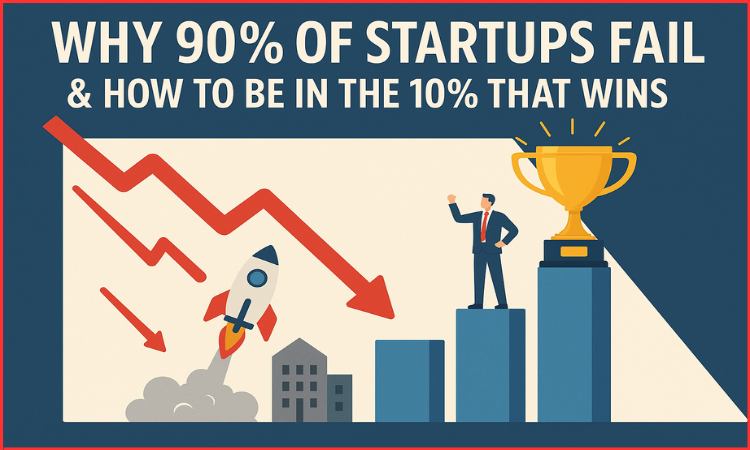
Every day, thousands of entrepreneurs start new companies with great hopes, but the harsh reality is that ~90% of startups fail. If you can truly understand why so many fail and what the successful 10% do differently, your chances of being part of the success will be better. This piece will cover the essential reasons why startups fail and what successful startups do and provide a practical roadmap that you can apply to your own projects to improve your odds.
Startup Failure Statistics
| Metric | Statistic | |
| Startups that ultimately fail | Around 90% | |
| Failures in first year | ~10% | |
| Most common failure reasons | Poor product-market fit (~42%), cash issues, team/leadership problems |
These numbers reveal that while starting a company is a long shot, it is not a lottery. The first year is tough, but the biggest challenges often come during scaling and sustainability. Understanding why startups fail helps you prepare, adapt, and reduce risk.
Key Reasons Why Startups Fail
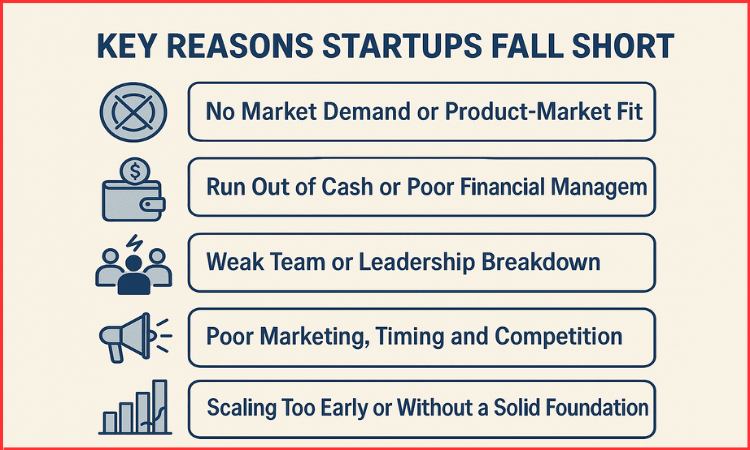
These are the most frequent reasons that pull many startups down into the 90% category and why they matter.
No Market Demand or Product-Market Fit
- Approximately 42% fail because they created a product nobody wants.
- If you build something that the market does not want, nothing else you do (marketing, funding) will matter.
Run Out of Cash or Poor Financial Management
- Many fail because of cash-flow difficulties, lack of funding, mis-budgeting, etc.
- If you don’t have enough runway, you cannot iterate, market, or pivot.
Weak Team or Leadership Breakdown
- The dynamics of the founding team, skill gaps, or misalignment can sink a startup.
- The best ideas need execution and that is where leadership, discipline and alignment come into play.
Poor Marketing, Timing and Competition
- A good product will fail if there is poor marketing and/or the timing is not right.
- Many underestimate competitive forces or delay too long until saturation.
Scaling Too Early or Without a Solid Foundation
- There is a phenomenon known as “premature scaling,” which often leads to chaos: increased costs, operational breakdowns, and quality issues.
- It’s generally better to build a stable core before you charge ahead.
What the top 10% do differently to succeed
Instead of being lucky, the successful minority adheres to specific patterns. Here is what distinguishes them.
Deep understanding of the customer and market
- They are quick to validate demand, build an initial version of their product, and iteratively hone it to customer feedback.
- They live by the motto “I am solving a real problem” as opposed to simply creating what is easiest for them to build.
Financial discipline and strategic financial planning
- They watch their cash closely, manage their cash burn, and plan for contingencies.
- They track and treat the key metrics seriously, like customer acquisition cost (CAC), lifetime value (LTV) and payback terms.
Strong, supportive team and leadership
- The founding team usually has complementary, varied skill sets (business, product, and technical) and has mutual trust.
- They adapt roles when the company scales, figure out how to bring in talent, and have no choke points with the founders.
Lean and agile with smart scaling
- They start small, test hypotheses, and pivot very quickly when required, and when it is timely and validated, they do scale.
- They let data do the decision-making and don’t just assume success will happen.
Clear vision, flexibility and focus on execution
- They remain clear-minded on the mission but can be flexible in their approach.
- They have a focus on execution; a great idea without execution is likely still a failure.
The Guide: How You Can Be Among the 10
Here is a practical guide to improve your chances of success.
Step 1 – Validate Your Idea
- Conduct customer interviews and market research to back up your assumptions.
- Create a Minimum Viable Product (MVP) and solicit feedback.
- Look for early indicators: are people willing to pay for it or use it?
Step 2 – Build the Right Team
- Make sure to have co-founders or early team members in place you can count on, covering the fundamental initial startup functions (product, marketing/sales, and operations).
- Synchronize goals, roles and incentives early.
- Engage advisors or mentors with experience in startups along the way.
Step 3 – Manage Finance and Metrics
- Create a realistic budget and control cash burn.
- Have a good grasp of key startup metrics (CAC, LTV, churn, growth rate)
- Always know your runway (how many months do you have to operate without cash).
Step 4 – Iterate, Learn & Pivot
- Use data and feedback to refine your product and go-to-market strategy.
- Don’t be afraid to pivot if there is no demand, but be purposeful about a pivot.
- Only scale if you have traction with real users/customers.
Step 5 – Scale Carefully with Intent
- Build repeatable processes and logic for marketing and operations in a way that will support growth.
- Determine what technologies, culture, and systems will support scaling.
- Check in on how you are performing and pivot as necessary as you grow.
Common Mistakes to Avoid

Source: edify
- The rush to scale before finding product-market fit.
- Overlooking the significance of marketing and sales in the early stages.
- Thinking customers will just find you automatically.
- Fulfilling cash-flow planning, or depending purely on funding.
- Founder disagreements, no delegation, or imbalances in skills.
- Fixating on one way of engaging customers in discovering your product without figuring it out from market signals.
Conclusion
Starting a business is risky, but failure is not inevitable.
By understanding why startups fail, validating real demand, managing finances, building a strong team, and iterating quickly, you increase your chances of joining the successful 10%.
Success will not come from avoiding the risks, but by managing the risks wisely while making it productive to achieve disciplined execution, consistent learning, and relentless execution of an examined process.
FAQs
Q1. Is the statistic that 90% of startups fail true?
Yes. Recently conducted research estimates that ~90% of startups ultimately fail, illustrating the high risk of entrepreneurship.
Q2. When in a startup’s life cycle do they most often fail?
While ~10% fail in the first year, quite a few fail in the second to fifth year when teams are scaling and have to manage market dynamics.
Q3. What is the best way to increase the probability of success for my startup?
Reverberate product-market fit; build a great team; understand your finances; iterate from feedback; and only scale when you are proven to have traction.
Q4. Can a startup succeed without funding?
Yes. Many successful startups grow through revenue by maintaining strong unit economics and discipline.
Q5. What are the early warning signs of failure?
High cash burn, weak revenue growth, team misalignment, customer churn, unclear business model, or no path to scale.