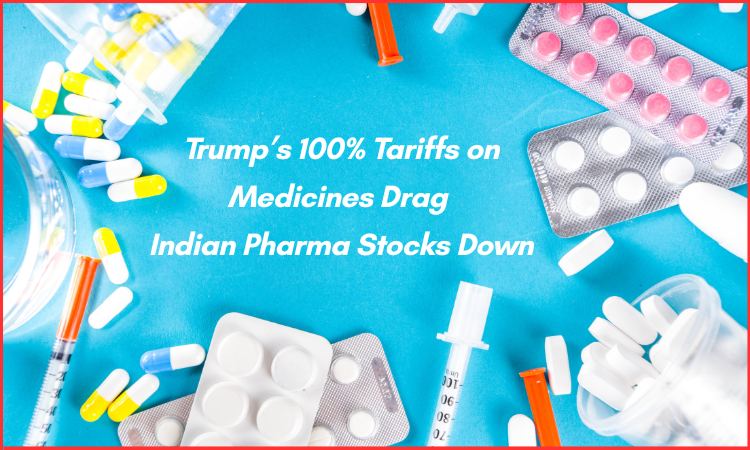
On Friday, September 26, pharmaceutical stocks in India fell sharply after President Trump said all imported, branded, patent-protected medicines will be hit with a 100% tariff from October 1.
Market Reaction in the Pharma Sector
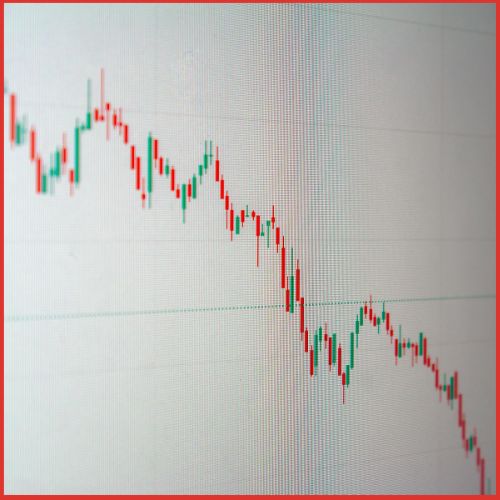
The announcement resulted in severe selling of pharma shares on Dalal Street.
- Sun Pharma plunged the most, as it declined 5% to ₹1,547, the lowest level it has been this year.
- Biocon fell 3.3% to ₹344.
- Zydus Lifesciences decreased 2.8% to ₹990.
- Aurobindo Pharma dropped 2.4% to ₹1,070.
- Dr. Reddy’s fell 2.3% to ₹1,245.30.
- Lupin and Cipla both decreased by 2% to close at ₹1,923.30 and ₹1,480, respectively.
- Torrent Pharma fell the least at 1.5% to ₹3,480.65.
- By 9:30 am, the Nifty Pharma Index was down 2.54%.
Trump’s Comment
Trump posted the information on the Truth Social website. He wrote, “Starting October 1st, 2025, we will be imposing a 100% Tariff on any branded or patented Pharmaceutical Product, unless a Company IS BUILDING their Pharmaceutical Manufacturing Plant in America. “IS BUILDING” will be defined as, “breaking ground” and/or “under construction.” There will, therefore, be no Tariff on these Pharmaceutical Products if construction has started. Thank you for your attention to this matter!” he wrote.
Effect on Indian Pharma
This development poses a significant concern for Indian drug companies. The U.S. market accounts for a significant portion of the revenue for companies such as Sun Pharma, Dr. Reddy’s, Cipla, Lupin, Aurobindo Pharma, and Zydus Lifesciences.
Biocon, Syngene, Gland Pharma, and Piramal Pharma, among other companies, are also dependent on the export of generic, biosimilars, and specialty medicines to the United States.
With their own tariffs, these companies could face lower profits or be required to invest in building plants in the US, which is time-consuming and expensive.
Banking and market expert Ajay Bagga told news agency PTI that Trump’s latest decision has added a new layer of uncertainty.
“The 100 per cent tariffs announced on branded pharma imports can potentially impact over USD 233 billion of US pharma exports. Indian generic drug exporters should be exempt for now, which safeguards most of the USD 12 billion of Indian pharma exports to the US,” he said.
What’s Next
Analysts believe stocks of companies whose business depends on U.S. sales may be under pressure in the near term. Conversely, analysts point out, Indian companies that focus on the domestic market only might thrive with shifts in global supply chains.
The administration and industry specialists anticipate closely monitoring the situation, as this policy may reshape trade in the global pharmaceutical sector.