The success story of Srikanth Bolla is a compelling example of resilience, innovation, and inclusive leadership. Srikanth was born blind in 1991 in a small village in Andhra Pradesh. He faced many social and educational implications. Although he was denied admission to the Indian college as a blind person, he was awarded a scholarship to attend the Massachusetts Institute of Technology (MIT).
At MIT, he continued to shape his vision for inclusive growth. After graduating from MIT, Srikanth moved back to India and founded Bollant Industries, a sustainable packaging company that employs hundreds of differently-abled workers. Today, the company has crossed an estimated value of $100 million, as well as achieved significant social impact and environmental progress.
The journey of Srikanth Bolla from rejection to global recognition shows that the real vision comes from purpose, not from sight. His story is not only inspiring but also a testament to what is possible in the areas of entrepreneurship, innovation, and human potential.
The Early Life Challenges Impacted a Visionary
Born Blind (1991-2000)
Imagine being born into a world you would never see. This was ultimately the case for Srikanth Bolla, born in 1991 in a small village in Andhra Pradesh, India. Neighbors told his family (parents making less than $2 a day) that it would be best to abandon their blind baby. “What is the point in raising him?” people said.

Source: Times Of India
However, his parents decided not to abandon him. They decided to choose love over fear.
Living blind in rural India was not just difficult, it was virtually impossible. There were none of no basic conveniences available for visually impaired people. Should schools facilitate the education of blind children? Miles away! Yet, young Srikanth was anything but ordinary. He developed a fierce curiosity about the world around him.
He learned to navigate through clearly identifiable sound and touch. While other kids played cricket, Srikanth invented his games, developing problem-solving capabilities he would draw upon later in life. He turned limitations into launching pads.
His mother was his first teacher, painting pictures only he could envision with descriptions of colors, shapes, and the world around him. For years, Srikanth’s father physically carried him on his shoulders to school. The weight of his son’s future was positioned atop his shoulders.
“My parents are my heroes,” Srikanth frequently says. “They couldn’t read or write, but they taught me one of life’s important lessons: ‘Disability is only a matter of perception.”
Barriers to Education and Discrimination in India (2000-2006)
Srikanth’s real struggle began when he entered the educational system. School officials were not simply hesitant to accept him; they were outright hostile. They questioned, “What will a blind boy do in school?” And, in most cases, he encountered a continual stream of rejection from teachers uncertain how to make their classrooms inclusive for him.
Srikanth sat in classrooms where:
- Teachers routinely ignored that he was even there
- Classroom lessons were fully visual without any accommodations
- Classmates were unwilling to partner with him
- Exams were never made available in Braille
Nonetheless, he achieved greater academic success than his classmates. While his peers read aloud their textbooks to him, he memorized the entire text. He had developed a photographic memory, an ironic feat for a person who had never seen a photograph.
The discrimination was blatant: even school officials personally told him, “You are taking a seat away from a normal student.” Still, Srikanth persisted, achieving the highest scores possible and effectively silencing any critics after every test. When classmates asked him how he studied when he could not see, he would grin widely and reply, “I may have no eyes, but I have vision.”
Fighting for the Right to Study Science (2006-2008)
Then came high school, which was the greatest challenge of all. Srikanth wanted to study science. The Indian authorities were blunt: “Science is not for blind people.” Their rationale? How could you do lab experiments without sight? How could you understand visual concepts, such as light refraction or cell division?
The system was rigged. Learning about science education and for students with disabilities was not only discouraged, it was explicitly banned by policy, so he had to work with school administrators who persuaded him to pursue his art subjects, telling him it was “for his good.” Srikanth was having none of this. He stood up to the system and took his battle to the Andhra Pradesh High Court. His argument was simple and profound: being denied education in science was a violation of his rights. He fought for months, and he won. But winning in court was just the first step: he still had to prove himself across the classroom.
Srikanth created innovative ways to make sense of scientific concepts. He created 3D models to understand geometry. He used the differences in the texture of the material to explain diagrams. He made up his way to work through complex equations. In the face of impossibility, he graduated at the top of his science class. “They told me I couldn’t do it,” Srikanth says. “It only made me even more determined to show everyone I could.”
The Turning Point: Rejected from IIT and Enrolled in MIT (2009)
After he had smashed both the General and Advanced Mathematics exams with an astonishing 98 percent average, Srikanth set his goal on gaining admission to the Indian Institutes of Technology (IIT) – the most respected engineering schools in India. The result was just another door slammed in his face.
IIT denied him admission explicitly because of his blindness. He concluded that even if he got a remarkable score, his disability disqualified him from admission. That rejection may have decimated him. However, the rejection redirected him. If India did not see him as a useful member of society, perhaps America would. Srikanth applied to eight different U.S. universities, including the most prestigious institutions: MIT, Stanford, and Berkeley. The results shocked everyone. Srikanth received acceptance offers from everywhere.
The Massachusetts Institute of Technology (MIT) offered him a full scholarship. In 2009, after landing at Logan Airport in Boston, Srikanth was carrying more than luggage. He was carrying the burden of proving to everyone what was possible. At MIT, he found an environment that was set up for innovation, not limitation. Many of his professors indicated that his blindness was not an absolute handicap, but simply a different way to comparably view the world. Srikanth majored in Management Science and focused on developing business models that were universally designed and provided inclusive solutions.
“MIT taught me disability is just a different ability”, Srikanth explains. “In America, I was judged by my potential. In India, I was judged by my limitations.” This encounter became the model for his next assignment: to return to India to change the very system that excluded him.
Founding Bollant Industries: A Business Breakthrough (2012)
After college, Srikanth had job offers from international companies. But he took a different direction, returning to India to represent real problems.
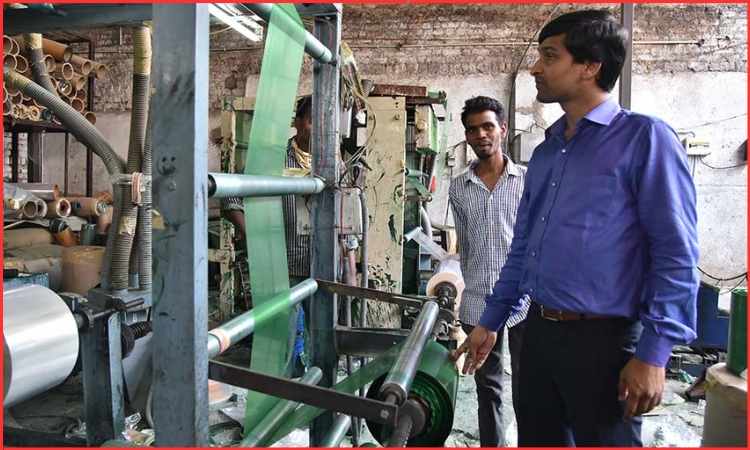
In 2012, Srikanth started Bollant Industries, a manufacturer of sustainable packaging products made from recycled paper and agricultural waste. What was unique about Bollant was not just the product, but also the people. Srikanth established the company to hire disabled and unskilled workers. He created a workplace where inclusivity and productivity could coexist.
Source: The Week
With the support of Ratan Tata and various other well-known investors, Bollant Industries quickly scaled to become a $100 million company. Under Srikanth’s leadership, the company was able to grow into five states and have multiple production units, with hundreds of direct employees and thousands of indirect beneficiaries.
Srikanth Bolla didn’t just create a company; he built a movement around accessible entrepreneurship, sustainability, and human dignity.
Breaking stereotypes in Indian Entrepreneurship
Srikanth’s success story broke stereotypes on multiple levels:
- A blind entrepreneur in manufacturing: Srikanth confronted the stereotype in an industry characterized by processes involving manual labor and visual inspection to show that adaptive processes and inclusive systems could be even more efficient.
- An eco-friendly industrialist, Bollant Industries, took on two issues simultaneously: providing jobs for the disabled and addressing plastic waste by producing biodegradable products made of industrial waste.
- Tech for sustainability: Srikanth created an automation model that could be run by visually impaired people to create a blend of technology and sustainability.
In summary, Srikanth Bolla not only challenged the stereotypical norms of Indian industry but also broke down the playbook to talk about what it means to be a successful entrepreneur with a disability.
Social Impact and Changing Lives
To measure Bollant Industries’ success, you have to look beyond the numbers. The true measure of success is daily lives changed for the better.
- Jobs for the differently-abled workers: Bollant employs more than 60 per cent of differently-abled workers, who were previously unemployed or marginalized.
- Jobs for rural communities: By establishing manufacturing units in semi-urban and rural areas, Srikanth gave jobs to people in the places where jobs were needed the most.
- Environmental impact: The company utilizes biodegradable raw materials and waste recycling processes to minimize its carbon footprint and do its part in fighting against plastic pollution in India.
- Srikanth Bolla’s impact is more than money: He is helping build a better, fairer, more sustainable, equitable, and inclusive India.
Insights from Srikanth’s Success Story
Srikanth Bolla’s path offers powerful lessons around resilience, innovation, and purpose-led entrepreneurship:
- Limitations are often societal, not personal: People said Srikanth was incapable, not due to abilities, but because of a societal view of disability.
- A purpose is stronger than obstacles: He didn’t just want to win, he wanted to change the system that once excluded him.
- Inclusion is a business advantage: Srikanth has demonstrated, compellingly, that a company can include people from different backgrounds and still achieve high levels of productivity and profitability.
- Adversity builds innovation: Srikanth started from learning through touch and inventing his study aids; he converted his challenges into new ways of being creative.
- Making a difference is a real difference: By employing persons with disabilities and focusing on sustainability, he formed a company that supports people and the planet.
Conclusion: Srikanth Bolla’s Success Story Is a Guide for Purpose-led Business
The Srikanth Bolla success story is more than overcoming blindness; it is about dismantling barriers, redefining leadership, and creating an inclusive India. Srikanth has shown that true vision can be found in resoluteness and purpose. His company stands today as a sustainable packaging and inclusive employment leader that exemplifies socially responsible entrepreneurship at its best.
Srikanth’s journey is an inspiration for entrepreneurs, change-makers, and for anyone who has ever been told “you can’t.” He is rewriting the script about disability, innovatively sustaining impact. The Srikanth Bolla success story shines a beacon of hope as India looks to be a more just and equitable society and demonstrates what can be achieved with ambition and determination.
FAQs
1. Why did Srikanth Bolla focus on sustainable packaging?
Srikanth combined his interest in addressing environmental issues with inclusive jobs by utilizing sustainable packaging as well as aligning with India’s initiatives to reduce plastic pollution.
2. Is Bollant Industries a for-profit or social enterprise?
Bollant Industries is a for-profit company with a strong social mission, reinvesting in inclusive hiring and sustainable manufacturing processes.
3. How does Bollant Industries train visually impaired workers?
Bollant uses custom-built machines with tactile interfaces and job-specific training programs to let differently-abled employees perform independently and efficiently.
4. Has Srikanth Bolla won any national or international awards?
Yes, Srikanth has accepted several awards, such as the NDTV Indian of the Year award, as well as recognition from the United Nations for his work on disability inclusion.
5. What is Srikanth Bolla’s success story?
The Srikanth Bolla success story is about a blind boy from rural India who overcame societal barriers to study at MIT and later founded Bollant Industries, a $100 million company focused on sustainability and inclusive employment.
6. What are the main products produced by Bollant Industries?
Bollant produces biodegradable plates, cups, packaging materials, and paper products produced from recycled paper, natural fibers, such as sugarcane and wheat bran.