In a world where startup technologies are rising, the general belief often guides a predictable path of raising venture capital, growing rapidly, and aiming for a lucrative exit through acquisition or IPO. However, one company has defied this playbook entirely by creating a multi-billion-dollar global software empire without raising a single rupee of external funding.
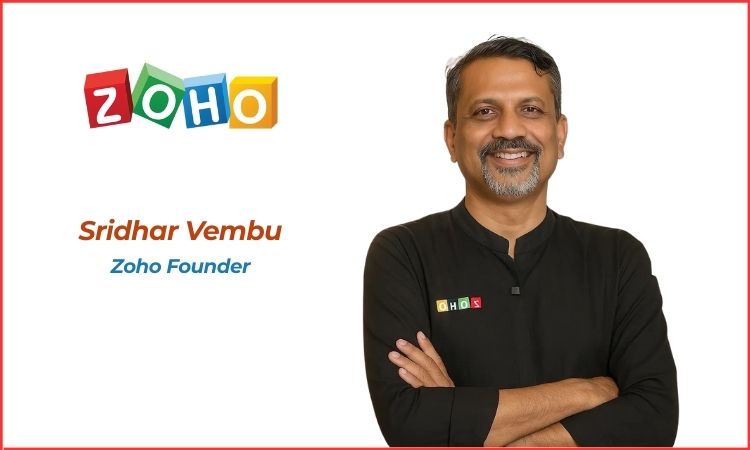
This is a remarkable story of Zoho Corporation and its visionary founder, Sridhar Vembu– a bootstrapped SaaS powerhouse. With over 100 million users globally across more than 55 business applications, Zoho has become a global giant entirely through bootstrapping. The company reported global revenues of approx US$1.5 billion in 2024, with a year-over-year growth of 27%, all while remaining privately owned and debt-free.
Sridhar Vembu’s Early Life & Education
Sridhar Vembu was born in Thanjavur, Tamil Nadu, in 1968, in a middle-class family. He began his journey far from the glamorous tech hubs of Silicon Valley.
He attended a local Tamil-medium school till the 10th grade and excelled in Science and Mathematics, and topped the Class 12th exams. He also secured the 27th rank in the IIT Joint Entrance Exam, earning a degree in Electrical Engineering, B.Tech from IIT Madras in 1989.
Sridhar Vembu pursued a PhD in Electrical Engineering at Princeton University, completing it in 1994 with research in advanced engineering topics.
His journey is a remarkable example of disciplined innovation, rural empowerment, and customer-centric growth, which has achieved around $1.5 billion in revenue by 2024.
AdventNet to Zoho Corporation
(Image Source: The Story Watch)
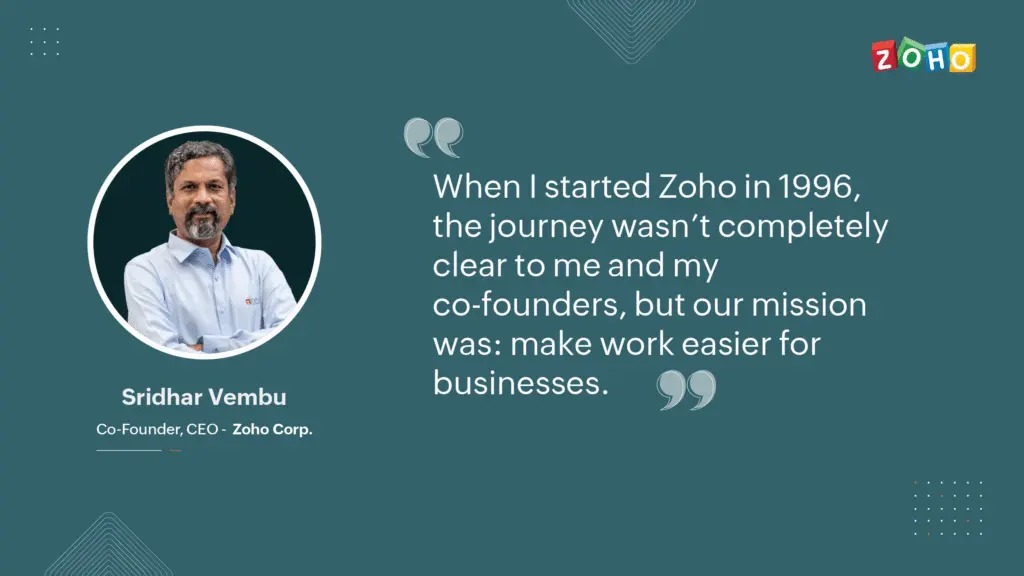
In 1996, Sridhar Vembu, along with his brothers Kumar and Shekhar, and their friend Tony Thomas, founded AdventNet in Pleasanton, California. The company focused on developing network management software for telecom clients.
The first product, Web NMS, was designed to help businesses manage operations digitally and garnered significant attention after outperforming major competitors, including HP, at a US tech fair.
By 1998, AdventNet’s sales had reached around ₹6 crore, and by 2000, they had secured their first major client– Cisco, which pushed their sales to ₹50 crore. However, the dot-com crash of the early 2000s dramatically reduced AdventNet’s customer base, forcing Sridhar Vembu to rethink his business strategy. In 2009, it was rebranded as Zoho Corporation.
The Dot-Com Crash of Companies
The dot-com crash burst in 2000, causing thousands of companies to go bankrupt, and they were unable to pay their bills. In between the chaos, the AdventNet had three distinct advantages:
- Cash reserves in the bank
- No external investors demanding returns
- Low operating costs with most employees based in India
During this challenging period, Sridhar Vembu faced internal turmoil due to the differences in opinion regarding company strategies, and his brothers and his friend left the company.
How Zoho became a Global SaaS without External Funding?
Despite the challenges, Zoho became a global Software-as-a-Service (SaaS) without external funding by reinvesting its profits and prioritising a broad, integrated ecosystem of affordable business applications, including CRM, HR, and Finance, for Small and Medium-sized Businesses.
Key Strategies of Zoho:
- Self-funding and Profit Reinvestment: Zoho used its own profit revenue for growth, allowing it to maintain control, focus on customer needs, and avoid growth-at-all-cost pressures.
- Integration of Ecosystem: Over 55 interconnected built applications like CRM, Mail, Finance, etc., creating a powerful, unified ‘Zoho One’ platform that solves many business needs from a single stop.
- Customer-centric, privacy-focused model: They normalise enterprise software by offering integrated, affordable business apps for small and medium-sized businesses that cannot afford higher-priced competitors.
- Moderate Innovation and Rural Talent: Zoho developed a world-class software from rural India and trains local talent, reduces operating costs, and creates numerous jobs by proving innovation is not confined to Silicon Valley.
- Sustainable and Long-term Vision: The founder of Zoho, Sridhar Vembu, rejected the ‘growth-at-all-costs’ and prioritised profitability, customer trust, and sustainable enterprise growth over flashy and bold valuations.
- Strategic Decentralisation: The team at Zoho built everything internally, from servers to software, ensuring quality and independence.
Growth of Zoho in Becoming a Global SaaS Giant
Zoho’s no-funding model prioritised profitability and stands as a truly global SaaS business from day one. Zoho reinvests 60% of revenue in Research & Development rather than marketing to drive organic, product-led growth.
- Revenue: 1.5 billion in 2024.
- Employees: About 18,000 employees worldwide. (Source: Forbes).
- Users: Over 100 million users across more than 55 business applications.
- Customers: Zoho serves 700,000+ business customers across more than 150 countries. (Source: Business Standard).
- Valuation: Zoho is valued at over ₹1.03 lakh crore on the 2024 Burgundy Private Hurun India 500 list, and ranks among India’s most valuable private companies. (Source: Outlook Business)
The company has expanded globally to 150+ countries and serves major brands such as Levi’s and Hyundai. Let’s take a look at the metrics and growth:
| Metrics | Data (2024) | Growth |
| Revenue | $1.5 billion | 27% to 32% YoY |
| Profit | Above $400 million | 30% to 35% margins |
| Users | Above 100 million | Across 150+ countries |
| Employees | Approx. 18,000 | Focus on rural hiring |
Zoho’s Financial Milestone & Values without External Funds
One of the reasons Zoho is becoming a global SaaS giant without external funding is its focus on revenue and growth:
- Zoho reported revenue of ₹8,703 crore and PAT of ₹2,836 crore in FY23.
- According to the 2024 Burgundy Private Hurun India 500 report, Zoho was ranked among India’s most valuable bootstrapped companies, with an approximate. valuation of ₹1.03 to ₹1.04 lakh crore.
- This was a 58% year-over-year increase in valuation, reflecting strong financial performance and market confidence.
Rural Empowerment Vision
Sridhar Vembu operates in Tenkasi, Chennai, Renigunta, Trichy, and Tiruppur, and hires local people to maintain a lower-cost structure, with 5 hubs and 30 spoke offices that employ around 2,000 rural workers. (Source: Business Standard)
The rural empowerment vision is a core business and social strategy that focuses on creating self-reliant and technology-enabled rural communities. This vision is based on transnational localism, a strategy to stay connected globally.
- Decentralisation of Opportunities:
This flips the idea of urban migration patterns for work by bringing high-tech and high-paying jobs to their lands. This allows employees to stay close to their families and communities.
- Talent over Credentials:
Recruiting local talent instead of elite institutions from high schools and tier 2/3 colleges. It is based on problem-solving skills and curiosity rather than academics.
- Building an Ecosystem:
A holistic local economy with the presence of Zoho’s offices, allied businesses like farming, real estate, and local shops.
- Long-term Commitment:
Zoho operates on a long-term horizon and invests in intellectual people, rather than seeking quick exits or external funding.
Some of the initiatives were also taken, such as providing free training, schools, and PURA-inspired development, which aligns with transnational localism for sustainable talent.
This philosophy powers Zoho’s innovation and helps revive villages.
Zoho’s Key Products & Their Global Impact
| Zoho Products | Uses |
| Zoho CRM | Sales & Marketing |
| Zoho One | All in one |
| Zoho Projects | PM Tool |
Sridhar Vembu’s vision extends beyond his business success to the social impact, especially in the development and education of rural areas. Through many initiatives such as Zoho Schools and rural offices, the company creates opportunities in regions that are often neglected by technology.
Zoho’s independent growth, without external funding, demonstrates that sustainable innovation can win without the funding hype that inspires entrepreneurs across the globe.
Sridhar Vembu’s Net Worth & Recognition
Sridhar Vembu’s net worth is estimated at $5.85 billion in 2014 by Forbes, making him among India’s wealthiest individuals, and he was known for his sensible lifestyle and commitment to rural development in India. He was also recognised by Padma Shri in 2021 for his contributions to trade.
Conclusion
This story of Sridhar Vembu offers a compelling alternative to the standard startup narrative. He prioritises independence, long-term thinking, and sustainable growth over rapid scaling, and has built Zoho, a global SaaS company that continues to grow without external funding.
FAQs
Q1. How did Zoho grow without external funding?
A: Zoho grows without external funding via a customer-funded model by maintaining a low operating cost, focusing on the quality of the product, and gradually expanding its product portfolio.
Q2. What is Sridhar Vembu’s net worth?
A: Sridhar Vembu’s net worth is estimated at around $5.85 billion, making him one of India’s wealthiest tech entrepreneurs. This wealth has been created entirely through building Zoho as a bootstrapped company without any external investments.
Q3. What are Zoho’s most successful products?
A: Zoho CRM is the company’s most successful product, serving 250,000+ businesses globally. Zoho Mail, Zoho Workplace, Zoho Projects, and Zoho Books are among them.
Q4. Why has Sridhar Vembu chosen Zoho to remain private instead of public?
A: Sridhar Vembu has chosen to keep Zoho private instead of going public to maintain control over the company’s direction and avoid the pressure of quarterly earnings expectations.
Q5. Why does Zoho focus on rural India?
A: Sridhar Vembu focuses on rural India because it aims to empower local talents, reduce costs, and drive community development.