(Image Source: IANS)
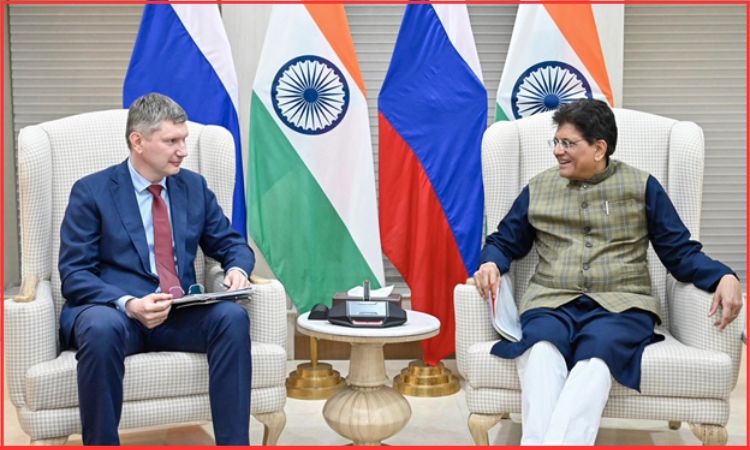
The Russia-India Business Forum wrapped up in New Delhi this week with both sides making it clear they want to grow their economic partnership beyond the usual areas. Held while President Putin was in town, the forum brought together business folks and officials from both countries to figure out how to hit that $100 billion trade target by 2030.
The event, put together by the Roscongress Foundation and FICCI, had “Balanced Trade, Shared Growth” as its theme. This wasn’t just fancy words. It tackled the real problem: right now, trade is heavily tilted toward Russia because India buys so much of their discounted crude. Last year, bilateral trade crossed $65 billion, but what India sells to Russia remains a small slice of that pie. Fixing this gap is now the main focus.
Tackling the Trade Imbalance
Commerce Minister Piyush Goyal started things off by pointing out that Russia actually needs a lot of what India makes. Cars, tractors, commercial vehicles, smartphones, electronics, medicines, textiles, and food products all have solid demand there. These aren’t small niche markets. They represent real chances for Indian companies to get a foothold in Russia.
The forum wasn’t just talk. Participants signed several agreements across different sectors. TASS and Press Trust of India agreed to cooperate on media coverage. Abrau-Durso and Indospirit Beverages will work together on alcoholic drinks. Sberbank and India’s CSIR will push ahead with scientific research. BDR Pharmaceuticals is teaming up with Kaluga Region and Pharmasyntez to build a pharmaceutical ingredients plant in Russia. Plus, there’s a new three-way agreement among Delovaya Rossiya, All-India Association of Industries, and World Trade Center Mumbai to help small and medium businesses work together.
New Sectors on the Table
Beyond these specific deals, the forum found common ground in medical technology, hospital infrastructure, cybersecurity, artificial intelligence, digital innovation, and advanced manufacturing. These fast-growing areas could shape the future of the partnership.
Alexander Stuglev, who runs the Roscongress Foundation, said the potential between the countries goes way beyond traditional sectors. He thinks a practical, opportunity-rich phase is ahead. But making it work depends on actually delivering results.
Making It Work on the Ground
Business leaders stressed they need to get more SMEs involved, simplify regulations, improve logistics networks, and create reliable ways for cross-border trade. The connectivity piece matters a lot. Delegates talked about shipping routes, rail connections, and digital infrastructure to build supply chains that can handle geopolitical pressures.
People-to-people connections also got attention. The forum looked at cooperation in tourism, education, research, and skills training through travel programs, student exchanges, and joint research projects. These initiatives create the human foundation for long-term business relationships.
The Window of Opportunity
The forum’s results line up with what Putin and Modi discussed during their summit. The two leaders want $100 billion in bilateral trade by 2030. More than that, they want trade that helps both sides equally.
For Indian businesses, this is an opening. Western sanctions have pulled many competitors out of Russia, leaving room for Indian companies to move in. The key is acting fast and building partnerships that last, not just filling temporary gaps.
The Roscongress Foundation has promised to organize follow-up trips, regional meetings, and business matchmaking platforms to turn forum discussions into real partnerships. This practical approach could make the difference between big talk and actual results.
The message from New Delhi is straightforward: India and Russia are ready to deepen their economic ties across new sectors, with concrete plans and institutional support to make it happen. Whether they hit that $100 billion target depends on how well businesses on both sides grab the opportunities now on the table.