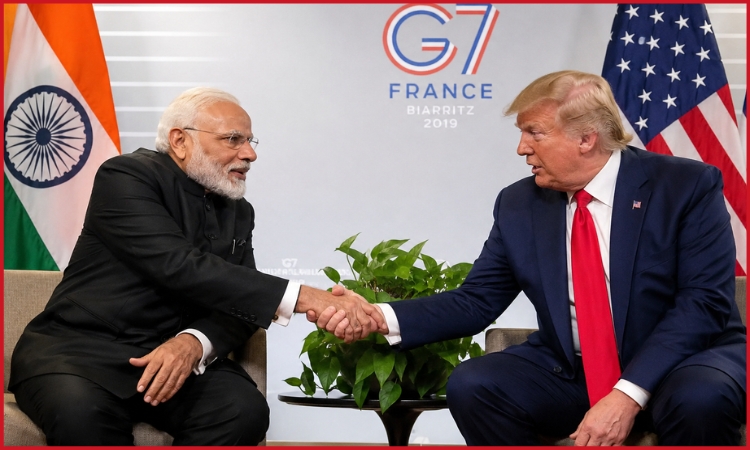
Prime Minister Narendra Modi held a bilateral meeting with US President Donald J. Trump on the sidelines of the G7 Summit in Evian, France on June 17, with the two leaders reviewing progress on an interim Bilateral Trade Agreement and instructing officials to work toward a balanced, mutually beneficial, and commercially meaningful agreement at the earliest.
US Trade Representative Jamieson Greer is scheduled to visit India next week in this connection.
The two leaders reviewed the substantial progress achieved under the India-US COMPACT (Catalyzing Opportunities for Military Partnership, Accelerated Commerce and Technology) since their meeting in Washington D.C. in February 2025, welcoming key developments across defence, strategic technologies, energy, and bilateral trade sectors.
Lauding Trump’s efforts to end the West Asia conflict
PM Modi also commended Trump for his efforts toward an understanding to end the conflict in West Asia, and underlined the importance of maintaining freedom of navigation and unimpeded commerce in the Strait of Hormuz.
Global growth, IMEC, and a new connectivity proposal
At the outreach session on balanced and sustainable economic growth, PMModi stated that growth should not be just about GDP or trade numbers, but its real impact on inclusion and well-being of people, citing India’s domestic principle of “Sabka Sath, Sabka Vikas, Sabka Vishwas, Sabka Prayas” as the same foundation guiding its international engagements, including its G20 presidency.
Highlighting that crises and conflicts have had a debilitating impact on the Global South, he called for international solidarity and suggested that international financial institutions develop support mechanisms to impart economic resilience to developing countries.
In France, PM Modi also called for extending connectivity projects to Africa, Latin America, and Pacific Island countries on the lines of IMEC.
To advance this, PM Modi proposed the creation of IMPACT, or the International Mobilization Partnership for Accelerating Connectivity and Trade, combining G7’s capital, India’s talent, and the Global South’s ownership.
AI governance: safety, inclusion, and cyber resilience
At the session on artificial intelligence, PM Modi outlined India’s MANAV, or human-centric, vision for AI and called for an integrated approach where safety, speed, and efficiency are addressed together. He emphasised that democratic countries must have access to AI models that can secure their critical information infrastructure and help them deal with cyber threats.
He put forward four priorities for global AI governance: AI systems should be safe-by-design; deployment must be accompanied by common standards, testing frameworks, and regulatory guidelines; there should be effective global cooperation to deal with deepfakes, misinformation and cyber fraud; and the benefits of AI must reach countries of the Global South to ensure an inclusive world.
PM Modi concluded the AI session by stating that the technology must expand human potential, empower human choice, and protect human dignity, and affirmed India’s intent to continue working with partners toward these objectives.