McKinsey says that banks around the world could unlock $1 trillion in annsucual value by using AI in smart ways. Because of the size and diversity of India, the potential is even greater for the country’s banking, NBFC, and fintech leaders. But language is a blockade.
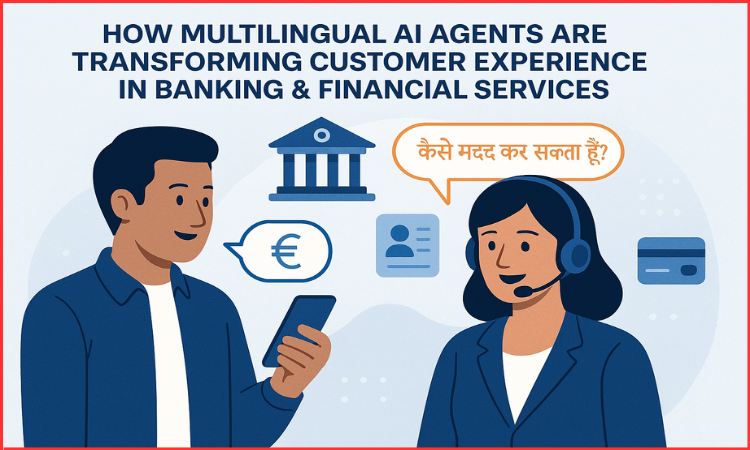
In the financial services industry, trust comes from being simple to understand. Every step, from opening an account to clearing up a loan term to addressing a billing mistake, depends on clear, reassuring communication. When customers cannot talk to you in their language, they get confused, lose trust, and miss out on the chance to build loyalty. This gap cannot be overlooked any longer, since the next wave of 500 million customers will come from Tier-2 and Tier-3 towns.
Why AI, That Begins with Language, Works
Multilingual AI agents are changing the way businesses talk to their customers. They are not just bots that translate for us. These are domain-trained systems that can understand and speak Hindi, Tamil, Bengali, Marathi, Kannada, and other languages. They fit right into the processes for onboarding, and customer service.
Imagine a person in a small town applying for a loan for the first time using their phones. They speak to an AI agent in their language instead of working through unfamiliar English terms. The agent verifies their KYC, explains repayment options, and answers their questions immediately. The conversation is clear and relevant to them.
This is different from old IVR menus. There is no “Press 1 for English” step. The AI Agent understands and responds in real time to make the interaction straightforward.
These AI agents are particularly effective because they can react contextually rather than just to direct questions. Whether a customer pauses in the middle of a transaction, struggles to upload an ID, or hesitates at a form field, the systems can monitor their behavior within the application. The AI proactively intervenes in these situations, providing focused, methodical assistance. This in-flow, invisible guidance feels more like a human advisor sitting next to the customer than a chatbot.
Just as important is memory. These AI agents do not forget what the customer has already shared. Once a customer has picked Hindi as their language or entered their PAN number, the system keeps it in mind. They don’t have to repeat the same details on every screen or in the next call. This small but important continuity removes the annoying “start over” feeling and makes the whole experience smoother, more personal, and easier to trust.
Promoting Financial Inclusion
Digital banking has taken off in cities, but many smaller towns and villages are still on the sidelines. People may have internet access, yet they often lack the language support needed to use these services comfortably. Multilingual AI agents help close this gap by enabling customers to open accounts, start mobile banking, or resolve issues in the language they are most familiar with.
This shift makes banking easier to access, while also ensuring compliance with regulatory requirements and promoting broader economic growth. The scale of this opportunity is impressive: although most digital banking platforms have long been designed in English, over 90% of Indians prefer to interact in their native language. The impact is clear – sales conversions can drop by up to 40% in English-only sessions, and nearly 67% of customers abandon their journey when language support is unavailable. By enabling natural language text and voice conversations in Hindi, Tamil, Kannada, Bengali, and more, multilingual AI agents help bridge this gap. In Tier-2 and Tier-3 towns, where comfort with regional languages is higher, the benefits are even more noticeable. Early pilots indicate that introducing these language-first agents can cut application abandonment rates by 40–55%.
Financial institutions are able to reach Bharat’s large underbanked population by removing language barriers, increasing access to savings, insurance, and credit products that were previously too difficult to pursue. Multilingual AI agents are essentially financial inclusion tools rather than merely service tools.
Global Examples Show Practical Results
Bank of America’s virtual assistant, Erica, is now a daily tool for millions of customers, helping them track spending, pay bills, and get answers instantly, proof that AI can scale without sacrificing service quality. HSBC takes a different approach, using AI to detect fraud, flag suspicious activity, and deliver personalized guidance, which not only boosts security but also builds customer confidence. Meanwhile, digital-first banks like Revolut and Monzo have made AI key to their customer experience by offering instant card freezing, real-time spending categorisation, and budgeting tools that give people more control over their money.
Effective use of AI in financial services could save the industry hundreds of billions of dollars annually. Many institutions, however, remain in pilot phases. Those integrating AI into core operations will see faster operational and customer service gains.
What Makes This Possible Now
AI systems can now understand speech and language far more accurately. As per Stanford’s 2024 AI Index, transformer-based models are advancing at recognising regional accents and grasping context instantly.
For banks and financial institutions, this means AI agents can:
- Manage compliance workflows without human intervention
- Deliver the same quality of service on chat, voice, and mobile
- Connect securely to core banking systems to complete transactions
What is different from earlier AI systems is that these can hold simple, natural conversations while also carrying out transactions accurately.
This capability comes from the vigilant coordination of many AI layers working together behind the scenes. Conversational AI uses large language models (LLMs) to make responses that are dynamic and aware of the context, instead of strict, pre-written ones. This forms the basis for multilingual text-to-speech (TTS) and speech-to-text (STT) systems, which let people talk to each other in different languages and dialects in a realistic way.
The integration layer often decides how useful an AI agent really is. On its own, the agent can only chat. But when it connects with payment gateways, loan systems, or customer databases, it becomes capable of real work. It can finish a payment, fetch a credit score, or update a customer record in the background without waiting for a person to do it.
It can also pick up on small signals. If someone drops out halfway through an application, the agent can detect the drop, and nudge the user via multiple channels. It can help a customer who keeps getting stuck on a form by giving them the right help at the right time. These little things help things keep going so that no request is missed and no one feels stuck.
The fact that it learns from interactions makes it even stronger. It gets better at explaining things every time it sees people trip over a poorly written loan term or an unclear interest rate. It makes the experience better for everyone who comes after it, not just one user.
Using Service to Drive Growth
People used to think of customer service as just a cost, but now multilingual AI Agents turn it into a way to grow by answering questions, suggesting products that are relevant, helping people make better financial decisions, and getting feedback from customers in their own words. If a credit card customer asks about charges, they could be told about an approved loan offer in a polite way and in their own words. These interactions make money on a large scale.
This change changes how the business tries to get customers to interact with it. Every service touchpoint, which used to cost money, is now a chance to sell more or sell different things. AI agents speak the same language as the customer, so their suggestions don’t sound like a sales pitch; they sound more like good advice. This not only gets more people to buy the product, but it also makes customers more loyal over time.
Risk and Compliance Management
In BFSI, every interaction includes compliance. These AI agents can follow RBI rules, keep full audit trails, and mark cases for people to look over. For KYC/AML compliance, conversations are recorded and written down. Fraud detection can even happen during the conversation, catching problems before they do any harm.
In smaller towns, people start using services faster and are more likely to complete the process. Consequently, this eases pressure on call centers. Most importantly, starting conversations in the customer’s language increases uptake and builds trust.
The compliance angle is vital. With domain-specific training, AI agents are designed to never stray outside approved language or advice. Their transcripts form an auditable trail, protecting both customers and institutions in the event of disputes. Furthermore, by embedding fraud detection into live conversations, risks can be flagged earlier – sometimes before a transaction is even completed. This proactive risk management capability is fast becoming one of the strongest business cases for deploying AI agents.
The technology works best when it is used with high-quality training data, regular checks for compliance, and tight integration with CRM and analytics platforms. Multilingual AI Agents can facilitate businesses in growing their market share while ensuring their customers are loyal at the same time, considering they are a part of the customer journey.
The bigger picture is that India’s financial services will only do well if it can literally talk to its people. The next half billion customers will not come from systems that are based on English. They will come through platforms that can understand and respond in Marathi, Hindi, Tamil, Kannada, and more. The companies that win in this field will be the ones that do not see customer language as a problem with translation, but as the key to trust, inclusion, and growth.
How well the digital finance sector in India connects with customers in their languages will shape the story of digital finance in India. Multilingual AI agents show that size, personalization, and compliance can all work together without any problems.