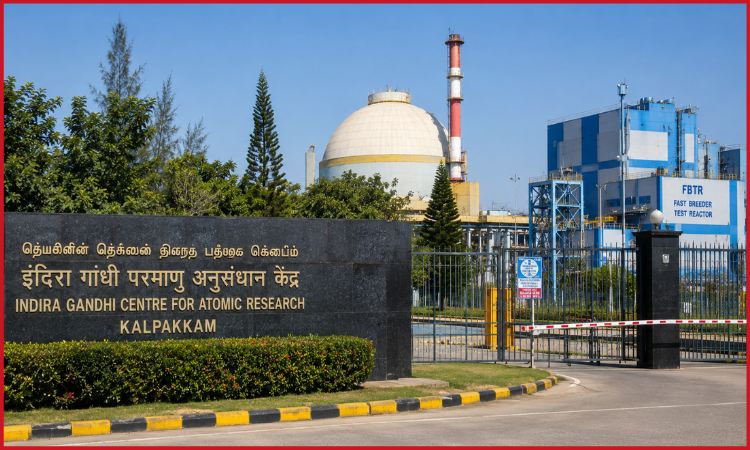
India now has the world’s first hydrogen production facility that runs on nuclear process heat, using a Copper-Chlorine (Cu-Cl) thermochemical cycle developed indigenously by the Bhabha Atomic Research Centre (BARC) and powered by heat from the Fast Breeder Test Reactor (FBTR) at Kalpakkam.
The plant was inaugurated by Dr Ajit Kumar Mohanty, Secretary, Department of Atomic Energy (DAE) and Chairman, Atomic Energy Commission, on June 26, in the presence of Sreekumar G Pillai, Director, Indira Gandhi Centre for Atomic Research (IGCAR).
A test reactor’s new job
FBTR is India’s only operating fast reactor research facility, running at IGCAR since the 1970s. It has so far been used to develop and validate fuels, materials and sodium technologies for India’s fast reactor programme, including the 500 MWe Prototype Fast Breeder Reactor.
The hydrogen plant marks its first major non-electric application, drawing on heat generated by the reactor instead of converting it to electricity.
Why the Cu-Cl cycle
DAE said the Cu-Cl thermochemical cycle is among the most promising routes for hydrogen production worldwide because it runs at comparatively lower operating temperatures and has higher thermodynamic efficiency than other thermochemical cycles.
The technology behind the process was developed in-house by BARC, Mumbai, and the plant itself was built jointly by BARC and IGCAR as a technology demonstrator, meant to validate the process before any move toward commercial-scale production.
The carbon-free pitch
Pairing nuclear process heat with hydrogen production removes dependence on fossil fuels and avoids the emissions tied to conventional hydrogen-making methods.
DAE positioned the facility as expanding nuclear energy’s role beyond electricity generation, into the second stage of India’s three-stage nuclear power programme.
What officials said
Mohanty said, “The integration of nuclear energy with emerging clean energy technologies such as hydrogen production represents a strategic pathway towards a sustainable energy future.”
He added that nuclear power’s ability to provide both carbon-free electricity and high-temperature process heat made it well suited to large-scale hydrogen production.
Pillai said the facility “builds upon more than four decades of operational experience and technological excellence gained through the Fast Breeder Test Reactor programme at IGCAR.”