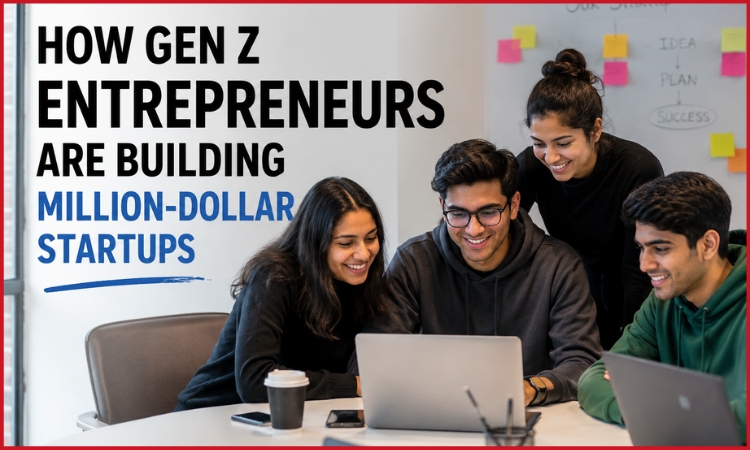
Startup success was thought to depend on experienced executives, Silicon Valley connections, and venture capital for many decades. This paradigm is changing now. A new wave of entrepreneurs is emerging earlier, starting companies faster, and growing businesses by means that were not even available ten years ago.
Generation Z, defined as people born between 1997 and 2012, revolutionizes entrepreneurship with a digital native mentality, AI-powered execution, creator-driven marketing, and very flexible business models. The difference between Generation Z entrepreneurs and previous waves is that the former have always been using mobile phones, social networks, immediate online access, and the creator economy.
Founders under 30 are creating millions of dollars worth of companies within such industries as e-commerce, financial technology, SaaS services, creator commerce, logistics, and artificial intelligence. Moreover, unlike classic startups, these organizations become profitable faster and need less conventional structures.
Generation Z entrepreneurship cannot be regarded simply as another trend. This phenomenon shows an entirely new way of how modern businesses emerge.
Why Gen Z Entrepreneurs Are Growing Faster than Millennials
One of the most significant advantages Gen Z entrepreneurs have is technology fluency. Previous generations had to adapt to the digital change. Generation Z was reared within it.
This provides younger founders with various strategic benefits.
- Quicker adoption of AI and automation tools.
- Improved understanding of internet consumer behavior.
- Lower startup costs thanks to SaaS platforms.
- Improved creator economy integration- More effective audience building with short-form content
According to many startup ecosystem assessments, younger founders increasingly value speed, experimentation, and direct consumer input over lengthy corporate planning cycles. Instead of spending years refining a product before launching, many Generation Z entrepreneurs create minimal viable products first, test demand online, and improve through rapid iteration.
The startup ecosystem has also grown more accessible. Platforms such as Shopify, Stripe, Notion, Canva, Webflow, Figma, and AI-powered productivity tools have significantly decreased the barriers to entry for those starting digital enterprises.
As a result, small teams can now achieve revenue milestones that once required large organizations.
Gen Z Startup Statistics 2025: The Numbers Behind the Boom
The statistics on Gen Z entrepreneurship demonstrate how quickly the landscape is moving.
Several venture capital reports show that the average age of successful startup founders is decreasing in high-growth industries such as AI and ecommerce. AI startups, in particular, are achieving billion-dollar valuations considerably faster than businesses did a decade ago.
Key trends influencing the market include (Data-analysis by LinkedIn, StartupOwl, and finance.yahoo):-
- The average time for AI firms to achieve unicorn status has decreased dramatically (4.2 years vs. 7-year historical average) when compared to previous startup cycles.
- 62% of Gen Z either already run their own business or plan to, with 92% of Gen Z startups beginning as side hustles.
- Gen Z surpassed Baby Boomers in new business startups as of 2026.
- 80% of Gen Z entrepreneurs launched their businesses online or through mobile platforms.
- Ecommerce infrastructure platforms now enable creators to create worldwide firms with a little initial investment.
- 45% of Gen Z business owners use personal savings to fund startups, only 16% take traditional bank loans.
- A growing number of first-time business entrepreneurs are under the age of thirty.
- Average startup success rate is 20.7% (companies completing M&A or IPO exits).
Investors are interested in digital-first enterprises due to their scalable online distribution platforms.
Social commerce is another significant factor. Generation Z founders have an innate understanding of digital culture. They create brands based on communities rather than depending solely on expensive advertising efforts.
This trend has impacted customer acquisition economics.
Rather than spending millions on traditional media, younger entrepreneurs frequently use:
- TikTok Marketing
- Influencer partnerships
- Creator partnerships
- Community-driven involvement
- Viral, short-form material
- Discord and Telegram communities.
Compared to traditional marketing tactics, these platforms provide cheaper acquisition costs and more brand visibility.
How AI Is Accelerating Gen Z Entrepreneurship
Artificial intelligence has emerged as one of the most significant equalizers in the startup world this decade.
A small founding team can now automate operations that were formerly performed by entire departments. AI tools aid startups:
- Produce marketing content.
- Develop customer service systems.
- Evaluate user data.
- Create website designs.
- Build prototypes.
- Increase advertising effectiveness.
- Automate recurring workflows.
This enables Gen Z entrepreneurs to work with incredible efficiency.
Many companies with fewer than ten workers are attaining revenue levels that were previously associated with considerably larger organizations.
As a result, company models become leaner, have fewer operational expenses, and are more scalable.
Importantly, Gen Z founders tend to incorporate AI from the start rather than seeing it as an add-on feature later. This provides operational benefits early in the growth cycle.
Zepto Success Story: How Gen Z Founders Built a $5.9B Unicorn
Zepto, a quick-commerce startup, is one of the most successful examples of Gen Z entrepreneurship in India.
Founded by Aadit Palicha & Kaivalya Vohra in 2021, the company disrupted India’s grocery delivery sector by emphasizing ultra-fast delivery infrastructure. According to livemint, It became a unicorn in 2023 and has a current valuation of $5.9 billion.
What distinguished Zepto was the age of its creators. Both entrepreneurs established the company while still in their early twenties. Both founders are ranked #1 and #2 youngest on Hurun India Rich List 2025.
Their success highlights numerous traits shared by Gen Z founders:
- Speed-oriented execution
- Technology-driven logistics and Data-driven operational decisions.
- Aggressive digital consumer acquisition.
- A thorough understanding of mobile-first customer behavior.
Zepto’s rapid rise also illustrated how investor trust has moved to younger founders who can quickly scale digital enterprises.
The company became one of the most talked-about startups in India’s current quick-commerce sector, inspiring a larger wave of young entrepreneurship.
The Creator Economy Advantage
The rise of the creator economy benefits Generation Z businesses as well.
Unlike previous businesses that depended primarily on mass-market advertising, modern startups frequently flourish through personality-driven branding and community involvement.
Consumers are increasingly trusting innovators and specialized groups rather than standard corporate advertising.
This has enabled founders to create extremely engaged audiences before introducing products.
Examples include:
- Beauty brands created through Instagram communities.
- TikTok has helped DTC fashion brands scale.
- Educational companies centered on YouTube creators.
- Productivity brands featured on LinkedIn and X.
- Gaming and internet communities drive e-commerce revenues.
In many cases, the founder becomes an integral element of the brand’s narrative.
This fosters a stronger emotional connection with customers and increases customer retention.
Case Study: DankStop and Sustainable Startup Growth
Growth trajectory of DankStop offers insight into yet another fundamental trait shared by Gen Z startups: sustainable scaling.
The startup, created by young entrepreneurs Louis Coniglio and Feliks Khaykin, was reportedly launched with a small amount of seed capital. Instead of growing recklessly, the entrepreneurs opted for revenue reinvestment and customer retention.
Eventually, DankStop developed into a multi-million dollar company, earning great fame and building a solid community of loyal customers.
What is remarkable about this particular example is that it disproves the myth that startups should consume massive amounts of venture capital funds to thrive.
These days, many Gen Z founders value profitability and efficiency, but also want their communities to stay united. They advocate sustainable scaling and look for solutions appropriate for compact teams.
Considering years of costly startup practices, this philosophy becomes increasingly appealing to investors..
Why Investors Are Paying Attention to Gen Z
Venture capitalists are more prepared to back younger founders because digital natives understand new internet behavior better than many older executives.
Gen Z entrepreneurs are particularly skilled in:
- Consumer Internet Businesses
- AI applications.
- Social Commerce
- Brands led by their creators
- Digital Communities
- Online Education
- Mobile-first products.
Investors also realize that younger entrepreneurs often detect societal and technological trends before elder firm leaders. This opens up opportunities to build enterprises on rising consumer trends before competitors react.
The growing deployment of AI techniques has enhanced this advantage even more.
Top 5 Challenges Gen Z Entrepreneurs Face in 2026
Despite amazing growth tales, Generation Z founders confront substantial difficulties.
One significant concern is sustainability. Only 23.4% of startups survive to the five-year mark, with the critical failure window occurring between years 2-4 when early momentum fades.(Dave Berkus)
Some startups are struggling with fragile operational foundations or poor cash flow management. While some are struggling because of inadequate legal compliance or burnout among founders.
- 38% of Gen Z ages 18-24 face difficulties stemming from cash flow issues. (CBInsights)
The urge to attain viral success might lead to short-term thinking.
Furthermore, in highly competitive digital industries, consumer loyalty is harder to preserve. Trends shift swiftly online, and consumers’ attention spans continue to shrink.
Another challenge is credibility. Younger founders sometimes face skepticism from investors, enterprise clients, or traditional business leaders due to limited professional experience.
However, strong execution increasingly matters more than age.
Case Study: BharatPe and India’s Young Fintech Wave
Younger entrepreneurs like Shashvat Nakrani have also contributed significantly to India’s fintech industry.
After assisting in the growth of BharatPe in the digital payments sector, he rose to become one of India’s youngest prominent fintech innovators.
Several structural trends were beneficial to the company:
- Rapid smartphone adoption.
- An increase in digital payments.
- Development of India’s startup ecosystem.
- UPI infrastructure development
- Increased merchant digitalization
The success of finance startup led by Ashneer Grover and Shashvat Nakrani demonstrates that Gen Z entrepreneurs are not restricted to social media or ecommerce. Many are forming infrastructure-focused enterprises to address large-scale economic issues.
Gen Z Startup Playbook vs Traditional Entrepreneurship (2026)
The Gen Z startup model differs significantly from traditional entrepreneurship.
| S.NO | Traditional startup playbook | Modern startup playbook |
| 1 | Large employee teams | Lean teams and AI-enabled processes |
| 2 | Long product development cycles | Fast product iteration |
| 3 | Corporate hierarchical structures | Flexible operational structures |
| 4 | Dependence on traditional advertising | Creator-led marketing |
| 5 | Significant upfront funding | Community-driven growth |
This new strategy enables startups to scale more quickly while incurring lower operating costs.
Importantly, Gen Z founders are more comfortable experimenting in public. Many entrepreneurs build in public, post their company adventures online, and solicit real-time audience feedback during product development.
This leads to higher consumer involvement and speedier market validation.
The Future of Gen Z Entrepreneurship: Trends Predicted for 2026
The rise of Gen Z entrepreneurship is probably still in its early stages.
Several elements like increased AI adoption, digital consumption and access to global markets along with development of the creative economy indicate continued growth.
Emerging technology will most likely propel entrepreneurship further by lowering operational complexity and allowing single founders or small teams to develop large-scale firms.
At the same time, competition will get more intense. Lower entry barriers mean that more startups enter the market each year.
Long-term winners will most likely be founders who can combine technological agility, operational discipline, and deep consumer awareness.
Conclusion: Gen Z Entrepreneurs Transforming Global Startup Ecosystem
Gen Z entrepreneurs are reinventing the business world as we know it through their creation of startups that work faster, more efficiently, and with higher levels of integration with technology compared to their predecessors.
It’s not simply their age group which is giving them the upper hand. Rather, it’s their ability to combine technology, online community, artificial intelligence solutions, and collaborative innovation to build scalable businesses.
Be it ecommerce, fast commerce, fintech or AI startups – the young founders of today prove that million dollar ventures don’t need years of experience and huge investment anymore.
As artificial intelligence and creator commerce gain momentum, the Gen Z entrepreneurs might become among the most influential business generations ever known in the history of economics.
Frequently Asked Questions
1. Why are Gen Z entrepreneurs growing so quickly?
Generation Z entrepreneurs grew up with digital technology, social media, and online commerce. Their expertise with AI tools, internet culture, and creator-led marketing enables them to scale firms faster and more efficiently.
2. Which industries do Generation Z founders dominate?
Gen Z entrepreneurs are particularly engaged in ecommerce, finance, AI, SaaS, fast commerce, creator economy platforms, gaming, and digital education.
3. How crucial is AI for Generation Z startups?
AI is critical because it lowers operating costs, automates procedures, increases marketing efficiency, and enables smaller teams to scale quickly.
4. Are Generation Z entrepreneurs highly reliant on venture capital?
No, not always. Many Generation Z firms start with bootstrapping, lean teams, and community-led development before seeking external capital.
5. What is the most difficult difficulty facing Gen Z founders?
One of the most difficult difficulties is to maintain sustainable long-term growth. Rapid growth without solid financial and operational underpinnings might provide long-term business dangers.